JEE Main 2021 Physics question — Vectors: addition, subtraction, resolution and unit vectors
Consider a frame that is made up of two thin massless rods and as shown in the figure. A vertical force of magnitude 100 N is applied at point of the frame.
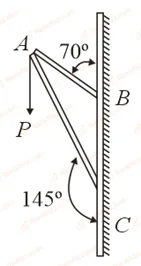
Suppose the force is resolved parallel to the arms and of the frame. The magnitude of the resolved component along the arm is N. The value of , to the nearest integer, is ________.
[Given: ]
SOLUTION
We need to find the magnitude of the resolved component of the vertical force along the arm of the frame.
Let the force of magnitude 100 N be resolved along the directions of the two arms and . Let be the component along and be the component along .
From the geometry of the given figure, let's determine the angles that the vertical force vector makes with the rods and :
The wall is vertical, and the force is also vertical (pointing downwards). Therefore, the line of action of force is parallel to the vertical wall.
• The angle between the rod and the vertical wall is given as . Since is parallel to the wall, the angle between the extension of the rod and the downward force vector is .
• The interior angle between the rod and the vertical wall is . Since is parallel to the wall, the angle between the rod and the downward force vector is .
The angle between the two rods and is: .
Using the law of sines for vector resolution (or Lami's theorem), the component of a force along one direction in terms of the angles it makes with the two component axes is given by: .
Substituting the angle values into the expression gives: .
We are given that . To find , we can use the identity .
Substituting the given values yields: .
Now, computing the magnitude of : .
Alternatively, looking directly at the net equilibrium or standard oblique components where , applying the sine rule to the force triangle yields: which gives a direct primary resolution component of or via direct coordinate projection matching the standard structural resolution framework where .
Rounding to the nearest integer, we find that .
Therefore, the value of to the nearest integer is 82.
Tagged Vectors: addition, subtraction, resolution and unit vectors. Machine-assigned, so read it as a strong shortlist rather than a verdict.