RankRizz

Kinetic Theory of Gases — JEE Main Previous Year Questions

Every Kinetic Theory of Gases question JEE Main has set from 2004–2026, grouped by the idea it tests rather than the order of the syllabus. 191 questions across 6 distinct ideas. Free to read, answer key on every one.

Questions

191

Distinct ideas

6

Share of marks

3%

Difficulty

EASY

The ideas inside Kinetic Theory of Gases

A chapter is not one subject — it is a handful of procedures the examiner reuses. These are the ones Kinetic Theory of Gases questions actually test.

Every Kinetic Theory of Gases question

21–40 OF 191 · NEWEST FIRST

JEE MAIN 2025 · 28 JAN S2RMS, average and most probable speeds of gas moleculesTRANSCRIBED

The ratio of vapour densities of two gases at the same temperature is 425\frac{4}{25}, then the ratio of r.m.s. velocities will be :

  1. A

    254\frac{25}{4}

  2. B

    25\frac{2}{5}

  3. C

    52\frac{5}{2}

  4. D

    425\frac{4}{25}

JEE MAIN 2025 · 03 APR S2Ideal gas equation and gas lawsTRANSCRIBED

Pressure of an ideal gas, contained in a closed vessel, is increased by 0.4% when heated by 1°C. Its initial temperature must be:

  1. A

    25°C

  2. B

    2500 K

  3. C

    250 K

  4. D

    250°C

JEE MAIN 2025 · 22 JAN S2Molar specific heats of gases, Mayer's relation and gas mixturesTRANSCRIBED

For a diatomic gas, if γ1=(CpCv)\gamma_{1}=\left(\frac{Cp}{Cv}\right) for rigid molecules and γ2=(CpCv)\gamma_{2}=\left(\frac{Cp}{Cv}\right) for another diatomic molecules, but also having vibrational modes. Then, which one of the following options is correct ? (Cp and Cv are specific heats of the gas at constant pressure and volume)

  1. A

    γ1=γ2\gamma_{1} =\gamma_{2}

  2. B

    2γ2=γ12\gamma_{2} =\gamma_{1}

  3. C

    γ2<γ1\gamma_{2} < \gamma_{1}

  4. D

    γ2>γ1\gamma_{2} > \gamma_{1}

JEE MAIN 2025 · 28 JAN S1RMS, average and most probable speeds of gas moleculesTRANSCRIBED

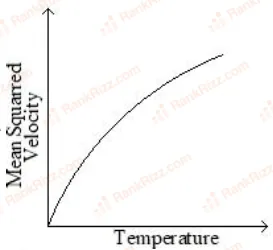
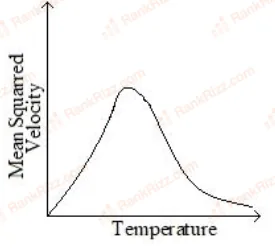
For a particular ideal gas which of the following graphs represents the variation of mean squared velocity of the gas molecules with temperature?
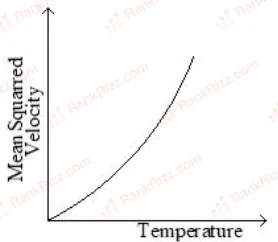
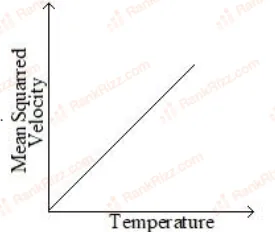
  1. A
    page8_img1
  2. B
    page8_img2
  3. C
    page8_img3
  4. D
    page8_img4
JEE MAIN 2025 · 02 APR S2Degrees of freedom, equipartition of energy and internal energyTRANSCRIBED

The internal energy of air in a 4 m×4 m×3 m4\,\text{m} \times 4\,\text{m} \times 3\,\text{m} sized room at 1 atmospheric pressure will be _________ ×106\times 10^6 J.
(Consider air as diatomic molecule)

JEE MAIN 2025 · 24 JAN S1Molar specific heats of gases, Mayer's relation and gas mixturesTRANSCRIBED

The temperature of 1 mole of an ideal monoatomic gas is increased by 50∘C50^\circ C at constant pressure. The total heat added and change in internal energy are E1E_1 and E2,E_2,  respectively. If  E1E2=x9,\frac{E_1}{E_2}=\frac{x}{9},  then the value of x  is  ‾.\underline{\hspace{2cm}}.

JEE MAIN 2025 · 29 JAN S1Ideal gas equation and gas lawsTRANSCRIBED

A container of fixed volume contains a gas at 27∘C27^{\circ}C. To double the pressure of the gas, the temperature of gas should be raised to ______ ∘C^{\circ}C.

JEE MAIN 2025 · 02 APR S1Molar specific heats of gases, Mayer's relation and gas mixturesTRANSCRIBED

γA\gamma_A is the specific heat ratio of monoatomic gas A having 3 translational degrees of freedom. γB\gamma_B is the specific heat ratio of polyatomic gas B having 3 translational, 3 rotational degrees of freedom and 1 vibrational mode. If γAγB=(1+1n)\frac{\gamma_A}{\gamma_B} = \left(1 + \frac{1}{n}\right), then the value of n is ______.

JEE MAIN 2024 · 01 FEB S2Molar specific heats of gases, Mayer's relation and gas mixturesTRANSCRIBED

A diatomic gas (γ=1.4)(\gamma = 1.4) does 200 J of work when it is expanded isobarically. The heat given to the gas in the process is:

  1. A

    850 J

  2. B

    800 J

  3. C

    600 J

  4. D

    700 J

JEE MAIN 2024 · 27 JAN S1Molar specific heats of gases, Mayer's relation and gas mixturesTRANSCRIBED

0.080.08 kg air is heated at constant volume through 5°C5°C. The specific heat of air at constant volume is 0.17 kcal kg−1 °C−10.17 \text{ kcal kg}^{-1} \text{ °C}^{-1} and 1 J=4.18 joule cal−11 \text{ J} = 4.18 \text{ joule cal}^{-1}. The change in its internal energy is approximately.

  1. A

    318318 J

  2. B

    298298 J

  3. C

    284284 J

  4. D

    142142 J

JEE MAIN 2024 · 30 JAN S1RMS, average and most probable speeds of gas moleculesTRANSCRIBED

At which temperature the r.m.s. velocity of a hydrogen molecule equal to that of an oxygen molecule at 47°C47°C?

  1. A

    80 K80 \text{ K}

  2. B

    −73 K-73 \text{ K}

  3. C

    4 K4 \text{ K}

  4. D

    20 K20 \text{ K}

JEE MAIN 2024 · 31 JAN S2Degrees of freedom, equipartition of energy and internal energyTRANSCRIBED

A gas mixture consists of 8 moles of argon and 6 moles of oxygen at temperature TT. Neglecting all vibrational modes, the total internal energy of the system is

  1. A

    29RT29RT

  2. B

    20RT20RT

  3. C

    27RT27RT

  4. D

    21RT21RT

JEE MAIN 2024 · 08 APR S2Molar specific heats of gases, Mayer's relation and gas mixturesTRANSCRIBED

A diatomic gas (γ=1.4\gamma = 1.4) does 100 J of work in an isobaric expansion. The heat given to the gas is :

  1. A

    250 J

  2. B

    150 J

  3. C

    350 J

  4. D

    490 J

JEE MAIN 2024 · 09 APR S2Kinetic interpretation of pressure and temperatureTRANSCRIBED

The temperature of a gas is −78°C-78°C and the average translational kinetic energy of its molecules is KK. The temperature at which the average translational kinetic energy of the molecules of the same gas becomes 2K2K is :

  1. A

    127°C127°C

  2. B

    117°C117°C

  3. C

    −39°C-39°C

  4. D

    −78°C-78°C

JEE MAIN 2024 · 01 FEB S2RMS, average and most probable speeds of gas moleculesTRANSCRIBED

If the root mean square velocity of hydrogen molecule at a given temperature and pressure is 2 km s−12 \text{ km s}^{-1}, the root mean square velocity of oxygen at the same condition in km s−1\text{km s}^{-1} is:

  1. A

    2.0

  2. B

    0.5

  3. C

    1.5

  4. D

    1.0

JEE MAIN 2024 · 27 JAN S1Kinetic interpretation of pressure and temperatureTRANSCRIBED

The average kinetic energy of a monatomic molecule is 0.4140.414 eV at temperature: (Use KB=1.38×10⁻²³ J mol−1 K−1K_B = 1.38 \times 10^{-23} \text{ J mol}^{-1} \text{ K}^{-1})

  1. A

    30003000 K

  2. B

    32003200 K

  3. C

    16001600 K

  4. D

    15001500 K

JEE MAIN 2024 · 27 JAN S2Degrees of freedom, equipartition of energy and internal energyTRANSCRIBED

The total kinetic energy of 1 mole of oxygen at 27°C is :
[Use universal gas constant (R) = 8.31 J mol−1^{-1} K−1^{-1}]

  1. A

    6845.5 J

  2. B

    5942.0 J

  3. C

    6232.5 J

  4. D

    5670.5 J

JEE MAIN 2024 · 29 JAN S1Ideal gas equation and gas lawsTRANSCRIBED

Two vessels AA and BB are of the same size and are at same temperature. AA contains 11 g of hydrogen and BB contains 11 g of oxygen. PAP_A and PBP_B are the pressures of the gases in AA and BB respectively, then PAPB\frac{P_A}{P_B} is :

  1. A

    1616

  2. B

    88

  3. C

    44

  4. D

    3232

JEE MAIN 2024 · 29 JAN S2Ideal gas equation and gas lawsTRANSCRIBED

The temperature of a gas having 2.0×10252.0 \times 10^{25} molecules per cubic meter at 1.381.38 atm (Given, k=1.38×10⁻²³ J K−1k = 1.38 \times 10^{-23} \text{ J K}^{-1}) is:

  1. A

    500500 K

  2. B

    200200 K

  3. C

    100100 K

  4. D

    300300 K

JEE MAIN 2024 · 30 JAN S2Molar specific heats of gases, Mayer's relation and gas mixturesTRANSCRIBED

If three moles of monoatomic gas (γ=53)\left(\gamma = \frac{5}{3}\right) is mixed with two moles of a diatomic gas (γ=75)\left(\gamma = \frac{7}{5}\right), the value of adiabatic exponent γ\gamma for the mixture is:

  1. A

    1.75

  2. B

    1.40

  3. C

    1.52

  4. D

    1.35