RankRizz

Mean free path — JEE Main Previous Year Questions

Every JEE Main question on Mean free path, one of the ideas inside Kinetic Theory of Gases: 19 questions from 2015–2026, 9 of them in the last five years. Newest first, answer key on every one. Free to read.

Questions

19

Years asked

9

Since

2015

Of the chapter

10%

When JEE Main asked it

Questions on Mean free path in each year it was asked.

20262
20251
20243
20232
20221
20212
20205
20192
20151

Every Mean free path question

1–19 OF 19 · NEWEST FIRST

JEE MAIN 2026 · 22 JAN S2Mean free pathTRANSCRIBED

Consider two boxes containing ideal gases A and B such that their temperatures, pressures and number densities are same. The molecular size of A is half of that of B and mass of molecule A is four times that of B. If the collision frequency in gas B is 32×1018/s32 \times 10^{18}/s then collision frequency in gas A is _____________/s.

  1. A

    32×10832 \times 10^{8}

  2. B

    2×1082 \times 10^{8}

  3. C

    8×1088 \times 10^{8}

  4. D

    4×1084 \times 10^{8}

JEE MAIN 2026 · 28 JAN S2Mean free pathTRANSCRIBED

The mean free path of a molecule of diameter 5×10⁻¹⁰m5\times 10^{-10}m at the temperature 41 °C and pressure 1.38×10⁵Pa1.38\times 10^{5} Pa, is given as ___ m (Given kB=1.38×10⁻²³J/Kk_{B}=1.38\times 10^{-23}J/K.)

  1. A

    22×10−102\sqrt{2}\times 10^{-10}

  2. B

    102×10−810\sqrt{2}\times 10^{-8}

  3. C

    22×10−82\sqrt{2}\times 10^{-8}

  4. D

    2×10−82\times 10^{-8}

JEE MAIN 2025 · 04 APR S1Mean free pathTRANSCRIBED

The mean free path and the average speed of oxygen molecules at 300 K and 1 atm are 3×10−73 \times 10^{-7} m and 600 m/s, respectively. Find the frequency of its collisions.

  1. A

    2×10102 \times 10^{10}/s

  2. B

    9×1059 \times 10^{5}/s

  3. C

    2×1092 \times 10^{9}/s

  4. D

    5×1085 \times 10^{8}/s

JEE MAIN 2024 · 05 APR S2Mean free pathTRANSCRIBED

If nn is the number density and dd is the diameter of the molecule, then the average distance covered by a molecule between two successive collisions (i.e. mean free path) is represented by :

  1. A

    2nπd2\sqrt{2} n\pi d^2

  2. B

    12nπd2\frac{1}{\sqrt{2n\pi d^2}}

  3. C

    12nπd2\frac{1}{\sqrt{2} n\pi d^2}

  4. D

    12n2π2d2\frac{1}{\sqrt{2} n^2 \pi^2 d^2}

JEE MAIN 2024 · 08 APR S2Mean free pathTRANSCRIBED

Given below are two statements : Statement (I) : The mean free path of gas molecules is inversely proportional to square of molecular diameter. Statement (II) : Average kinetic energy of gas molecules is directly proportional to absolute temperature of gas. In the light of the above statements, choose the correct answer from the options given below :

  1. A

    Statement I is true but Statement II is false

  2. B

    Both Statement I and Statement II are false

  3. C

    Both Statement I and Statement II are true

  4. D

    Statement I is false but Statement II is true

JEE MAIN 2024 · 05 APR S1Mean free pathTRANSCRIBED

If the collision frequency of hydrogen molecules in a closed chamber at 27°C27°C is ZZ, then the collision frequency of the same system at 127°C127°C is :

  1. A

    32Z\frac{\sqrt{3}}{2}Z

  2. B

    23Z\frac{2}{\sqrt{3}}Z

  3. C

    34Z\frac{3}{4}Z

  4. D

    43Z\frac{4}{3}Z

JEE MAIN 2023 · 13 APR S2Mean free pathTRANSCRIBED

The mean free path of molecules of a certain gas at STP is 1500d1500d, where dd is the diameter of the gas molecules. While maintaining the standard pressure, the mean free path of the molecules at 373373 K is approximately:

  1. A

    750d750d

  2. B

    1098d1098d

  3. C

    2049d2049d

  4. D

    1500d1500d

JEE MAIN 2023 · 06 APR S1Mean free pathTRANSCRIBED

The number of air molecules per cm3^3 is increased from 3×10193 \times 10^{19} to 12×101912 \times 10^{19}. The ratio of collision frequency of air molecules before and after the increase in number respectively is:

  1. A

    0.75

  2. B

    1.25

  3. C

    0.50

  4. D

    0.25

JEE MAIN 2022 · 27 JUN S2Mean free pathTRANSCRIBED

According to kinetic theory of gases,
A. The motion of the gas molecules freezes at 0°0°C.
B. The mean free path of gas molecules decreases if the density of molecules is increased.
C. The mean free path of gas molecules increases if temperature is increased keeping pressure constant.
D. Average kinetic energy per molecule per degree of freedom is 32kBT\frac{3}{2}k_BT (for monoatomic gases).
Choose the most appropriate answer from the options given below

  1. A

    A and C only

  2. B

    B and C only

  3. C

    A and B only

  4. D

    C and D only

JEE MAIN 2021 · 16 MAR S2Mean free pathTRANSCRIBED

Calculate the value of the mean free path (λ\lambda) for oxygen molecules at temperature 27°C and pressure 1.01×1051.01 \times 10^{5} Pa. Assume the molecular diameter 0.3 nm and the gas is ideal. (k=1.38×10⁻²³k = 1.38 \times 10^{-23} J K−1^{-1})

  1. A

    58 nm

  2. B

    32 nm

  3. C

    86 nm

  4. D

    102 nm

JEE MAIN 2021 · 25 JUL S2Mean free pathTRANSCRIBED

A system consists of two types of gas molecules AA and BB having the same number density 2×10252 \times 10^{25} m−3^{-3}. The diameter of AA and BB are 10A and 5A respectively. They suffer collisions at room temperature. The ratio of average distance covered by the molecule AA to that of BB between two successive collisions is _________ ×10−2\times 10^{-2}

JEE MAIN 2020 · 07 JAN S2Mean free pathTRANSCRIBED

Under an adiabatic process, the volume of an ideal gas gets doubled. Consequently, the mean collision time between the gas molecules changes from τ1\tau_1 to τ2\tau_2. If CpCv=γ\frac{C_p}{C_v} = \gamma for this gas then a good estimate for τ2τ1\frac{\tau_2}{\tau_1} is given by

  1. A

    2

  2. B

    12\frac{1}{2}

  3. C

    (12)γ\left(\frac{1}{2}\right)^\gamma

  4. D

    (12)−γ+12\left(\frac{1}{2}\right)^{-\frac{\gamma+1}{2}}

JEE MAIN 2020 · 02 SEP S2Mean free pathTRANSCRIBED

An ideal gas in a closed container is slowly heated. As its temperature increases, which of the following statements are true?
(A) the mean free path of the molecules decreases
(B) the mean collision time between the molecules decreases.
(C) the mean free path remains unchanged.
(D) the mean collision time relations unchanged.

  1. A

    (B) and (C)

  2. B

    (A) and (B)

  3. C

    (C) and (D)

  4. D

    (A) and (D)

JEE MAIN 2020 · 06 SEP S2Mean free pathTRANSCRIBED

In a dilute gas at pressure P and temperature T, the time between successive collision of a molecule varies with T as:

  1. A

    T

  2. B

    1T\frac{1}{\sqrt{T}}

  3. C

    1T\frac{1}{T}

  4. D

    T\sqrt{T}

JEE MAIN 2020 · 08 JAN S1Mean free pathTRANSCRIBED

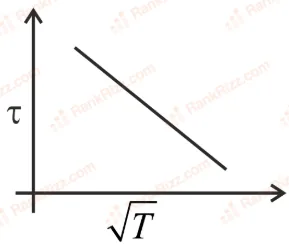
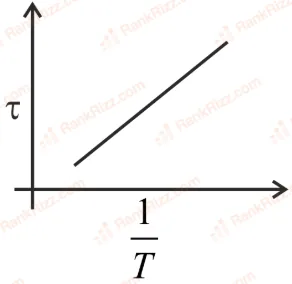
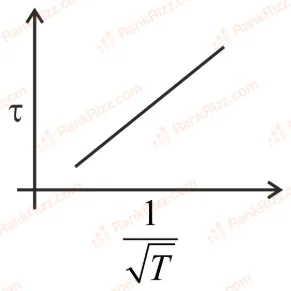
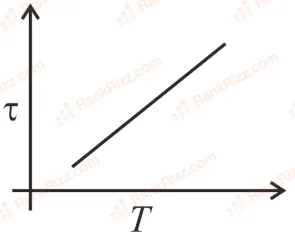
The plot that depicts the behavior of the mean free time τ\tau (time between two successive collisions) for the molecules of an ideal gas, as a function of temperature (T), qualitatively, is: (Graphs are schematic and not drawn to scale)

  1. A
    Figure for JEE Main 2020 Physics question on Mean free path
  2. B
    Figure for JEE Main 2020 Physics question on Mean free path
  3. C
    Figure for JEE Main 2020 Physics question on Mean free path
  4. D
    Figure for JEE Main 2020 Physics question on Mean free path
JEE MAIN 2020 · 09 JAN S2Mean free pathTRANSCRIBED

Two gases - argon (atomic radius 0.07 nm, atomic weight 40) and xenon (atomic radius 0.1 nm, atomic weight 140) have the same number density and are at the same temperature. The ratio of their respective mean free times is closest to:

  1. A

    3.67

  2. B

    1.83

  3. C

    2.3

  4. D

    1.09

JEE MAIN 2019 · 10 APR S1Mean free pathTRANSCRIBED

A 25×10−325 \times 10^{-3} m3^3 volume cylinder is filled with 1 mol of O2_2 gas at room temperature (300 K). The molecular diameter of O2_2, and its root mean square speed, are found to be 0.3 nm and 200 m/s, respectively. What is the average collision rate (per second) for an O2_2 molecule?

  1. A

    ~1011^{11}

  2. B

    ~1012^{12}

  3. C

    ~1010^{10}

  4. D

    ~1013^{13}

JEE MAIN 2019 · 12 JAN S2Mean free pathTRANSCRIBED

An ideal gas is enclosed in a cylinder at pressure of 2 atm and temperature, 300 K. The mean time between two successive collisions is 6×10−86 \times 10^{-8} s. If the pressure is doubled and temperature is increased to 500 K, the mean time between two successive collisions will be close to:

  1. A

    2×10−72 \times 10^{-7} s

  2. B

    3×10−63 \times 10^{-6} s

  3. C

    0.5×10−80.5 \times 10^{-8} s

  4. D

    4×10−84 \times 10^{-8} s

JEE MAIN 2015 · 04 APR OFFLINEMean free pathTRANSCRIBED

Consider an ideal gas confined in an isolated closed chamber. As the gas undergoes an adiabatic expansion, the average time of collision between molecules increases as VqV^q, where VV is the volume of the gas. The value of qq is (γ=CpCv)\left(\gamma = \frac{C_p}{C_v}\right)

  1. A

    γ−12\frac{\gamma - 1}{2}

  2. B

    3γ+56\frac{3\gamma + 5}{6}

  3. C

    3γ−56\frac{3\gamma - 5}{6}

  4. D

    γ+12\frac{\gamma + 1}{2}