JEE MAIN 2023 · 29 JAN S1Electric flux and Gauss's lawTRANSCRIBED
In a cuboid of dimension , a charge is placed at the centre of the surface having area of . The flux through the opposite surface to is given by
- A
- B
- C
- D
Every JEE Main question on Electric flux and Gauss's law, one of the ideas inside Electrostatics: 53 questions from 2008–2026, 29 of them in the last five years. Newest first, answer key on every one. Free to read.
Questions
53
Years asked
17
Since
2008
Of the chapter
18%
21–40 OF 53 · NEWEST FIRST
In a cuboid of dimension , a charge is placed at the centre of the surface having area of . The flux through the opposite surface to is given by
A capacitor of capacitance is charged to a potential . The flux of the electric field through a closed surface enclosing the positive plate of the capacitor is:
Zero
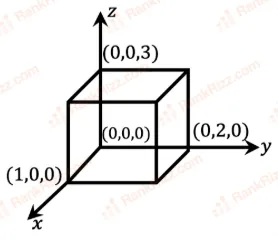
As shown in figure, a cuboid lies in a region with electric field N C. The magnitude of charge within the cuboid is C. The value of is ______ (if dimension of cuboid is m)
Expression for an electric field is given by V m. The electric flux through the cube of side 20 cm when placed in electric field (as shown in the figure) is ______ V cm.
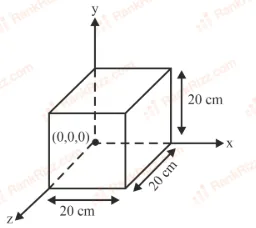
A cubical volume is bounded by the surfaces , , , , , . The electric field in the region is given by . Where NC m. If cm, the charge contained in the cubical volume is C. The value of is ______. (Take C Nm)
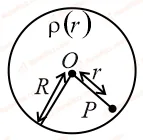
A spherically symmetric charge distribution is considered with charge density varying as
Where, is the distance from the centre O (as shown in figure). The electric field at point P will be:
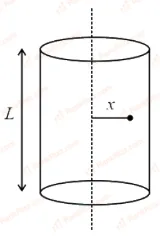
A long cylindrical volume contains a uniformly distributed charge of density . The radius of cylindrical volume is . A charge particle () revolves around the cylinder in a circular path. The kinetic energy of the particle is :
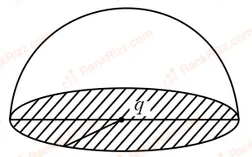
If a charge is placed at the centre of a closed hemispherical non-conducting surface, the total flux passing through the flat surface would be
A long cylindrical volume contains a uniformly distributed charge of density . The electric field inside the cylindrical volume at a distance from its axis is ______ .
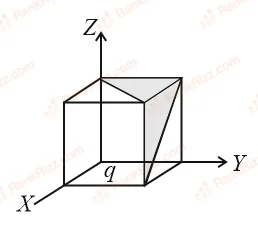
A charge is placed at one corner of a cube as shown in figure. The flux of electrostatic field through the shaded area is:
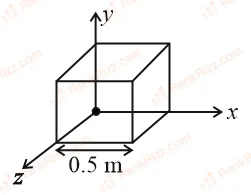
A cube is placed inside an electric field, . The side of the cube is 0.5 m and is placed in the field as shown in the given figure. The charge inside the cube is:
C
C
C
C
Choose the incorrect statement:
(a) The electric lines of force entering into a Gaussian surface provide negative flux.
(b) A charge is placed at the centre of a cube. The flux through all the faces will be the same.
(c) In a uniform electric field net flux through a closed Gaussian surface containing no net charge, is zero.
(d) When an electric field is parallel to a Gaussian surface, it provides a finite non-zero flux.
Choose the most appropriate answer from the options given below:
(b) and (d) Only
(c) and (d) Only
(a) and (c) Only
(d) Only
The electric field in a region is given by N C. The ratio of flux of reported field through the rectangular surface of area 0.2 m (parallel to plane) to that of the surface of area 0.3 m (parallel to plane) is , where = ______?[Here and are unit vectors along and -axes respectively]
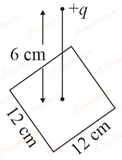
A point charge of is at a distance 6 cm vertically above the centre of a square of side 12 cm as shown in figure. The magnitude of the electric flux through the square will be ______ N m C.
The electric field in a region is given by with N C. The flux of this field through a rectangular surface, area 0.4 m parallel to the plane is ________ N m C.
The total charge enclosed in an incremental volume of m located at the origin is ___ nC, if electric flux density of its field is found as C m
In finding the electric field using Gauss law the formula is applicable. In the formula is permittivity of free space, A is the area of the Gaussian surface and is charge enclosed by the Gaussian surface. This equation can be used in which of the following situation?
Only when the Gaussian surface is an equipotential surface
Only when the Gaussian surface is an equipotential surface and is constant on the surface.
Only when = constant on the surface.
For any choice of Gaussian surface.
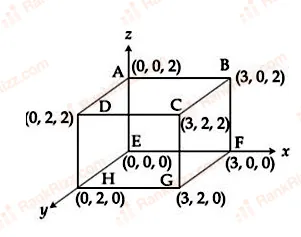
An electric field N/C passes through the box shown in figure. The flux of the electric field through surfaces ABCD and BCGF are marked as and respectively. The absolute difference between is (in Nm/C) ___________.
Let a total charge 2Q be distributed in a sphere of radius R, with the charge density given by , where r is the distance from the centre. Two charges A and B, of -Q each, are placed on diametrically opposite points, at equal distance, a, from the centre. If A and B do not experience any force, then:
a =
a =
a =
a =
A charge Q is placed at a distance a/2 above the centre of the square surface of edge a as shown in the figure. The electric flux through the square surface is: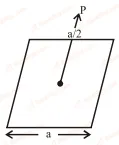
RELATED ELECTROSTATICS TOPICS