RankRizz
JEE MAIN 2023 · 30 JAN S2+4 / −1MEDIUMTRANSCRIBED

JEE Main 2023 Physics question — Electric flux and Gauss's law

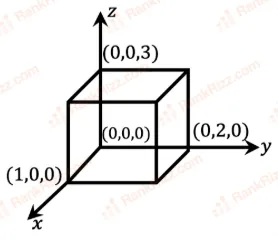
As shown in figure, a cuboid lies in a region with electric field E=2x2i^−4yj^+6k^E = 2x^2\hat{i} - 4y\hat{j} + 6\hat{k} N C−1^{-1}. The magnitude of charge within the cuboid is nε0n\varepsilon_0 C. The value of nn is ______ (if dimension of cuboid is 1×2×31 \times 2 \times 3 m3^3)

Figure for JEE Main 2023 Physics question on Electric flux and Gauss's law
SOLUTION

Use Gauss’s law in differential form:

∇⋅E⃗=ρε0\nabla\cdot\vec{E}=\frac{\rho}{\varepsilon_0}

and total charge enclosed

Q=ε0∭(∇⋅E⃗)dVQ=ε_0∭(∇⋅E⃗)dV

Given

E=2x2i^−4yj^+6k^E = 2x^2\hat{i} - 4y\hat{j} + 6\hat{k} N C−1^{-1}.

Divergence is

∇⋅E⃗=∂(2x2)∂x+∂(−4y)∂y+∂(6)∂z\nabla\cdot\vec{E}=\frac{\partial(2x^2)}{\partial x}+\frac{\partial(-4y)}{\partial y}+\frac{\partial(6)}{\partial z}

=4x−4+0=4x−4+0

=4x−4=4x−4

Now cuboid dimensions from figure:

0≤x≤10\le x\le1

0≤y≤20\le y\le2

0≤z≤30\le z\le3

So

Q=ε0∫∫∫(4x−4)dzdydxQ=ε_0\int\int\int(4x−4)dzdydx

First integrate over z:

=ε0∫∫3(4x−4)dydx=ε_0\int\int3(4x−4)dydx

Integrate over y:

=ε0∫6(4x−4)dx=ε_0\int6(4x−4)dx

=6ε0∫01(4x−4)dx=6\varepsilon_0\int_0^1(4x-4)dx

=6ε0(2x2−4x)01=6\varepsilon_0\left(2x^2-4x\right)_0^1

=6ε0(2−4)=6\varepsilon_0(2-4)

=−12ε0=-12\varepsilon_0

Magnitude of charge:

∣Q∣=12ε0|Q|=12\varepsilon_0

Tagged Electric flux and Gauss's law. Machine-assigned, so read it as a strong shortlist rather than a verdict.

SubjectPhysics
TopicElectric flux and Gauss's law
TypeNumerical answer