RankRizz

Electric flux and Gauss's law — JEE Main Previous Year Questions

Every JEE Main question on Electric flux and Gauss's law, one of the ideas inside Electrostatics: 53 questions from 2008–2026, 29 of them in the last five years. Newest first, answer key on every one. Free to read.

Questions

53

Years asked

17

Since

2008

Of the chapter

18%

Every Electric flux and Gauss's law question

41–53 OF 53 · NEWEST FIRST

JEE MAIN 2017 · 09 APR ONLINEElectric flux and Gauss's lawTRANSCRIBED

Four closed surfaces and corresponding charge distributions are shown below.
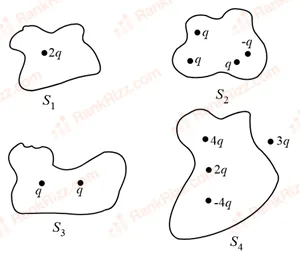
Figure for JEE Main 2017 Physics question on Electric flux and Gauss's law

Let the respective electric fluxes through the surfaces be ϕ1\phi_1, ϕ2\phi_2, ϕ3\phi_3 and ϕ4\phi_4. Then:

  1. A

    ϕ1>ϕ2>ϕ3>ϕ4\phi_1 > \phi_2 > \phi_3 > \phi_4

  2. B

    ϕ1<ϕ2=ϕ3>ϕ4\phi_1 < \phi_2 = \phi_3 > \phi_4

  3. C

    ϕ1>ϕ3\phi_1 > \phi_3; ϕ2<ϕ4\phi_2 < \phi_4

  4. D

    ϕ1=ϕ2=ϕ3=ϕ4\phi_1 = \phi_2 = \phi_3 = \phi_4

JEE MAIN 2016 · 03 APR OFFLINEElectric flux and Gauss's lawTRANSCRIBED

The region between two concentric spheres of radii 'a' and 'b', respectively (see figure), has volume charge density ρ=Ar\rho = \frac{A}{r}, where A is a constant and r is the distance from the centre. At the centre of the spheres is a point charge Q. The value of A such that the electric field in the region between the spheres will be constant, is:
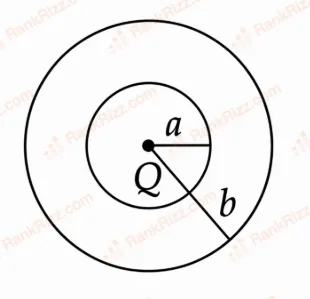
Figure for JEE Main 2016 Physics question on Electric flux and Gauss's law
  1. A

    2Qπ(a2−b2)\frac{2Q}{\pi(a^2 - b^2)}

  2. B

    2Qπa2\frac{2Q}{\pi a^2}

  3. C

    Q2πa2\frac{Q}{2\pi a^2}

  4. D

    Q2π(b2−a2)\frac{Q}{2\pi(b^2 - a^2)}

JEE MAIN 2014 · 09 APR ONLINEElectric flux and Gauss's lawTRANSCRIBED

The magnitude of the average electric field normally present in the atmosphere just above the surface of the Earth is about 150 N/C, directed inward towards the center of the Earth. This gives the total net surface charge carried by the Earth to be: [Given: ϵ0=8.85×10⁻¹²\epsilon_0 = 8.85 \times 10^{-12} C2^2/N-m2^2, RE=6.37×10⁶R_E = 6.37 \times 10^6 m]

  1. A

    −680-680 kC

  2. B

    +670+670 kC

  3. C

    +680+680 kC

  4. D

    −670-670 kC

JEE MAIN 2014 · 11 APR ONLINEElectric flux and Gauss's lawTRANSCRIBED

A cone of base radius R and height h is located in a uniform electric field E⃗\vec{E} parallel to its base. The electric flux entering the cone is:

  1. A

    12EhR\frac{1}{2}EhR

  2. B

    EhR

  3. C

    2EhR

  4. D

    4EhR

JEE MAIN 2014 · 12 APR ONLINEElectric flux and Gauss's lawTRANSCRIBED

A spherically symmetric charge distribution is characterised by the following charge density variations: ρ(r)=ρo(1−rR)\rho(r) = \rho_o\left(1 - \frac{r}{R}\right) for r<Rr < R, ρ(r)=0\rho(r) = 0 for r≥Rr \geq R. Where r is the distance from the centre of the charge distribution and ρo\rho_o is a constant. The electric field at an internal point (r<Rr < R) is:

  1. A

    ρo4εo(r3−r24R)\frac{\rho_o}{4\varepsilon_o}\left(\frac{r}{3} - \frac{r^2}{4R}\right)

  2. B

    ρoεo(r3−r24R)\frac{\rho_o}{\varepsilon_o}\left(\frac{r}{3} - \frac{r^2}{4R}\right)

  3. C

    ρo3εo(r3−r24R)\frac{\rho_o}{3\varepsilon_o}\left(\frac{r}{3} - \frac{r^2}{4R}\right)

  4. D

    ρo12εo(r3−r24R)\frac{\rho_o}{12\varepsilon_o}\left(\frac{r}{3} - \frac{r^2}{4R}\right)

JEE MAIN 2014 · 19 APR ONLINEElectric flux and Gauss's lawTRANSCRIBED

The electric field in a region of space is given by, E⃗=E0i^+2E0j^\vec{E} = E_0\hat{i} + 2E_0\hat{j} where E0=100E_0 = 100 N C−1^{-1}. The flux of this field through a circular surface of radius 0.02 m parallel to the Y-Z plane is nearly:

  1. A

    0.02 N m2^2 C−1^{-1}

  2. B

    0.005 N m2^2 C−1^{-1}

  3. C

    0.125 N m2^2 C−1^{-1}

  4. D

    3.14 N m2^2 C−1^{-1}

JEE MAIN 2012Electric flux and Gauss's lawTRANSCRIBED

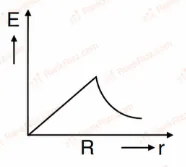
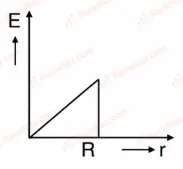
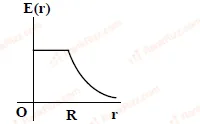
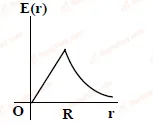
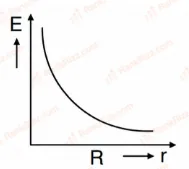
In a uniformly charged sphere of total charge QQ and radius RR, the electric field EE is plotted as a function of distance from the centre. The graph which would correspond to the above will be
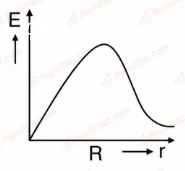
  1. A
    Figure for JEE Main 2012 Physics question on Electric flux and Gauss's law
  2. B
    Figure for JEE Main 2012 Physics question on Electric flux and Gauss's law
  3. C
    Figure for JEE Main 2012 Physics question on Electric flux and Gauss's law
  4. D
    Figure for JEE Main 2012 Physics question on Electric flux and Gauss's law
JEE MAIN 2012Electric flux and Gauss's lawTRANSCRIBED

The electric potential V(x)V(x) in a region around the origin is given by V(x)=4x2V(x) = 4x^2 volts. The electric charge enclosed in a cube of 1 m side with its centre at the origin is (in coulomb)

  1. A

    8ε08\varepsilon_0

  2. B

    −4ε0-4\varepsilon_0

  3. C

    0

  4. D

    −8ε0-8\varepsilon_0

JEE MAIN 2012Electric flux and Gauss's lawTRANSCRIBED

The flat base of a hemisphere of radius aa with no charge inside it lies in a horizontal plane. A uniform electric field E⃗\vec{E} is applied at an angle π4\frac{\pi}{4} with the vertical direction. The electric flux through the curved surface of the hemisphere is
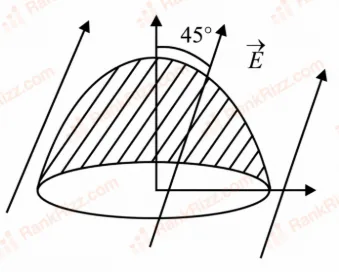
Figure for JEE Main 2012 Physics question on Electric flux and Gauss's law
  1. A

    πa2E\pi a^2 E

  2. B

    πa2E2\frac{\pi a^2 E}{\sqrt{2}}

  3. C

    πa2E22\frac{\pi a^2 E}{2\sqrt{2}}

  4. D

    (π+2πϕ2)E(222)\frac{(\pi+2\pi\phi^2)E}{(2\sqrt{2}^2)}

JEE MAIN 2011Electric flux and Gauss's lawTRANSCRIBED

The electrostatic potential inside a charged spherical ball is given by ϕ=αr2+b\phi = \alpha r^2 + b where rr is the distance from the centre; a,ba, b are constants. Then the charge density inside ball is:

  1. A

    −6aε0r-6 a \varepsilon_0 r

  2. B

    −24πaε0-24 \pi a \varepsilon_0

  3. C

    −6aε0-6 a \varepsilon_0

  4. D

    −24πaε0r-24 \pi a \varepsilon_0 r

JEE MAIN 2010Electric flux and Gauss's lawTRANSCRIBED

Let there be a spherically symmetric charge distribution with charge density varying as ρ(r)=ρ0(54−rR)\rho(r) = \rho_0 \left(\frac{5}{4} - \frac{r}{R}\right) upto r=Rr = R, and ρ(r)=0\rho(r) = 0 for r>Rr > R, where rr is the distance from the origin. The electric field at a distance rr (r<Rr < R) from the origin is given by

  1. A

    4πρ0r3ε0(53−rR)\frac{4\pi \rho_0 r}{3 \varepsilon_0} \left(\frac{5}{3} - \frac{r}{R}\right)

  2. B

    ρ0r4ε0(53−rR)\frac{\rho_0 r}{4 \varepsilon_0} \left(\frac{5}{3} - \frac{r}{R}\right)

  3. C

    4ρ0r3ε0(54−rR)\frac{4 \rho_0 r}{3 \varepsilon_0} \left(\frac{5}{4} - \frac{r}{R}\right)

  4. D

    ρ0r3ε0(54−rR)\frac{\rho_0 r}{3 \varepsilon_0} \left(\frac{5}{4} - \frac{r}{R}\right)

JEE MAIN 2009Electric flux and Gauss's lawTRANSCRIBED

Let P(r)=QπR4rP(r) = \frac{Q}{\pi R^4}r be the charge density distribution for a solid sphere of radius RR and total charge QQ. For a point 'pp' inside the sphere at distance r1r_1 from the centre of the sphere, the magnitude of electric field is

  1. A

    00

  2. B

    Q4πε0r12\frac{Q}{4\pi\varepsilon_0 r_1^2}

  3. C

    Qr124πε0R4\frac{Qr_1^2}{4\pi\varepsilon_0 R^4}

  4. D

    Qr123πε0R4\frac{Qr_1^2}{3\pi\varepsilon_0 R^4}

JEE MAIN 2008Electric flux and Gauss's lawTRANSCRIBED

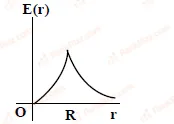
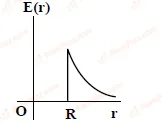
A thin spherical shell of radius RR has charge QQ spread uniformly over its surface. Which of the following graphs most closely represents the electric field E(r)E(r) produced by the shell in the range 0≤r<∞0 \le r < \infty, where rr is the distance from the centre of the shell?
  1. A
    Figure for JEE Main 2008 Physics question on Electric flux and Gauss's law
  2. B
    Figure for JEE Main 2008 Physics question on Electric flux and Gauss's law
  3. C
    Figure for JEE Main 2008 Physics question on Electric flux and Gauss's law
  4. D
    Figure for JEE Main 2008 Physics question on Electric flux and Gauss's law