RankRizz
JEE MAIN 2020 · 09 JAN S2+4MEDIUMTRANSCRIBED

JEE Main 2020 Physics question — Electric flux and Gauss's law

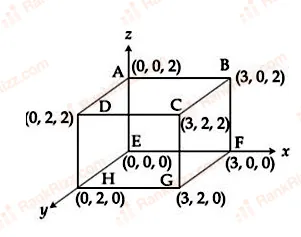
An electric field E⃗=4xi^−(y2+1)j^\vec{E} = 4x\hat{i} - (y^2 + 1)\hat{j} N/C passes through the box shown in figure. The flux of the electric field through surfaces ABCD and BCGF are marked as ϕI\phi_I and ϕII\phi_{II} respectively. The absolute difference between (ϕI−ϕII)(\phi_I - \phi_{II}) is (in Nm2^2/C) ___________.

Figure for JEE Main 2020 Physics question on Electric flux and Gauss's law
SOLUTION

For surface ABCD (Top face at z=2z = 2):

The outward normal area vector points along the z-direction: dA⃗=dx dy k^\text{The outward normal area vector points along the z-direction: } d\vec{A} = dx\,dy\,\hat{k}

E⃗=4xi^−(y2+1)j^\vec{E} = 4x\hat{i} - (y^2 + 1)\hat{j}

ϕI=∬E⃗⋅dA⃗=∬[4xi^−(y2+1)j^]⋅[dx dy k^]=0\phi_I = \iint \vec{E} \cdot d\vec{A} = \iint [4x\hat{i} - (y^2 + 1)\hat{j}] \cdot [dx\,dy\,\hat{k}] = 0

For surface BCGF (Right face at x=3x = 3):

The outward normal area vector points along the x-direction: dA⃗=dy dz i^\text{The outward normal area vector points along the x-direction: } d\vec{A} = dy\,dz\,\hat{i}

At x=3, the x-component of the electric field is: Ex=4(3)=12 N/C\text{At } x = 3\text{, the x-component of the electric field is: } E_x = 4(3) = 12\text{ N/C}

ϕII=∬Ex dy dz=12∫02dy∫02dz=12×(2×2)=48\phi_{II} = \iint E_x \,dy\,dz = 12 \int_{0}^{2} dy \int_{0}^{2} dz = 12 \times (2 \times 2) = 48

∣ϕI−ϕII∣=∣0−48∣=48|\phi_I - \phi_{II}| = |0 - 48| = 48

Tagged Electric flux and Gauss's law. Machine-assigned, so read it as a strong shortlist rather than a verdict.
SubjectPhysics
TopicElectric flux and Gauss's law
TypeNumerical answer