RankRizz
JEE MAIN 2022 · 29 JUL S1+4 / −1MEDIUMTRANSCRIBED

JEE Main 2022 Physics question — Electric flux and Gauss's law

A spherically symmetric charge distribution is considered with charge density varying as ρ(r)={ρ0(34−rR)for r≤R0for r>R\rho(r) = \begin{cases} \rho_0\left(\frac{3}{4} - \frac{r}{R}\right) & \text{for } r \leq R \\ 0 & \text{for } r > R \end{cases}
Where, r(r<R)r(r < R) is the distance from the centre O (as shown in figure). The electric field at point P will be:
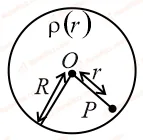
Figure for JEE Main 2022 Physics question on Electric flux and Gauss's law
SOLUTION

We need to find the electric field at a point PP located at a distance rr (r<Rr < R) from the center of a spherically symmetric charge distribution.

The charge density is given as:

ρ(r)=ρ0(34−rR)for r≤R\rho(r) = \rho_0 \left( \frac{3}{4} - \frac{r}{R} \right) \quad \text{for } r \le R

Step 1: Applying Gauss's Law

According to Gauss's Law, the electric flux through a spherical Gaussian surface of radius rr is equal to the enclosed charge (QenclQ_{\text{encl}}) divided by the permittivity of free space (ε0\varepsilon_0):

∮E⃗⋅dA⃗=Qenclε0\oint \vec{E} \cdot d\vec{A} = \frac{Q_{\text{encl}}}{\varepsilon_0}

Due to spherical symmetry, the electric field EE is radial and constant in magnitude at a distance rr. The surface area of the sphere is 4πr24\pi r^2, so the left side of the equation simplifies to:

E⋅(4πr2)=Qenclε0  ⟹  E=Qencl4πε0r2E \cdot (4\pi r^2) = \frac{Q_{\text{encl}}}{\varepsilon_0} \implies E = \frac{Q_{\text{encl}}}{4\pi \varepsilon_0 r^2}

Step 2: Finding the Enclosed Charge (QenclQ_{\text{encl}})

The total charge enclosed within a sphere of radius rr is found by integrating the charge density over the volume of thin spherical shells of thickness dxdx from 00 to rr:

Qencl=∫0rρ(x)⋅(4πx2 dx)Q_{\text{encl}} = \int_0^r \rho(x) \cdot (4\pi x^2 \, dx)

Substituting the given charge density formula into the integral expression:

Qencl=4π∫0rρ0(34−xR)x2 dxQ_{\text{encl}} = 4\pi \int_0^r \rho_0 \left( \frac{3}{4} - \frac{x}{R} \right) x^2 \, dx

Qencl=4πρ0∫0r(34x2−x3R)dxQ_{\text{encl}} = 4\pi \rho_0 \int_0^r \left( \frac{3}{4}x^2 - \frac{x^3}{R} \right) dx

Performing the integration term by term:

Qencl=4πρ0[34⋅x33−x44R]0rQ_{\text{encl}} = 4\pi \rho_0 \left[ \frac{3}{4} \cdot \frac{x^3}{3} - \frac{x^4}{4R} \right]_0^r

Qencl=4πρ0(r34−r44R)Q_{\text{encl}} = 4\pi \rho_0 \left( \frac{r^3}{4} - \frac{r^4}{4R} \right)

Factoring out r34\frac{r^3}{4} from the expression:

Qencl=4πρ0⋅r34(1−rR)=πρ0r3(1−rR)Q_{\text{encl}} = 4\pi \rho_0 \cdot \frac{r^3}{4} \left( 1 - \frac{r}{R} \right) = \pi \rho_0 r^3 \left( 1 - \frac{r}{R} \right)

Step 3: Calculating the Electric Field (EE)

Now, substitute the enclosed charge value back into the Gauss's Law expression:

E=πρ0r3(1−rR)4πε0r2E = \frac{\pi \rho_0 r^3 \left( 1 - \frac{r}{R} \right)}{4\pi \varepsilon_0 r^2}

Canceling out π\pi and r2r^2 from the numerator and denominator simplifies the equation to:

E=ρ0r4ε0(1−rR)E = \frac{\rho_0 r}{4\varepsilon_0} \left( 1 - \frac{r}{R} \right)

Therefore, the correct choice is matching the marked green option:

ρ0r4ε0(1−rR)\frac{\rho_0 r}{4\varepsilon_0} \left( 1 - \frac{r}{R} \right)

Tagged Electric flux and Gauss's law. Machine-assigned, so read it as a strong shortlist rather than a verdict.

SubjectPhysics
TopicElectric flux and Gauss's law
TypeMultiple choice