JEE MAIN 2026 · 24 JAN S1Electric dipole and dipole in external fieldTRANSCRIBED
Three charges+ 2q, +3q and -4q are situated at (0, -3a), (2a, 0) and (-2a, 0) respectively in the x y plane. The resultant dipole moment about origin is ___ .
- A
- B
- C
- D
Every JEE Main question on Electric dipole and dipole in external field, one of the ideas inside Electrostatics: 39 questions from 2006–2026, 24 of them in the last five years. Newest first, answer key on every one. Free to read.
Questions
39
Years asked
11
Since
2006
Of the chapter
13%
Questions on Electric dipole and dipole in external field in each year it was asked.
1–20 OF 39 · NEWEST FIRST
Three charges+ 2q, +3q and -4q are situated at (0, -3a), (2a, 0) and (-2a, 0) respectively in the x y plane. The resultant dipole moment about origin is ___ .
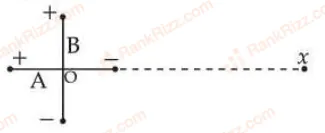
Two short electric dipoles A and B having dipole moment p and p respectively are placed with their axis mutually perpendicular as shown in the figure. The resultant electric field at a point x is making an angle of 60° with the line joining points O and x. The ratio of the dipole moments p/p is __________.
A rigid dipole undergoes a simple harmonic motion about its centre in the presence of an electric field . If another electric field is introduced to the system, what will be the percentage change in the frequency of the oscillation (approximate)?
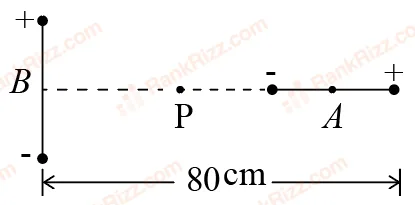
Two shorts dipoles , having charges and length 1 cm and having charges and length 1 cm are placed with their centres 80 cm apart as shown in the figure. The electric field at a point , equi-distant from the centres of both dipoles is ____ N/ C.
An electric dipole of mass m, charge q, and length is placed in a uniform electric field . When the dipole is rotated slightly from its equilibrium position and released, the time period of its oscillations will be:
A point particle of charge Q is located at P along the axis of an electric dipole 1 at a distance r as shown in the figure. The point P is also on the equatorial plane of a second electric dipole 2 at a distance r . The dipoles are made of opposite charge q separated by a distance 2a. For the charge particle at P not to experience any net
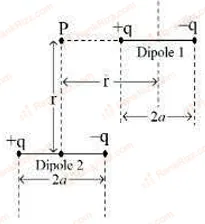
force, which of the following correctly describes the situation?
Given below are two statements : one is labelled as Assertion (A) and the other is labelled as Reason (R).
Assertion (A) : Net dipole moment of a polar linear isotropic dielectric substance is not zero even in the absence of an external electric field.
Reason (R) : In absence of an external electric field, the different permanent dipoles of a polar dielectric substance are oriented in random directions.
In the light of the above statements, choose the most appropriate answer from the options given below :
(A) is correct but (R) is not correct
Both (A) and (R) are correct but (R) is not the correct explanation of (A)
Both (A) and (R) are correct and (R) is the correct explanation of (A)
(A) is not correct but (R) is correct
Two point charges and , constituting an electric dipole, are placed at (−9, 0, 0)cm and (9, 0, 0)cm in a uniform electric field of strength . The work done on the dipole in rotating it from the equilibrium through is :
18.4 mJ
14.4 mJ
12.4 mJ
16.4 mJ
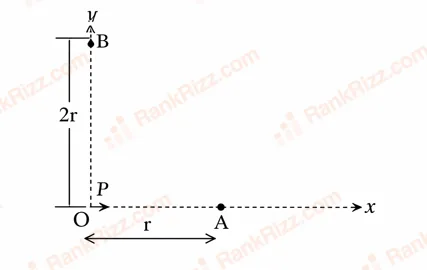
For a short dipole placed at origin O, the dipole moment is along x-axis, as shown in the figure. If the electric potential and electric field at A are and , respectively, then the correct combination of the electric potential and electric field, respectively, at point B on the -axis is given by
A dipole with two electric charges of 2 C magnitude each, with separation distance 0.5 m, is placed between the plates of a capacitor such that its axis is parallel to an electric field established between the plates when a potential difference of 5 V is applied. Separation between the plates is 0.5 mm. If the dipole is rotated by 30° from the axis, the value of the torque is :
Nm
Nm
Nm
Nm
Two small spherical balls of mass 10g each with charges and , are attached to two ends of very light rigid rod of length 20 cm. The arrangement is now placed near an infinite non-conducting charge sheet with uniform charge density such that length of rod makes an angle of 30° with electric field generated by charge sheet. Net torque acting on the rod is: (Take )
112 Nm
1.12 Nm
2.24 Nm
11.2 Nm
An electric dipole is placed at a distance of 2 cm from an infinite plane sheet having positive charge density .
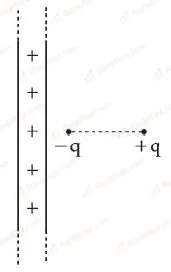
Choose the correct option from the following.
Potential energy and torque both are maximum.
Torque on dipole is zero and net force is directed away from the sheet.
Torque on dipole is zero and net force acts towards the sheet.
Potential energy of dipole is minimum and torque is zero.
An electric dipole of dipole moment is placed in uniform electric field of magnitude . Initially, the dipole moment is parallel to electric field. The work that needs to be done on the dipole to make its dipole moment opposite to the field, will be ____ J.
The electrostatic potential due to an electric dipole at a distance varies as :
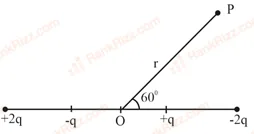
The distance between charges and is and between and is . The electrostatic potential at point at a distance from centre is V, where the value of is. (Use N m C)
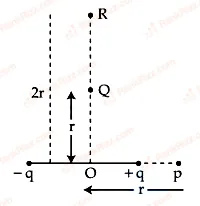
The electric field at point due to an electric dipole is . The electric field at point on equitorial line will be . The value of
Two charges of C and C are placed at the points m and m located in an electric field V cm. The magnitude of the torque acting on the dipole is N m, where = _____.
Given below are two statements: one is labelled as Assertion A and the other is labelled as Reason R.
Assertion A : If an electric dipole of dipole moment C m is enclosed by a closed surface, the net flux coming out of the surface will be zero.
Reason R : Electric dipole consists of two equal and opposite charges.
In the light of above, statements, choose the correct answer from the options given below.
Both A and R are true and R is the correct explanation of A
A is false but R is true
A is true but R is false
Both A and R are true and R is NOT the correct explanation of A
The electric field due to a short electric dipole at a large distance from center of dipole on the equatorial plane varies with distance as :
A dipole comprises of two charged particles of identical magnitude and opposite in nature. The mass of the positive charged particle is half of the mass of the negative charged particle. The two charges are separated by a distance . If the dipole is placed in a uniform electric field , in such a way that dipole axis makes a very small angle with the electric field, . The angular frequency of the oscillations of the dipole when released is given by:
RELATED ELECTROSTATICS TOPICS