RankRizz

Conductors, concentric shells and earthing — JEE Main Previous Year Questions

Every JEE Main question on Conductors, concentric shells and earthing, one of the ideas inside Electrostatics: 11 questions from 2006–2026, 5 of them in the last five years. Newest first, answer key on every one. Free to read.

Questions

11

Years asked

9

Since

2006

Of the chapter

4%

When JEE Main asked it

Questions on Conductors, concentric shells and earthing in each year it was asked.

20261
20252
20241
20231
20181
20151
20132
20121
20061

Every Conductors, concentric shells and earthing question

1–11 OF 11 · NEWEST FIRST

JEE MAIN 2026 · 04 APR S2Conductors, concentric shells and earthingTRANSCRIBED

Given below are two statements: one is labelled as Assertion A and the other is labelled as Reason R

Assertion A: In electrostatics, a conductor does not store any net charge inside.

Reason R: Inside the capacitor (with no dielectric medium), the free charge carriers, if placed between the plates of capacitor, experience force and drift.
Choose the correct answer from the options given below:

  1. A

    Both A and R are true, and R is the correct explanation of A

  2. B

    Both A and R are true, but R is NOT the correct explanation of A

  3. C

    A is true but R is false

  4. D

    A is false but R is true

JEE MAIN 2025 · 08 APR S2Conductors, concentric shells and earthingTRANSCRIBED

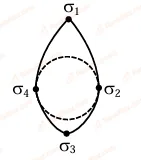
Electric charge is transferred to an irregular metallic disk as shown in figure. If σ1\sigma_1, σ2\sigma_2, σ3\sigma_3 and σ4\sigma_4 are charge densities at given points then, choose the correct answer from the options given below :

Figure for JEE Main 2025 Physics question on Conductors, concentric shells and earthing

(A) σ1>σ3  ;  σ2=σ4\sigma_1 > \sigma_3 \; ; \; \sigma_2 = \sigma_4             (B) σ1>σ2  ;  σ3>σ4\sigma_1 > \sigma_2 \; ; \; \sigma_3 > \sigma_4

(C) σ1>σ3>σ2=σ4\sigma_1 > \sigma_3 > \sigma_2 = \sigma_4                   (D) σ1=σ2=σ3=σ4\sigma_1 = \sigma_2 = \sigma_3 = \sigma_4

(E) σ1=σ2>σ3=σ4\sigma_1 = \sigma_2 > \sigma_3 = \sigma_4

  1. A

    A, B and C Only

  2. B

    A and C Only

  3. C

    D and E Only

  4. D

    B and C Only

JEE MAIN 2025 · 08 APR S2Conductors, concentric shells and earthingTRANSCRIBED

Two metal spheres of radius R and 3R have same surface charge density σ\sigma. If they are brought in contact and then separated, the surface charge density on smaller and bigger sphere becomes σ1\sigma_1 and σ2\sigma_2, respectively. The ratio σ1σ2\frac{\sigma_1}{\sigma_2} is :

  1. A

    19\frac{1}{9}

  2. B

    9

  3. C

    13\frac{1}{3}

  4. D

    3

JEE MAIN 2024 · 08 APR S1Conductors, concentric shells and earthingTRANSCRIBED

Two charged conducting spheres of radii aa and bb are connected to each other by a conducting wire. The ratio of charges of the two spheres respectively is:

  1. A

    ab\frac{a}{b}

  2. B

    ab\sqrt{ab}

  3. C

    ba\frac{b}{a}

  4. D

    abab

JEE MAIN 2023 · 30 JAN S1Conductors, concentric shells and earthingTRANSCRIBED

Two isolated metallic solid spheres of radii RR and 2R2R are charged such that both have same charge density σ\sigma. The spheres are then connected by a thin conducting wire. If the new charge density of the bigger sphere is σ′\sigma'. The ratio σ′σ\frac{\sigma'}{\sigma} is:

  1. A

    94\frac{9}{4}

  2. B

    43\frac{4}{3}

  3. C

    53\frac{5}{3}

  4. D

    56\frac{5}{6}

JEE MAIN 2018 · 08 APR OFFLINEConductors, concentric shells and earthingTRANSCRIBED

Three concentric metal shells A, B and C of respective radii a, b and c (a < b < c) have surface charge densities +σ+\sigma, −σ-\sigma and +σ+\sigma respectively. The potential of shell B is:

  1. A

    σε0[b2−c2c+a]\frac{\sigma}{\varepsilon_0}\left[\frac{b^2 - c^2}{c} + a\right]

  2. B

    σε0[a2−b2a+c]\frac{\sigma}{\varepsilon_0}\left[\frac{a^2 - b^2}{a} + c\right]

  3. C

    σε0[a2−b2b+c]\frac{\sigma}{\varepsilon_0}\left[\frac{a^2 - b^2}{b} + c\right]

  4. D

    σε0[b2−c2b+a]\frac{\sigma}{\varepsilon_0}\left[\frac{b^2 - c^2}{b} + a\right]

JEE MAIN 2015 · 10 APR ONLINEConductors, concentric shells and earthingTRANSCRIBED

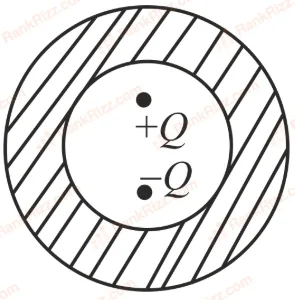
Shown in the figure are two point charges +Q+Q and −Q-Q inside the cavity of a spherical shell. The charges are kept near the surface of the cavity on opposite sides of the centre of the shell. If σ1\sigma_1 is the surface charge on the inner surface and Q1Q_1 net charge on it and σ2\sigma_2 the surface charge on the outer surface and Q2Q_2 net charge on it then:

Figure for JEE Main 2015 Physics question on Conductors, concentric shells and earthing
  1. A

    σ1=0,Q1=0,σ2=0,Q2=0\sigma_1 = 0, Q_1 = 0, \sigma_2 = 0, Q_2 = 0

  2. B

    σ1≠0,Q1=0,σ2≠0,Q2=0\sigma_1 \neq 0, Q_1 = 0, \sigma_2 \neq 0, Q_2 = 0

  3. C

    σ1≠0,Q1≠0,σ2≠0,Q2≠0\sigma_1 \neq 0, Q_1 \neq 0, \sigma_2 \neq 0, Q_2 \neq 0

  4. D

    σ1≠0,Q1=0,σ2=0,Q2=0\sigma_1 \neq 0, Q_1 = 0, \sigma_2 = 0, Q_2 = 0

JEE MAIN 2013 · 22 APR ONLINEConductors, concentric shells and earthingTRANSCRIBED

A point charge of magnitude +1μC+1\mu C is fixed at (0, 0, 0). An isolated uncharged spherical conductor, is fixed with its center at (4, 0, 0). The potential and the induced electric field at the centre of the sphere is :

  1. A

    1.8×1051.8 \times 10^5 V and −5.625×10⁶-5.625 \times 10^6 V/m

  2. B

    0 V and 0 V/m

  3. C

    2.25×1052.25 \times 10^5 V and −5.625×10⁶-5.625 \times 10^6 V/m

  4. D

    2.25×1052.25 \times 10^5 V and 0 V/m

JEE MAIN 2013 · 23 APR ONLINEConductors, concentric shells and earthingTRANSCRIBED

Consider a finite insulated, uncharged conductor placed near a finite positively charged conductor. The uncharged body must have a potential :

  1. A

    less than the charged conductor and more than at infinity.

  2. B

    more than the charged conductor and less than at infinity.

  3. C

    more than the charged conductor and more than at infinity.

  4. D

    less than the charged conductor and less than at infinity.

JEE MAIN 2012Conductors, concentric shells and earthingTRANSCRIBED

A charge of total amount QQ is distributed over two concentric hollow spheres of radii rr and R (R>r)R\ (R > r) such that the surface charge densities on the two spheres are equal. The electric potential at the common centre is

  1. A

    14πε0⋅(R−r)Q(R2+r2)\frac{1}{4\pi\varepsilon_0}\cdot\frac{(R-r)Q}{(R^2+r^2)}

  2. B

    14πε0⋅(R+r)Q2(R2+r2)\frac{1}{4\pi\varepsilon_0}\cdot\frac{(R+r)Q}{2(R^2+r^2)}

  3. C

    14πε0⋅(R+r)Q(R2+r2)\frac{1}{4\pi\varepsilon_0}\cdot\frac{(R+r)Q}{(R^2+r^2)}

  4. D

    14πε0⋅(R−r)Q2(R2+r2)\frac{1}{4\pi\varepsilon_0}\cdot\frac{(R-r)Q}{2(R^2+r^2)}

JEE MAIN 2006Conductors, concentric shells and earthingTRANSCRIBED

Two spherical conductors AA and BB of radii 1 mm1\,mm and 2 mm2\,mm are separated by a distance of 5 cm5\,cm and are uniformly charged. If the spheres are connected by a conducting wire then in equilibrium condition, the ratio of the magnitude of the electric fields at the surface of spheres AA and BB is

  1. A

    1 : 4

  2. B

    4 : 1

  3. C

    1 : 2

  4. D

    2 : 1