JEE Main 2021 Physics question — Electric flux and Gauss's law
A cube is placed inside an electric field, . The side of the cube is 0.5 m and is placed in the field as shown in the given figure. The charge inside the cube is:
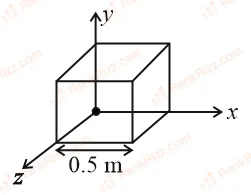
SOLUTION
We need to determine the total electric charge enclosed inside a cube of side length placed in a position-dependent electric field.
1. Analyze the Electric Field and Cube Orientation
From the diagram , the electric field vector is given as:
This tells us two very important things:
- The electric field points exclusively along the -axis ( component). Because there are no components along the or directions, the net electric flux through the four side faces parallel to the -axis (left, right, front, and back faces) is exactly zero.
- The strength of the electric field depends entirely on the height coordinate . Therefore, flux will only pass through the bottom face and the top face of the cube.
2. Calculate the Net Electric Flux ()
Let's evaluate the electric flux through the two active faces:
-
Bottom Face (located at ):
Substitute into the electric field equation:Since the electric field strength is zero at the base plane, the flux passing through the bottom face is:
-
Top Face (located at ):
The area of this square face is . The outward normal vector for the top surface points upwards ().
Substitute into the electric field equation:The flux passing out of the top face is:
The total net electric flux () emerging from the entire cube is:
3. Find the Enclosed Charge () Using Gauss's Law
According to Gauss's Law, the net electric flux through any closed surface is proportional to the net charge enclosed inside it:
Using the standard permittivity constant value ():
Conclusion
The total net charge inside the cube is , which corresponds exactly to Option A.
Tagged Electric flux and Gauss's law. Machine-assigned, so read it as a strong shortlist rather than a verdict.