JEE Main 2023 Physics question — Electric flux and Gauss's law
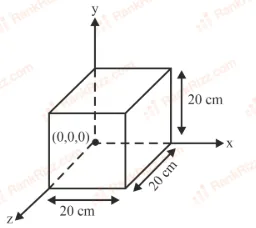
Expression for an electric field is given by E=4000x2i^ V m−1. The electric flux through the cube of side 20 cm when placed in electric field (as shown in the figure) is ______ V cm.
SOLUTION
The electric field is uniform in direction (along +i^) but varies with the x-coordinate: E=4000x2i^V m−1.
Place the cube so that its faces are perpendicular to the coordinate axes and the two faces perpendicular to the x-axis lie at x=0 and x=a, where the edge length of the cube is a=20 cm=0.20 m.
Electric flux through a closed surface is Φ=∮SE⋅dA.
The field has no y or z components, so the four faces whose outward normals are ±j^ or ±k^ give zero contribution because E⋅dA=0 there.
Only the two faces perpendicular to the x-axis contribute.
Case 1: Face at x=a=0.20 m (right face)
Outward normal n^=+i^, dA=i^dA, E⋅dA=ExdA=(4000a2)dA.
Total flux through this face: Φx=a=Ex(a)A=4000a2A, where A=a2 is the area of one face.
Case 2: Face at x=0 (left face)
Outward normal n^=−i^, dA=−i^dA, E⋅dA=−Ex(0)dA=0 because Ex(0)=0.
Hence Φx=0=0.
Net outward flux through the entire cube: Φ=Φx=a−Φx=0=4000a2A.
Substitute a=0.20 m: A=a2=(0.20)2=0.040 m2, Ex(a)=4000(0.20)2=4000×0.040=160 V m−1.
Therefore Φ=160 V m−1×0.040 m2=6.4 V m.
The question asks for the answer in V cm. Since 1 m=100 cm, 6.4 V m=6.4×100 V cm=640 V cm.
Electric flux through the cube = 640 V cm.
Tagged Electric flux and Gauss's law. Machine-assigned, so read it as a strong shortlist rather than a verdict.