RankRizz

Electric field due to point charges and superposition — JEE Main Previous Year Questions

Every JEE Main question on Electric field due to point charges and superposition, one of the ideas inside Electrostatics: 25 questions from 2005–2026, 10 of them in the last five years. Newest first, answer key on every one. Free to read.

Questions

25

Years asked

10

Since

2005

Of the chapter

9%

When JEE Main asked it

Questions on Electric field due to point charges and superposition in each year it was asked.

20261
20251
20244
20224
20217
20204
20191
20121
20071
20051

Every Electric field due to point charges and superposition question

1–20 OF 25 · NEWEST FIRST

JEE MAIN 2026 · 22 JAN S1Electric field due to point charges and superpositionTRANSCRIBED

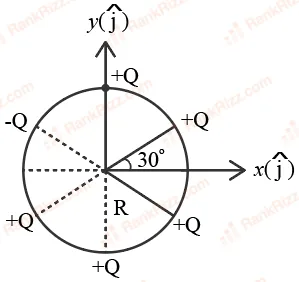
Six point charges are kept 60o60^{o} apart from each other on the circumference of a
circle of radius RR as shown in figure . The net electric field at the center of the circle is______.
( ϵo\epsilon_{o} is permittivity of free space)

Screenshot_34
  1. A

    −Q4πϵoR2(3i^−j^)-\frac{Q}{4\pi\epsilon_{o}R^{2}}\left(\sqrt{3}\widehat{i}- \widehat{j} \right)

  2. B

    −5Q8πϵoR2(i^+3j^)-\frac{5Q}{8\pi\epsilon_{o}R^{2}}\left(\widehat{i}+ \sqrt{3}\widehat{j} \right)

  3. C

    −(5Q8πϵoR2)(i^−3j^)-\left(\frac{5Q}{8\pi\epsilon_{o}R^{2}}\right)\left(\widehat{i}- \sqrt{3}\widehat{j} \right)

  4. D

    Q4πϵoR2(3i^−j^)\frac{Q}{4\pi\epsilon_{o}R^{2}}\left(\sqrt{3}\widehat{i}- \widehat{j} \right)

JEE MAIN 2025 · 22 JAN S1Electric field due to point charges and superpositionTRANSCRIBED

An electron is made to enter symmetrically between two parallel and equally but oppositely charged metal plates, each of 10 cm length. The electron emerges out of the electric field region with a horizontal component of velocity 106m/s10^{6} m/s . If the magnitude of the electric field between the plates is 9.1 V/cm9.1\text{ } V/cm, then the vertical component of velocity of electron is (mass of electron =9.1×1031kg=9.1\times 10^{31}kg and charge of electron =1.6×10⁻¹⁹C)=1.6\times 10^{-19}C)

  1. A

    0

  2. B

    1×10⁶m/s1 \times 10 ^{6} m/s

  3. C

    16×106m/s16 \times 10 ^{6} m/s

  4. D

    16×104m/s16 \times 10 ^{4} m/s

JEE MAIN 2024 · 31 JAN S1Electric field due to point charges and superpositionTRANSCRIBED

Two charges qq and 3q3q are separated by a distance 'rr' in air. At a distance xx from charge qq, the resultant electric field is zero. The value of xx is :

  1. A

    (1+3)r(1 + \sqrt{3})r

  2. B

    r3(1+3)\frac{r}{3(1 + \sqrt{3})}

  3. C

    r(1+3)\frac{r}{(1 + \sqrt{3})}

  4. D

    r(1+3)r(1 + \sqrt{3})

JEE MAIN 2024 · 01 FEB S2Electric field due to point charges and superpositionTRANSCRIBED

Suppose a uniformly charged wall provides a uniform electric field of 2×10⁴ N C−12 \times 10^4 \text{ N C}^{-1} normally. A charged particle of mass 2 g being suspended through a silk thread of length 20 cm and remain stayed at a distance of 10 cm from the wall. Then the charge on the particle will be 1xμC\frac{1}{\sqrt{x}} \mu C where xx = ______ [use g=10 m s−2g = 10 \text{ m s}^{-2}]

JEE MAIN 2024 · 29 JAN S1Electric field due to point charges and superpositionTRANSCRIBED

An electron is moving under the influence of the electric field of a uniformly charged infinite plane sheet SS having surface charge density +σ+\sigma. The electron at t=0t = 0 is at a distance of 11 m from SS and has a speed of 11 m s−1^{-1}. The maximum value of σ\sigma, if the electron strikes SS at t=1t = 1 s is α[mε0e]Cm2\alpha \left[\frac{m\varepsilon_0}{e}\right] \frac{C}{m^2}. The value of α\alpha is _______.

JEE MAIN 2024 · 06 APR S1Electric field due to point charges and superpositionTRANSCRIBED

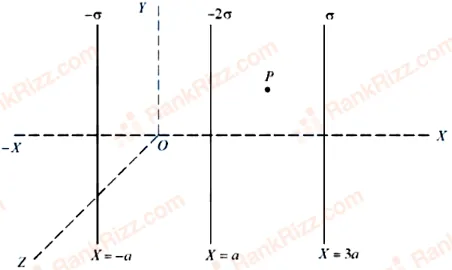
Three infinitely long charged thin sheets are placed as shown in the figure. The magnitude of electric field at point PP is xσϵo\frac{x\sigma}{\epsilon_o}. The value of xx is _______ (all quantities are measured in SI units).

Figure for JEE Main 2024 Physics question on Electric field due to point charges and superposition
JEE MAIN 2022 · 25 JUN S1Electric field due to point charges and superpositionTRANSCRIBED

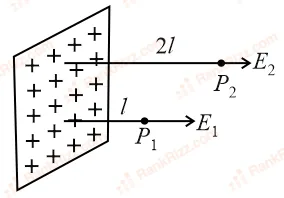
In the figure, a very large plane sheet of positive charge is shown. P1P_1 and P2P_2 are two points at distance ll and 2l2l from the charge distribution. If σ\sigma is the surface charge density, then the magnitude of electric fields E1E_1 and E2E_2 at P1P_1 and P2P_2 respectively are

Figure for JEE Main 2022 Physics question on Electric field due to point charges and superposition
  1. A

    E1=σε0,E2=σ2ε0E_1 = \frac{\sigma}{\varepsilon_0}, E_2 = \frac{\sigma}{2\varepsilon_0}

  2. B

    E1=2σε0,E2=σε0E_1 = \frac{2\sigma}{\varepsilon_0}, E_2 = \frac{\sigma}{\varepsilon_0}

  3. C

    E1=E2=σ2ε0E_1 = E_2 = \frac{\sigma}{2\varepsilon_0}

  4. D

    E1=E2=σε0E_1 = E_2 = \frac{\sigma}{\varepsilon_0}

JEE MAIN 2022 · 28 JUL S2Electric field due to point charges and superpositionTRANSCRIBED

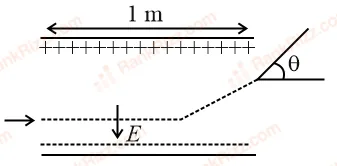
A uniform electric field E=8meE = \frac{8m}{e} V m−1^{-1} is created between two parallel plates of length 1 m as shown in figure, (where mm = mass of electron and ee = charge of electron). An electron enters the field symmetrically between the plates with a speed of 2 m s−1^{-1}. The angle of the deviation θ\theta of the path of the electron as it comes out of the field will be

Figure for JEE Main 2022 Physics question on Electric field due to point charges and superposition
  1. A

    tan⁡−1(4)\tan^{-1}(4)

  2. B

    tan⁡−1(2)\tan^{-1}(2)

  3. C

    tan⁡−1(13)\tan^{-1}\left(\frac{1}{3}\right)

  4. D

    tan⁡−1(3)\tan^{-1}(3)

JEE MAIN 2022 · 26 JUL S2Electric field due to point charges and superpositionTRANSCRIBED

Two uniformly charged spherical conductors AA and BB of radii 5 mm5 \text{ mm} and 10 mm10 \text{ mm} are separated by a distance of 2 cm2 \text{ cm}. If the spheres are connected by a conducting wire, then in equilibrium condition, the ratio of the magnitudes of the electric fields at the surface of the sphere AA and BB will be

  1. A

    1:21:2

  2. B

    2:12:1

  3. C

    1:11:1

  4. D

    1:41:4

JEE MAIN 2022 · 28 JUN S2Electric field due to point charges and superpositionTRANSCRIBED

Two point charges AA and BB of magnitude +8×10⁻⁶+8 \times 10^{-6}C and −8×10⁻⁶-8 \times 10^{-6}C respectively are placed at a distance dd apart. The electric field at the middle point OO between the charges is 6.4×1046.4 \times 10^4 N C−1^{-1}. The distance 'dd' between the point charges AA and BB is

  1. A

    2 m

  2. B

    3 m

  3. C

    1 m

  4. D

    4 m

JEE MAIN 2021 · 26 FEB S2Electric field due to point charges and superpositionTRANSCRIBED

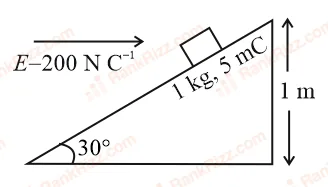
An inclined plane making an angle of 30° with the horizontal is placed in a uniform horizontal electric field 200 NC\frac{N}{C} as shown in the figure. A body of mass 1 kg and charge 5 mC is allowed to slide down from rest at a height of 1 m. If the coefficient of friction is 0.2, find the time taken by the body to reach the bottom.
[g = 9.8 m s−2s^{-2}; sin⁡30∘=12\sin 30^{\circ} =\frac{1}{2}; cos⁡30∘=32\cos 30^{\circ} = \frac{\sqrt{3}}{2}] 

Figure for JEE Main 2021 Physics question on Electric field due to point charges and superposition
  1. A

    0.92 s

  2. B

    1.3 s

  3. C

    0.46 s

  4. D

    2.3 s

JEE MAIN 2021 · 16 MAR S2Electric field due to point charges and superpositionTRANSCRIBED

Find out the surface charge density at the intersection of point x=3x = 3 m plane and xx-axis, in the region of uniform line charge of 8 nC m−1^{-1} lying along the zz-axis in free space.

  1. A

    0.424 nC m−2^{-2}

  2. B

    47.88 nC m−2^{-2}

  3. C

    0.07 nC m−2^{-2}

  4. D

    4.0 nC m−2^{-2}

JEE MAIN 2021 · 27 AUG S1Electric field due to point charges and superpositionTRANSCRIBED

A uniformly charged disc of radius RR having surface charge density σ\sigma is placed in the xyxy plane with its center at the origin. Find the electric field intensity along the zz-axis at a distance ZZ from origin:

  1. A

    E=2ε0σ(1(Z2+R2)1/2+Z)E = \frac{2\varepsilon_0}{\sigma}\left(\frac{1}{(Z^2+R^2)^{1/2}} + Z\right)

  2. B

    E=σ2ε0(1+Z(Z2+R2)1/2)E = \frac{\sigma}{2\varepsilon_0}\left(1 + \frac{Z}{(Z^2+R^2)^{1/2}}\right)

  3. C

    E=σ2ε0(1−Z(Z2+R2)1/2)E = \frac{\sigma}{2\varepsilon_0}\left(1 - \frac{Z}{(Z^2+R^2)^{1/2}}\right)

  4. D

    E=σ2ε0(1(Z2+R2)+1Z2)E = \frac{\sigma}{2\varepsilon_0}\left(\frac{1}{(Z^2+R^2)} + \frac{1}{Z^2}\right)

JEE MAIN 2021 · 31 AUG S1Electric field due to point charges and superpositionTRANSCRIBED

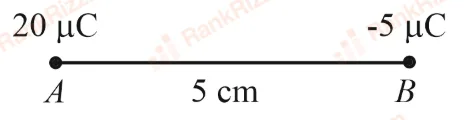
Two particles AA and BB having charges 20 μ\muC and −5-5 μ\muC respectively are held fixed with a separation of 5 cm. At what position a third charged particle should be placed so that it does not experience a net electric force?

Figure for JEE Main 2021 Physics question on Electric field due to point charges and superposition
  1. A

    At 5 cm from −5-5 μ\muC on the right side

  2. B

    At 5 cm from 20 μ\muC on the left side of system

  3. C

    At 1.25 cm from −5-5 μ\muC between two charges

  4. D

    At midpoint between two charges

JEE MAIN 2021 · 25 FEB S2Electric field due to point charges and superpositionTRANSCRIBED

An electron with kinetic energy K1K_1 enters between parallel plates of a capacitor at an angle α\alpha with the plates. It leaves the plates at angle β\beta with kinetic energy K2K_2. Then the ratio of kinetic energies K1:K2K_1 : K_2 will be:

  1. A

    sin⁡2βcos⁡2α\frac{\sin^2\beta}{\cos^2\alpha}

  2. B

    cos⁡βsin⁡α\frac{\cos\beta}{\sin\alpha}

  3. C

    cos⁡βcos⁡α\frac{\cos\beta}{\cos\alpha}

  4. D

    cos⁡2βcos⁡2α\frac{\cos^2\beta}{\cos^2\alpha}

JEE MAIN 2021 · 24 FEB S1Electric field due to point charges and superpositionTRANSCRIBED

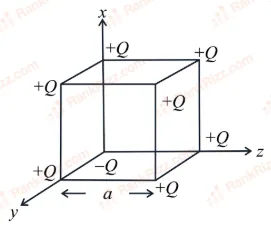
A cube of side aa has point charges +Q located at each of its vertices except at the origin where the charge is -Q. The electric field at the centre of cube is: 

Figure for JEE Main 2021 Physics question on Electric field due to point charges and superposition
  1. A

    −Q33πε0a2(x^+y^+z^)\frac{-Q}{3\sqrt{3}\pi\varepsilon_0 a^2}(\hat{x} + \hat{y} + \hat{z})

  2. B

    Q33πε0a2(x^+y^+z^)\frac{Q}{3\sqrt{3}\pi\varepsilon_0 a^2}(\hat{x} + \hat{y} + \hat{z})

  3. C

    2Q33πε0a2(x^+y^+z^)\frac{2Q}{3\sqrt{3}\pi\varepsilon_0 a^2}(\hat{x} + \hat{y} + \hat{z})

  4. D

    −2Q33πε0a2(x^+y^+z^)\frac{-2Q}{3\sqrt{3}\pi\varepsilon_0 a^2}(\hat{x} + \hat{y} + \hat{z})

JEE MAIN 2021 · 27 JUL S2Electric field due to point charges and superpositionTRANSCRIBED

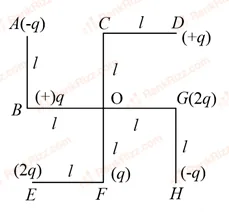
What will be the magnitude of the electric field at point OO as shown in the figure? Each side of the figure is ll and perpendicular to the other.

Figure for JEE Main 2021 Physics question on Electric field due to point charges and superposition
  1. A

    14πε0ql2\frac{1}{4\pi\varepsilon_0} \frac{q}{l^2}

  2. B

    14πε0q(2l2)(22−1)\frac{1}{4\pi\varepsilon_0} \frac{q}{(2l^2)}\left(2\sqrt{2} - 1\right)

  3. C

    q4πε0(2l)2\frac{q}{4\pi\varepsilon_0 (2l)^2}

  4. D

    14πε02q2l2(2)\frac{1}{4\pi\varepsilon_0} \frac{2q}{2l^2}\left(\sqrt{2}\right)

JEE MAIN 2020 · 06 SEP S1Electric field due to point charges and superpositionTRANSCRIBED

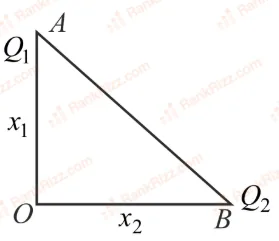
Charges Q1Q_1 and Q2Q_2 are at points A and B of a right-angled triangle OAB. The resultant electric field at point O is perpendicular to the hypotenuse, then Q1/Q2Q_1/Q_2 is proportional to:

Figure for JEE Main 2020 Physics question on Electric field due to point charges and superposition
  1. A

    x13x23\frac{x_1^3}{x_2^3}

  2. B

    x2x1\frac{x_2}{x_1}

  3. C

    x1x2\frac{x_1}{x_2}

  4. D

    x22x12\frac{x_2^2}{x_1^2}

JEE MAIN 2020 · 08 JAN S1Electric field due to point charges and superpositionTRANSCRIBED

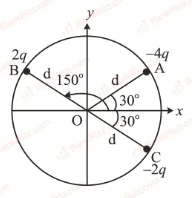
Three charged particles A, B and C with charges −4q-4q, 2q2q and −2q-2q are present on the circumference of a circle of radius dd. The charged particles A, C and centre O of the circle formed an equilateral triangle as shown in the figure. The electric field at the point O is

Figure for JEE Main 2020 Physics question on Electric field due to point charges and superposition
  1. A

    3qπε0d2\frac{\sqrt{3}q}{\pi\varepsilon_0 d^2}

  2. B

    23qπε0d2\frac{2\sqrt{3}q}{\pi\varepsilon_0 d^2}

  3. C

    3q4πε0d2\frac{\sqrt{3}q}{4\pi\varepsilon_0 d^2}

  4. D

    33q4πε0d2\frac{3\sqrt{3}q}{4\pi\varepsilon_0 d^2}

JEE MAIN 2020 · 06 SEP S2Electric field due to point charges and superpositionTRANSCRIBED

Consider the force F on a charge 'q' due to a uniformly charged spherical shell of radius R carrying charge Q distributed uniformly over it. Which one of the following statements is true for F, if 'q' is placed at distance r from the centre of the shell?

  1. A

    F=14πε0QqR2F = \frac{1}{4\pi\varepsilon_0}\frac{Qq}{R^2} for r<Rr < R

  2. B

    14πε0qQR2>F>0\frac{1}{4\pi\varepsilon_0}\frac{qQ}{R^2} > F > 0 for r<Rr < R

  3. C

    F=14πε0Qqr2F = \frac{1}{4\pi\varepsilon_0}\frac{Qq}{r^2} for r>Rr > R

  4. D

    F=14πε0Qqr2F = \frac{1}{4\pi\varepsilon_0}\frac{Qq}{r^2} for all r