RankRizz

Electric potential and potential energy — JEE Main Previous Year Questions

Every JEE Main question on Electric potential and potential energy, one of the ideas inside Electrostatics: 62 questions from 2004–2026, 28 of them in the last five years. Newest first, answer key on every one. Free to read.

Questions

62

Years asked

17

Since

2004

Of the chapter

21%

When JEE Main asked it

Questions on Electric potential and potential energy in each year it was asked, the latest 12 of 17.

20269
20255
20245
20236
20223
20213
20208
201911
20171
20152
20141
20132

Every Electric potential and potential energy question

1–20 OF 62 · NEWEST FIRST

JEE MAIN 2026Electric potential and potential energyTRANSCRIBED

Two smooth spherical non conducting shells each of radius RR having uniformly distributed charge QQ & −Q-Q on their surfaces are released on a smooth non-conducting surface when the distance between their centers is 10R10R. The mass of A is mm and that of B is 2m2m. The speed of A just before A and B collide is: [Neglect gravitational interaction]
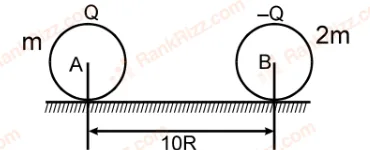
Figure for JEE Main 2026 Physics question on Electric potential and potential energy
  1. A

    Q2K15mR Q\sqrt{\frac{2K}{15mR}\ }

  2. B

    Q4K15mR Q\sqrt{\frac{4K}{15mR}\ }

  3. C

    Q8K15mR Q\sqrt{\frac{8K}{15mR}\ }

  4. D

    Q16K15mR Q\sqrt{\frac{16K}{15mR}\ }

JEE MAIN 2026 · 22 JAN S1Electric potential and potential energyTRANSCRIBED

Electric field in a region is given by E→=Axi^+Byj^\overrightarrow{E}=Ax\widehat{i}+By\widehat {j}, where A=10V/m2A= 10V/m^{2}, and B=5V/m2B= 5V/m^{2}. If the electric potential at a point (10, 20) is 500 VV, then the electric potential at origin is____ VV.

  1. A

    2000

  2. B

    0

  3. C

    500

  4. D

    1000

JEE MAIN 2026 · 22 JAN S2Electric potential and potential energyTRANSCRIBED

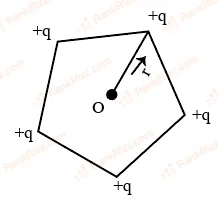
Five positive charges each having charge q are placed at the vertices of a pentagon as shown in the figure. The electric potential (V) and the electric field (E→)(\overrightarrow{E}) at the center O of the pentagon due to these five positive charges are:

Figure for JEE Main 2026 Physics question on Electric potential and potential energy
  1. A

    V=5q4πϵ0rV= \frac{5q}{4 \pi \epsilon_{0}r} and E→=0\overrightarrow{E} = 0

  2. B

    V=5q4πϵ0rV= \frac{5q}{4 \pi \epsilon_{0}r} and E→=5q4πϵ0r2r^\overrightarrow{E} = \frac{5q}{4\pi \epsilon_{0}r^{2}} \widehat{r}

  3. C

    V=5q4πϵ0rV= \frac{5q}{4 \pi \epsilon_{0}r} and E→=53q8πϵ0r2r^\overrightarrow{E} = \frac{5\sqrt{3}q}{8\pi \epsilon_{0}r^{2}} \widehat{r}

  4. D

    V = 0 and E→=0\overrightarrow{E} = 0

JEE MAIN 2026 · 24 JAN S1Electric potential and potential energyTRANSCRIBED

There are three co-centric conducting spherical shells A, B and C of radii a, b and c respectively (c > b > a) and they are charged with charge q1,q2 and q3q_{1},q_{2}\text{ and }q_{3} respectively. The potentials of the spheres A, Band C respectively, are :

  1. A

    14π∈∘(q1+q2+q3a)\frac{1}{4\pi \in_{\circ}}\left(\frac{q_{1}+q_{2}+q_{3}}{a}\right), 14π∈∘(q1+q2b+q3c)\frac{1}{4\pi \in_{\circ}}\left(\frac{q_{1}+q_{2}}{b}+\frac{q_{3}}{c}\right), 14π∈∘(q1a+q2b+q3c)\frac{1}{4\pi \in_{\circ}}\left(\frac{q_{1}}{a}+\frac{q_{2}}{b}+\frac{q_{3}}{c}\right)

  2. B

    14π∈∘(q1a+q2b+q3c)\frac{1}{4\pi \in_{\circ}}\left(\frac{q_{1}}{a}+\frac{q_{2}}{b}+\frac{q_{3}}{c}\right), 14π∈∘(q1+q2b+q3c)14π∈∘(q1+q2+q3c)\frac{1}{4\pi \in_{\circ}}\left(\frac{q_{1}+q_{2}}{b}+\frac{q_{3}}{c}\right)\frac{1}{4\pi \in_{\circ}}\left(\frac{q_{1}+q_{2}+q_{3}}{c}\right)

  3. C

    14π∈∘(q1+q2+q3a),14π∈∘(q1+q2+q3b),14π∈∘(q1+q2+q3c)\frac{1}{4\pi \in_{\circ}}\left(\frac{q_{1}+q_{2}+q_{3}}{a}\right),\frac{1}{4\pi \in_{\circ}}\left(\frac{q_{1}+q_{2}+q_{3}}{b}\right),\frac{1}{4\pi \in_{\circ}}\left(\frac{q_{1}+q_{2}+q_{3}}{c}\right)

  4. D

    14π∈∘(q1a+q2b+q3c)\frac{1}{4\pi\in_{\circ}}\left(\frac{q_{1}}{a}+\frac{q_{2}}{b}+\frac{q_{3}}{c}\right), 14π∈∘(q1+q2+q3b)\frac{1}{4\pi \in_{\circ}}\left(\frac{q_{1}+q_{2}+q_{3}}{b}\right), 14π∈∘(q1+q2+q3c)\frac{1}{4\pi \in_{\circ}}\left(\frac{q_{1}+q_{2}+q_{3}}{c}\right)

JEE MAIN 2026 · 23 JAN S2Electric potential and potential energyTRANSCRIBED

Two charges 7μC7\mu C and  −2μC-2\mu C are placed at (-9,0,0)cm and (9,0,0)cm respectively in an external field E=Ar2r‾E=\frac{A}{r^{2}}\overline{r}, where A=9×10⁵N/C.m2.A=9\times 10^{5}N/C.m^{2}. Considering the potential at infinity is 0, the electrostatic energy of the configuration is ______J.

  1. A

    1.4

  2. B

    -90.7

  3. C

    49.3

  4. D

    24.3

JEE MAIN 2026 · 28 JAN S1Electric potential and potential energyTRANSCRIBED

Two point charges of 1 nC and 2 nC are placed at the two corners of equilateral triangle of side 3 cm. The work done in bringing a charge of3 nC from infinity to the third corner of the triangle is __ μJ\mu J
14π∈∘=9×10⁹N.m2/C2\frac{1}{4\pi \in_{\circ}}=9\times 10^{9}N.m^{2}/C^{2}

  1. A

    3.3

  2. B

    2.7

  3. C

    27

  4. D

    5.4

JEE MAIN 2026 · 22 JAN S2Electric potential and potential energyTRANSCRIBED

Three small identical drops of water having same charge on each coalesce to form a bigger drop. Then the ratio of the potentials on one initial drop and that on the resultant bigger drop is :

  1. A

    323:13^{ \frac{2}{3}} : 1

  2. B

    1:3231: 3^{\frac{2}{3}}

  3. C

    1:2231: 2^{\frac{2}{3}}

  4. D

    1:3131: 3^{\frac{1}{3}}

JEE MAIN 2026 · 02 APR S2Electric potential and potential energyTRANSCRIBED

Two metal plates (A, B) are kept horizontally with separation of 12π\frac{12}{\pi} cm, with plate A on the top. An atomizer jet sprays oil (density 1.51.5 g/cm3^3) droplets of radius 1 mm horizontally. All oil droplets carry a charge 5 nC. The potentials VAV_A and VBV_B are required on plates A and B respectively in order to ensure the droplets do not descend. The values of VAV_A and VBV_B are ______.
(Neglect the air resistance to the droplets and take g=10g = 10 m/s2^2)

  1. A

    100100 V and 580580 V

  2. B

    580580 V and 100100 V

  3. C

    6060 V and 400400 V

  4. D

    00 V and −200-200 V

JEE MAIN 2026 · 06 APR S1Electric potential and potential energyTRANSCRIBED

A three coulomb charge moves from the point (0, -2, -5) to the point (5, 1, 2) in an electric field expressed as E⃗=2xi^+3y2j^+4k^\vec{E} = 2x\hat{i} + 3y^2\hat{j} + 4\hat{k} N/C. The work done in moving the charge is _______ J.

JEE MAIN 2025 · 28 JAN S1Electric potential and potential energyTRANSCRIBED

Three infinitely long wires with linear charge density λ\lambda are placed along the x-axis, y-axis and z-axis respectively. Which of the following denotes an equipotential surface?

  1. A

    xyz=constantxyz = constant

  2. B

    xy+yz+zx=constantxy+yz+zx = constant

  3. C

    (x2+y2)(y2+z2)(z2+x2)=constant(x^{2}+y^{2})(y^{2}+z^{2})(z^{2}+x^{2})=constant

  4. D

    (x+Y)(y+z)(z+x)=constant(x+Y)(y+z)(z+x)= constant

JEE MAIN 2025 · 23 JAN S2Electric potential and potential energyTRANSCRIBED

Two charges 7μc7\mu c and −4μc-4\mu c are placed at (−7 cm, 0, 0) and (7 cm, 0, 0) respectively. Given, ϵ∘=8.85×10⁻¹²C2m−2\epsilon_{\circ}=8.85\times 10^{-12}C^{2}m^{-2}, the electrostatic potential energy of the charge configuration is :

  1. A

    -1.8 J

  2. B

    -2.0 J

  3. C

    -1.5 J

  4. D

    -1.2 J

JEE MAIN 2025 · 02 APR S2Electric potential and potential energyTRANSCRIBED

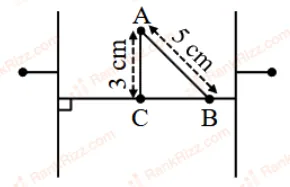
Two large plane parallel conducting plates are kept 10 cm apart as shown in figure. The potential difference between them is V. The potential difference between the points A and B (shown in the figure) is :

Figure for JEE Main 2025 Physics question on Electric potential and potential energy
  1. A

    14V\frac{1}{4}V

  2. B

    25V\frac{2}{5}V

  3. C

    34V\frac{3}{4}V

  4. D

    1 V1\,V

JEE MAIN 2025 · 03 APR S1Electric potential and potential energyTRANSCRIBED

The electrostatic potential on the surface of uniformly charged spherical shell of radius R = 10 cm is 120 V. The potential at the centre of shell, at a distance r = 5 cm from centre, and at a distance r = 15 cm from the centre of the shell, respectively, are :

  1. A

    120V, 120V, 80V

  2. B

    40V, 40V, 80V

  3. C

    0V, 0V, 80V

  4. D

    0V, 120V, 40V

JEE MAIN 2025 · 07 APR S1Electric potential and potential energyTRANSCRIBED

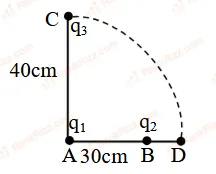
Two charges q1q_1 and q2q_2 are separated by a distance of 30 cm. A third charge q3q_3 initially at 'C' as shown in the figure, is moved along the circular path of radius 40 cm from C to D. If the difference in potential energy due to movement of q3q_3 from C to D is given by q3K4πϵ0\frac{q_3 K}{4\pi\epsilon_0}, the value of K is :

Figure for JEE Main 2025 Physics question on Electric potential and potential energy
  1. A

    8q28q_2

  2. B

    6q26q_2

  3. C

    8q18q_1

  4. D

    6q16q_1

JEE MAIN 2024 · 27 JAN S1Electric potential and potential energyTRANSCRIBED

An electric charge 10−610^{-6} μ\muC is placed at origin (0,0)(0, 0) m of X−YX - Y co-ordinate system. Two points PP and QQ are situated at (3,3)(\sqrt{3}, \sqrt{3}) m and (6,0)(\sqrt{6}, 0) m respectively. The potential difference between the points PP and QQ will be :

  1. A

    3\sqrt{3} V

  2. B

    6\sqrt{6} V

  3. C

    00 V

  4. D

    33 V

JEE MAIN 2024 · 27 JAN S2Electric potential and potential energyTRANSCRIBED

Given below are two statements : one is labelled as Assertion (A) and the other is labelled as Reason (R).
Assertion (A) : Work done by electric field on moving a positive charge on an equipotential surface is always zero.
Reason (R) : Electric lines of forces are always perpendicular to equipotential surfaces.
In the light of the above statements, choose the most appropriate answer from the options given below :

  1. A

    Both (A) and (R) are correct but (R) is not the correct explanation of (A)

  2. B

    (A) is correct but (R) is not correct

  3. C

    (A) is not correct but (R) is correct

  4. D

    Both (A) and (R) are correct and (R) is the correct explanation of (A)

JEE MAIN 2024 · 04 APR S1Electric potential and potential energyTRANSCRIBED

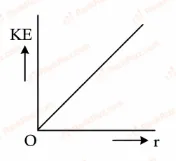
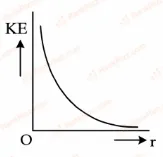
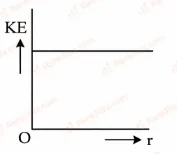
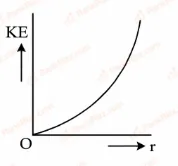
An infinitely long positively charged straight thread has a linear charge density λ Cm−1\lambda\ Cm^{-1}. An electron revolves along a circular path having axis along the length of the wire. The graph that correctly represents the variation of the kinetic energy of electron as a function of radius of circular path from the wire is:

  1. A
    Figure for JEE Main 2024 Physics question on Electric potential and potential energy
  2. B
    Figure for JEE Main 2024 Physics question on Electric potential and potential energy
  3. C
    Figure for JEE Main 2024 Physics question on Electric potential and potential energy
  4. D
    Figure for JEE Main 2024 Physics question on Electric potential and potential energy
JEE MAIN 2024 · 27 JAN S2Electric potential and potential energyTRANSCRIBED

The electric potential at the surface of an atomic nucleus (Z=50Z = 50) of radius 9×10−139 \times 10^{-13} cm is α×106\alpha \times 10^6 V. What is the value of α\alpha?
(Charge of proton 1.6×10−191.6 \times 10^{-19} C)

JEE MAIN 2024 · 09 APR S1Electric potential and potential energyTRANSCRIBED

At the centre of a half ring of radius R=10R = 10 cm and linear charge density 44 nCm−1^{-1}, the potential is xπx\pi V. The value of xx is _______

JEE MAIN 2023 · 31 JAN S1Electric potential and potential energyTRANSCRIBED

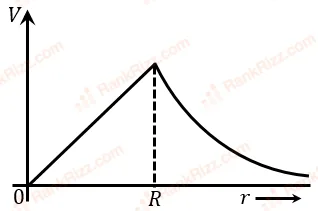
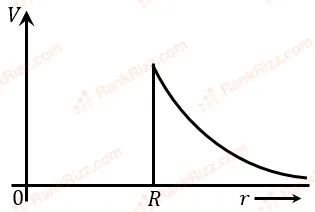
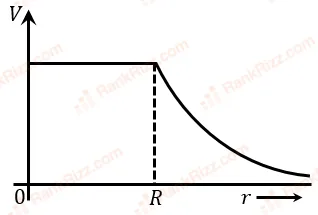
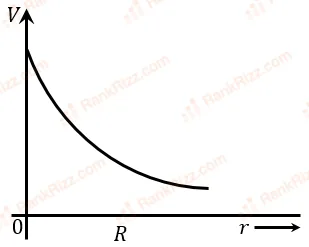
Which of the following correctly represents the variation of electric potential (V)(V) of a charged spherical conductor of radius (R)(R) with radial distance (r)(r) from the centre?

  1. A
    Figure for JEE Main 2023 Physics question on Electric potential and potential energy
  2. B
    Figure for JEE Main 2023 Physics question on Electric potential and potential energy
  3. C
    Figure for JEE Main 2023 Physics question on Electric potential and potential energy
  4. D
    Figure for JEE Main 2023 Physics question on Electric potential and potential energy