RankRizz

Purification and Characterisation of Organic Compounds — JEE Main Previous Year Questions

Every Purification and Characterisation of Organic Compounds question JEE Main has set from 2004–2026, grouped by the idea it tests rather than the order of the syllabus. 151 questions across 4 distinct ideas. Free to read, answer key on every one.

Questions

151

Distinct ideas

4

Share of marks

3.8%

Difficulty

EASY

The ideas inside Purification and Characterisation of Organic Compounds

A chapter is not one subject — it is a handful of procedures the examiner reuses. These are the ones Purification and Characterisation of Organic Compounds questions actually test.

Every Purification and Characterisation of Organic Compounds question

21–40 OF 151 · NEWEST FIRST

JEE MAIN 2025 · 07 APR S2Methods of purification of organic compoundsTRANSCRIBED

Mixture of 1 g each of chlorobenzene, aniline and benzoic acid is dissolved in 50 mL ethyl acetate and placed in a separating funnel, 5 M NaOH (30 mL) was added in the same funnel. The funnel was shaken vigorously and then kept aside. The ethyl acetate layer in the funnel contains :

  1. A

    benzoic acid

  2. B

    benzoic acid and aniline

  3. C

    benzoic acid and chlorobenzene

  4. D

    chlorobenzene and aniline

JEE MAIN 2025 · 29 JAN S1Methods of purification of organic compoundsTRANSCRIBED

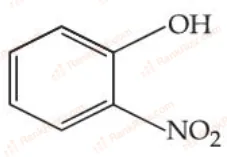
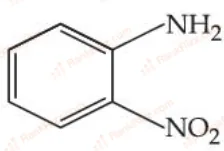
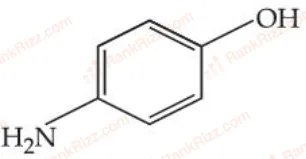
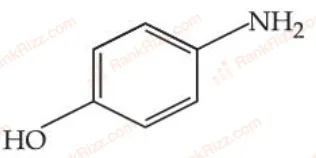
The steam volatile compounds among the following are :
 (A)

page9_img1


(B) 

page9_img2


(C)

page9_img3


(D) 

page9_img4


Choose the correct answer from the options given below :

  1. A

    (B) and (D) Only

  2. B

    (A) and (C) Only

  3. C

    (A), (B) and (C) Only

  4. D

    (A) and (B) Only

JEE MAIN 2025 · 23 JAN S1Quantitative estimation of elementsTRANSCRIBED

Given below are two statements:
Statement I: In Lassaigne's test, the covalent organic molecules are transformed into ionic compounds.
Statement II: The sodium fusion extract of an organic compound having N and S gives prussian blue colour with FeSO4FeSO_{4} and Na4[Fe(CN)6]Na_{4}[Fe(CN)_{6}] In the light of the above statements, choose
the correct answer from the options given below.

  1. A

    Statement I is true but Statement II is false

  2. B

    Both Statement I and Statement II are false

  3. C

    Both Statement I and Statement II are true

  4. D

    Statement I is false but Statement II is true

JEE MAIN 2025 · 04 APR S2Methods of purification of organic compoundsTRANSCRIBED

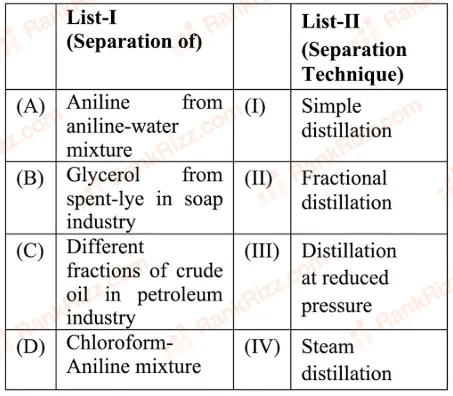
Match List-I (Separation of) with List-II (Separation Technique) :

Figure for JEE Main 2025 Chemistry question on Methods of purification of organic compounds

Choose the correct answer from the options given below : 

  1. A

    (A)-(IV), (B)-(III), (C)-(II), (D)-(I)

  2. B

    (A)-(I), (B)-(II), (C)-(III), (D)-(IV)

  3. C

    (A)-(III), (B)-(IV), (C)-(I), (D)-(II)

  4. D

    (A)-(II), (B)-(I), (C)-(IV), (D)-(III)

JEE MAIN 2025 · 28 JAN S2Methods of purification of organic compoundsTRANSCRIBED

The purification method based on the following physical transformation is :

page9_img5
  1. A

    Distillation

  2. B

    Extraction

  3. C

    Sublimation

  4. D

    Crystallization

JEE MAIN 2025 · 03 APR S2Quantitative estimation of elementsTRANSCRIBED

In Dumas' method for estimation of nitrogen 0.4 g of an organic compound gave 60 mL of nitrogen collected at 300 K temperature and 715 mm Hg pressure. The percentage composition of nitrogen in the compound is (Given: Aqueous tension at 300 K = 15 mm Hg)

  1. A

    15.71%

  2. B

    20.95%

  3. C

    17.46%

  4. D

    7.85%

JEE MAIN 2025 · 02 APR S2Methods of purification of organic compoundsTRANSCRIBED

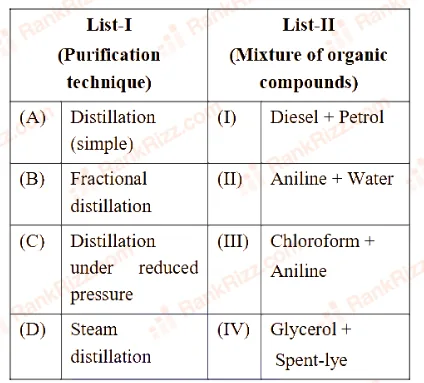
Match List-I with List-II.

Figure for JEE Main 2025 Chemistry question on Methods of purification of organic compounds

Choose the correct answer from the options given below :

  1. A

    (A)-(II), (B)-(III), (C)-(IV), (D)-(I)

  2. B

    (A)-(II), (B)-(IV), (C)-(I), (D)-(III)

  3. C

    (A)-(III), (B)-(IV), (C)-(II), (D)-(I)

  4. D

    (A)-(III), (B)-(I), (C)-(IV), (D)-(II)

JEE MAIN 2025 · 24 JAN S1Quantitative estimation of elementsTRANSCRIBED

Given below are two statements I and II. Statement I: Dumas method is used for estimation of "Nitrogen" in an organic compound. Statement II: Dumas method involves the formation of ammonium sulphate by heating the organic compound with conc H2SO4H_2 SO_4. In the light of the above statements, choose the correct answer from the options given below

  1. A

    Statement I is true but Statement II is false

  2. B

    Both Statement I and Statement II are false

  3. C

    Statement I is false but Statement II is true

  4. D

    Both Statement I and Statement II are true

JEE MAIN 2025 · 29 JAN S2Methods of purification of organic compoundsTRANSCRIBED

Given below are two statements : Statement (I): In partition chromatography, stationary phase is thin film of liquid present in the inert support. Statement (II) : In paper chromatography, the material of paper acts as a stationary phase. In the light of the above statements, choose the correct answer from the options given below :

  1. A

    Statement I is true but Statement II is false

  2. B

    Statement I is false but Statement II is true

  3. C

    Both Statement I and Statement II are false

  4. D

    Both Statement I and Statement II are true

JEE MAIN 2025 · 02 APR S2Quantitative estimation of elementsTRANSCRIBED

In Dumas' method for estimation of nitrogen, 0.5 gram of an organic compound gave 60 mL of nitrogen collected at 300 K temperature and 715 mm Hg pressure. The percentage composition of nitrogen in the compound (Aqueous tension at 300 K = 15 mm Hg) is

  1. A

    1.2571.257

  2. B

    20.8720.87

  3. C

    18.6718.67

  4. D

    12.5712.57

JEE MAIN 2025 · 03 APR S1Quantitative estimation of elementsTRANSCRIBED

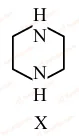
During estimation of nitrogen by Dumas' method of compound X (0.42 g) :

Figure for JEE Main 2025 Chemistry question on Quantitative estimation of elements


_________ mL of N2N_2 gas will be liberated at STP. (nearest integer)
(Given molar mass in g mol−1^{-1} : C : 12, H : 1, N : 14)

JEE MAIN 2025 · 24 JAN S2Quantitative estimation of elementsTRANSCRIBED

In Carius method of estimation of halogen, 0.25 g0.25\,g  of an organic compound gave  0.15 g0.15\,g  of silver bromide (AgBr).(AgBr). The percentage of Bromine in the organic compound is ‾×10−1\underline{\hspace{2cm}}\times 10^{-1} (Nearest integer). }[ Given: Molar mass of Ag is 108 and Br is 80 g  mol−1mol^{-1}]

JEE MAIN 2025 · 29 JAN S2Quantitative estimation of elementsTRANSCRIBED

In the sulphur estimation, 0.20 g of a pure organic compound gave 0.40 g of barium sulphate. The percentage of sulphur in the compound is ______ ×10−1\times 10^{-1}%. (Molar mass : O = 16, S=32, Ba = 137 in gmol−1gmol^{-1})

JEE MAIN 2025 · 04 APR S1Quantitative estimation of elementsTRANSCRIBED

In Dumas' method for estimation of nitrogen 1g of an organic compound gave 150 mL of nitrogen collected at 300K temperature and 900 mm Hg pressure. The percentage composition of nitrogen in the compound is ________ % (nearest integer). (Aqueous tension at 300 K = 15 mm Hg)

JEE MAIN 2025 · 07 APR S2Quantitative estimation of elementsTRANSCRIBED

In Dumas' method 292 mg of an organic compound released 50 mL of nitrogen gas (N2N_2) at 300 K temperature and 715 mm Hg pressure. The percentage composition of 'N' in the organic compound is _____ %.(Nearest integer)
(Aqueous tension at 300 K = 15 mm Hg)

JEE MAIN 2025 · 23 JAN S1Quantitative estimation of elementsTRANSCRIBED

During " S " estimation, 160 mg of an organic compound gives 466 mg of barium sulphate. The percentage of Sulphur in the given compound is _______ %. (Given molar mass in gmol−1gmol^{-1} of Ba : 137, S : 32, O : 16)

JEE MAIN 2025 · 22 JAN S1Quantitative estimation of elementsTRANSCRIBED

In Carius method for estimation of halogens, 180 mg of an organic compound produced 143.5 mg of AgCl . The percentage composition of chlorine in the compound is _______ %. (Given : molar mass in g mol−1 of Ag:108,Cl:35.5mol^{-1} \text{ of } Ag: 108, Cl: 35.5)

JEE MAIN 2024 · 30 JAN S2Methods of purification of organic compoundsTRANSCRIBED

Which among the following purification methods is based on the principle of "Solubility" in two different solvents?

  1. A

    Column Chromatography

  2. B

    Sublimation

  3. C

    Distillation

  4. D

    Differential Extraction

JEE MAIN 2024 · 09 APR S1Methods of purification of organic compoundsTRANSCRIBED

Methods used for purification of organic compounds are based on :

  1. A

    nature of compound and presence of impurity.

  2. B

    neither on nature of compound nor on the impurity present.

  3. C

    nature of compound only.

  4. D

    presence of impurity only.

JEE MAIN 2024 · 04 APR S1Quantitative estimation of elementsTRANSCRIBED

Which of the following nitrogen containing compound does not give Lassaigne's test?

  1. A

    Urea

  2. B

    Phenyl hydrazine

  3. C

    Glycine

  4. D

    Hydrazine