JEE MAIN 2021 · 20 JUL S2Quantitative estimation of elementsTRANSCRIBED
In Carius method, halogen containing organic compound is heated with fuming nitric acid in the presence of:
- A
HNO
- B
AgNO
- C
CuSO
- D
BaSO
Every Purification and Characterisation of Organic Compounds question JEE Main has set from 2004–2026, grouped by the idea it tests rather than the order of the syllabus. 151 questions across 4 distinct ideas. Free to read, answer key on every one.
Questions
151
Distinct ideas
4
Share of marks
3.8%
Difficulty
EASY
A chapter is not one subject — it is a handful of procedures the examiner reuses. These are the ones Purification and Characterisation of Organic Compounds questions actually test.
101–120 OF 151 · NEWEST FIRST
In Carius method, halogen containing organic compound is heated with fuming nitric acid in the presence of:
HNO
AgNO
CuSO
BaSO
Which one of the following tests used for the identification of functional groups in organic compounds does not use copper reagent?
Seliwanoff's test
Biuret test for peptide bond
Barfoed's test
Benedict's test
Match List-I with List-II:
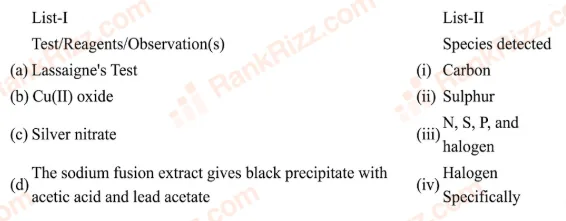
The correct match is:
(a)-(iii), (b)-(i), (c)-(ii), (d)-(iv)
(a)-(i), (b)-(iv), (c)-(iii), (d)-(ii)
(a)-(iii), (b)-(i), (c)-(iv), (d)-(ii)
(a)-(i), (b)-(ii), (c)-(iv), (d)-(iii)
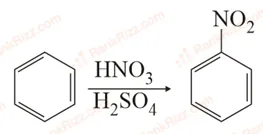
In the above reaction, 3.9 g of benzene on nitration gives 4.92 g of nitrobenzene. The percentage yield of nitrobenzene in the above reaction is ________ %. (Round off to the Nearest Integer).
(Given atomic mass: C: 12.0 u, H: 1.0 u, O: 16.0 u, N: 14.0 u)
When 0.15 g of an organic compound was analyzed using Carius method for estimation of bromine, 0.2397 g of AgBr was obtained. The percentage of bromine in the organic compound is ___. (Nearest integer)
[Atomic mass : Silver = 108, Bromine = 80]
The transformation occurring in Duma's method is given below
The value of y is _________. (Integer answer)
In the sulphur estimation, 0.471 g of an organic compound gave 1.44 g of barium sulfate. The percentage of sulphur in the compound is _________ (Nearest integer) (Atomic Mass of Ba = 137u)
In Duma's method of estimation of nitrogen, 0.1840 g of an organic compound gave 30 mL of nitrogen collected at 287 K and 758 mm of Hg pressure. The percentage composition of nitrogen in the compound is ________. (Round off to the Nearest Integer).
[Given: Aqueous tension at 287 K = 14 mm of Hg]
0.8 g of an organic compound was analysed by Kjeldahl's method for the estimation of nitrogen. If the percentage of nitrogen in the compound was found to be 42%, then _________ mL of 1M HSO would have been neutralized by the ammonia evolved during the analysis.
The number of moles of CuO, that will be utilized in Dumas method for estimating nitrogen in a sample of 57.5 g of N, N-dimethylaminopentane is _________ . (Nearest integer)
An organic compound is subjected to chlorination to get compound A using 5.0 g of chlorine. When 0.5 g of compound A is reacted with AgNO [Carius Method], the percentage of chlorine in compound A is when it forms 0.3849 g of AgCl. (Round off to the Nearest Integer)
(Atomic masses of Ag and Cl are 107.87 and 35.5 respectively)
Using the provided information in the following paper chromatogram:
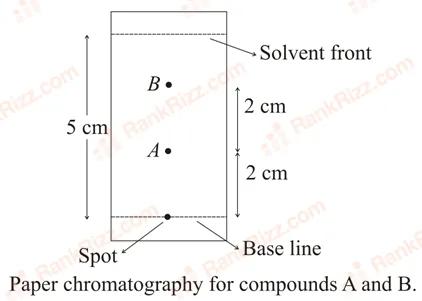
The calculated value of A is ______ .
In Carius method for estimation of halogens, 0.2 g of an organic compound gave 0.188 g of AgBr. The percentage of bromine in the compound is _________. (Nearest integer)
[Atomic mass: Ag = 108, Br = 80]
Glycerol is separated in soap industries by:
Fractional distillation
Differential distillation
Steam distillation
Distillation under reduced pressure
Match the following:
Test/Method Reagent
(i) Lucas Test (a) / aq. KOH
(ii) Dumas method (b) /
(iii) Kjeldahl's method (c) CuO /
(iv) Hinsberg Test (d) Conc. HCl and
(e)
(i)-(d), (ii)-(c), (iii)-(b), (iv)-(e)
(i)-(b), (ii)-(d), (iii)-(e), (iv)-(a)
(i)-(d), (ii)-(c), (iii)-(e), (iv)-(a)
(i)-(b), (ii)-(a), (iii)-(c), (iv)-(d)
The Kjeldahl method of Nitrogen estimation fails for which of the following reaction products?

(c) and (d)
(a) and (d)
(a), (c) and (d)
(b) and (c)
A solution of m-chloroaniline, m-chlorophenol and m-chlorobenzoic acid in ethyl acetate was extracted initially with a saturated solution of NaHCO to give fraction A. The left over organic phase was extracted with dilute NaOH solution to give fraction B. The final organic layer was labelled as fraction C. Fractions A, B and C, contain respectively:
m-chlorobenzoic acid, m-chloroaniline and m-chlorophenol
m-chlorobenzoic acid, m-chlorophenol and m-chloroaniline
m-chlorophenol, m-chlorobenzoic acid and m-chloroaniline
m-chloroaniline, m-chlorobenzoic acid and m-chlorophenol
A chromatography column, packed with silica gel as stationary phase, was used to separate a mixture of compounds consisting of (A) benzanilide (B) aniline and (C) acetophenone. When the column is eluted with a mixture of solvents, hexane:ethyl acetate (20 : 80), the sequence of obtained compounds is:
(B), (C) and (A)
(B), (A) and (C)
(C), (A) and (B)
(A), (B) and (C)
Kjeldahl's method cannot be used to estimate nitrogen for which of the following compounds?
CHNH
CHCH-CN
CHNO
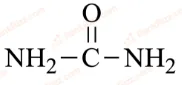
A flask contains a mixture of isohexane and 3-methylpentane. One of the liquids boils at 63C while the other boils at 60C. What is the best way to separate the two liquids and which one will be distilled out first?
fractional distillation, isohexane
simple distillation, 3-methylpentane
simple distillation, isohexane
fractional distillation, 3-methylpentane
OTHER CHEMISTRY CHAPTERS