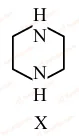
When 1 g of cmnpow1d (X) is subjected to Kjeldahl's method for estimation of nitrogen, 15 mL 1 M was neutrilized by ammonia evolved. The percentage of nitrogen in compound
(X) is :
- A
42
- B
0.42
- C
0.21
- D
21
Every JEE Main question on Quantitative estimation of elements, one of the ideas inside Purification and Characterisation of Organic Compounds: 75 questions from 2004–2026, 46 of them in the last five years. Newest first, answer key on every one. Free to read.
Questions
75
Years asked
15
Since
2004
Of the chapter
50%
Questions on Quantitative estimation of elements in each year it was asked, the latest 12 of 15.
1–20 OF 75 · NEWEST FIRST
When 1 g of cmnpow1d (X) is subjected to Kjeldahl's method for estimation of nitrogen, 15 mL 1 M was neutrilized by ammonia evolved. The percentage of nitrogen in compound
(X) is :
42
0.42
0.21
21
By usual analysis, 1.00 g of compound (X) gave 1.79 g of magnesium pyrophosphate. The percentage of phosphorus in compound (X) is: (nearest integer)
(Given, molar mass in : 0 = 16, Mg = 24, P = 31 )
40
20
30
50
In Carius method 0.2425 g of an organic compound gave 0.5253 g silver chloride.
The percentage of chlorine in the organic compound is
37.57%
53.58%
87.65%
34.79%
Complete combustion of g of an organic compound gave 0.25 g of CO and 0.12 g of HO. If the % of carbon is 25% and of hydrogen is 4.89%, then _____ g. (Nearest integer) (Molar mass of C, H and O are 12, 1 and 16 g mol respectively.)
In Carius method, 0.75 g of an organic compound gave 1.2 g of barium sulphate, find percentage of sulphur (molar mass 32 g ) Molar mass of barium sulphate is 233 g
10.30%
16.48%
4.55%
21.97%
In Dumas method for estimation of nitrogen, 0.50 g of an organic compound gave 70 mL of nitrogen collected at 300 K and 715 mm pressure. The percentage of nitrogen in the organic compound is __ %.
(Aqueous tension at 300 K is 15 mm).
In an estimation of sulphur by Carius method 0.2 g of the substance gave 0.6 g of BaSO. The percentage of sulphur in the substance is _______%. (Given molar mass in g mol S: 32, BaSO: 231)
2.0 g of a bromo hydrocarbon was subjected to Carius analysis, gave 3.36 g of AgBr. The percentage of carbon in the compound is 26.7%. Total number of carbon atoms in the empirical formula for compound is _____.
( Given molar mass in g )
Sodium fusion extract of an organic compound (Y) with and chlorine water gives violet color to the layer. 0.15g of gave 0.12g of the silver halide precipitate in Carius method. Percentage of halogen in the compound is _______ . (Nearest integer)
(Given : molar mass g C : 12 , H : 1, Cl : 35.5, Br : 80 , I : 127)
In sulphur estimation, mol of an organic compound (X) (molar mass 76 g mol) gave 0.4813 g of barium sulphate (molar mass 233 g mol). The percentage of sulphur in the compound (X) is _________ % (Nearest integer)
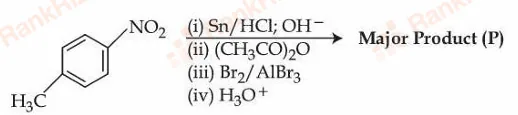
Consider the following reactions sequence.
When the product (P) is subjected to Carius analysis using AgNO, 1.0 g of the product (P) will produce _____ g of the precipitate of AgBr. (Nearest Integer)
(Given: molar mass in g mol C: 12, H: 1, O: 16, N: 14, Br: 80, Ag: 108)
Given below are two statements : Statement (I) : Nitrogen, sulphur, halogen and phosphorus present in an organic compound are detected by Lassaigne's Test. Statement (II) : The elements present in the compound are converted from covalent form into ionic form by fusing the compound with Magnesium in Lassaigne's test. In the light of the above statements, choose the correct anower from the options given below :
Statement I is false but Statement II is true
Both Statement I and Statement II are true
Both Statement I and Statement II are false
Statement I is true but Statement II is false
Given below are two statements:
Statement I: In Lassaigne's test, the covalent organic molecules are transformed into ionic compounds.
Statement II: The sodium fusion extract of an organic compound having N and S gives prussian blue colour with and In the light of the above statements, choose
the correct answer from the options given below.
Statement I is true but Statement II is false
Both Statement I and Statement II are false
Both Statement I and Statement II are true
Statement I is false but Statement II is true
In Dumas' method for estimation of nitrogen 0.4 g of an organic compound gave 60 mL of nitrogen collected at 300 K temperature and 715 mm Hg pressure. The percentage composition of nitrogen in the compound is (Given: Aqueous tension at 300 K = 15 mm Hg)
15.71%
20.95%
17.46%
7.85%
Given below are two statements I and II. Statement I: Dumas method is used for estimation of "Nitrogen" in an organic compound. Statement II: Dumas method involves the formation of ammonium sulphate by heating the organic compound with conc . In the light of the above statements, choose the correct answer from the options given below
Statement I is true but Statement II is false
Both Statement I and Statement II are false
Statement I is false but Statement II is true
Both Statement I and Statement II are true
In Dumas' method for estimation of nitrogen, 0.5 gram of an organic compound gave 60 mL of nitrogen collected at 300 K temperature and 715 mm Hg pressure. The percentage composition of nitrogen in the compound (Aqueous tension at 300 K = 15 mm Hg) is
During estimation of nitrogen by Dumas' method of compound X (0.42 g) :
_________ mL of gas will be liberated at STP. (nearest integer)
(Given molar mass in g mol : C : 12, H : 1, N : 14)
In Carius method of estimation of halogen, of an organic compound gave of silver bromide The percentage of Bromine in the organic compound is (Nearest integer). }[ Given: Molar mass of Ag is 108 and Br is 80 g ]
In the sulphur estimation, 0.20 g of a pure organic compound gave 0.40 g of barium sulphate. The percentage of sulphur in the compound is ______ . (Molar mass : O = 16, S=32, Ba = 137 in )
In Dumas' method for estimation of nitrogen 1g of an organic compound gave 150 mL of nitrogen collected at 300K temperature and 900 mm Hg pressure. The percentage composition of nitrogen in the compound is ________ % (nearest integer). (Aqueous tension at 300 K = 15 mm Hg)
RELATED PURIFICATION AND CHARACTERISATION OF ORGANIC COMPOUNDS TOPICS