JEE Main 2025 Chemistry question — Methods of purification of organic compounds
Match List-I (Separation of) with List-II (Separation Technique) :
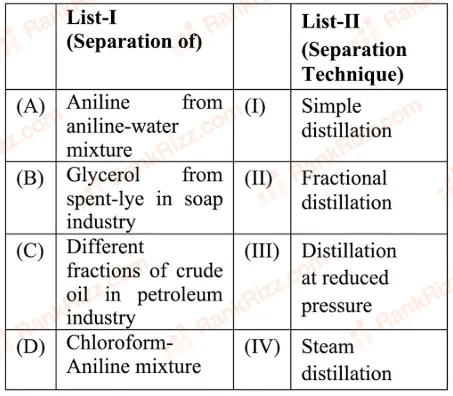
Choose the correct answer from the options given below :
SOLUTION
In separation techniques we always match the physical property of the mixture with the most suitable method:
Case A: Aniline-water mixture
Aniline boils around and is immiscible with water. When such a liquid is subjected to steam, the total vapour pressure is the sum of the individual vapour pressures, so the mixture boils below and aniline distils along with steam. Hence the correct technique is steam distillation.
Case B: Glycerol from spent-lye in the soap industry
Pure glycerol decomposes near its normal boiling point . To avoid decomposition it is distilled under low pressure, so that it boils at a much lower temperature. Therefore we need distillation at reduced (vacuum) pressure.
Case C: Different fractions of crude oil
Crude petroleum contains components whose boiling ranges overlap over fairly narrow intervals. Separation is done in a fractionating column where rising vapours repeatedly condense and revapourise. This is classical fractional distillation.
Case D: Chloroform-aniline mixture
Chloroform boils at while aniline boils at . Such a large difference means the lower-boiling component can be collected first without elaborate apparatus. Hence we use simple distillation.
Summarising the matches:
(A) Aniline / water IV Steam distillation
(B) Glycerol / spent-lye III Distillation at reduced pressure
(C) Crude-oil fractions II Fractional distillation
(D) Chloroform / aniline I Simple distillation
Therefore the correct choice is Option A.
Tagged Methods of purification of organic compounds. Machine-assigned, so read it as a strong shortlist rather than a verdict.