JEE Main 2025 Chemistry question — Methods of purification of organic compounds
Match List-I with List-II.
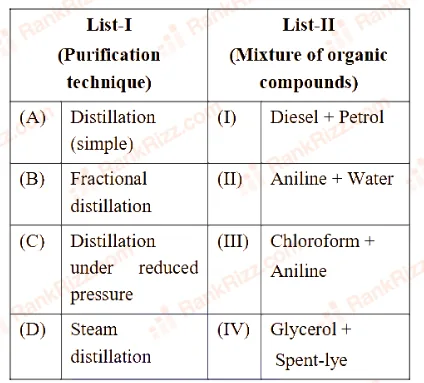
Choose the correct answer from the options given below :
SOLUTION
Case A : Simple distillation
Simple (ordinary) distillation is used when the two liquids are completely miscible and their boiling points differ by more than about .
Chloroform boils at while aniline boils at , a difference of .
Therefore the pair chloroform + aniline can be separated by ordinary distillation.
Hence (A) (III).
Case B : Fractional distillation
Fractional distillation is chosen for mixtures whose components are miscible and have boiling points that are close to each other (difference less than about ).
Petrol and diesel are overlapping fractions of petroleum whose components possess closely spaced boiling ranges; they are separated industrially in a fractionating tower.
Hence (B) (I).
Case C : Distillation under reduced pressure (vacuum distillation)
When a liquid has a very high boiling point and tends to decompose at its normal boiling point, it is distilled at a lowered external pressure so that it boils at a lower temperature.
Glycerol (bp ) is separated from spent-lye (the residual liquor in soap manufacture) by vacuum distillation to avoid its decomposition.
Hence (C) (IV).
Case D : Steam distillation
Steam distillation is applicable to compounds that are volatile in steam, immiscible with water, and possess high boiling points.
Aniline is immiscible with water and forms a separate layer; it distils along with steam at a temperature much lower than its normal boiling point, allowing its separation from water.
Hence (D) (II).
Collecting all matches:
(A) - (III), (B) - (I), (C) - (IV), (D) - (II).
This correspondence is provided by Option D.
Tagged Methods of purification of organic compounds. Machine-assigned, so read it as a strong shortlist rather than a verdict.