JEE Main 2025 Chemistry question — Valence bond theory of complexes
Match List-I with List-II.
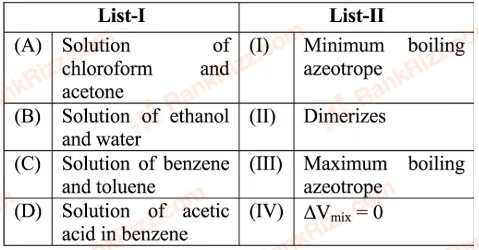
Choose the correct answer from the options given below :
SOLUTION
For each pair we first decide whether the solution shows ideal behaviour, positive deviation or negative deviation from Raoult’s law. Then we match the corresponding properties from List-II.
Case A: Chloroform (CHCl₃) + Acetone (CH₃COCH₃)
• CHCl₃ has an acidic hydrogen that forms strong hydrogen bonds with the carbonyl oxygen of acetone.
• The intermolecular attraction between unlike molecules becomes stronger than that between like molecules.
• Stronger attractions total vapour pressure these mixtures show negative deviation from Raoult’s law.
• Negative deviation gives a solution whose boiling point is higher than either pure component, i.e. a maximum-boiling azeotrope.
Thus (A) (III).
Case B: Ethanol (C₂H₅OH) + Water (H₂O)
• When ethanol mixes with water, some hydrogen bonds of pure water are broken; the unlike interactions are weaker than the strong H-bond network of water.
• Weaker attractions total vapour pressure positive deviation from Raoult’s law.
• Positive deviation produces a minimum-boiling azeotrope.
Thus (B) (I).
Case C: Benzene (C₆H₆) + Toluene (C₆H₅CH₃)
• Both are non-polar aromatic liquids with very similar molecular sizes and intermolecular forces.
• Their mixture obeys Raoult’s law almost exactly: and .
Thus (C) (IV).
Case D: Acetic acid (CH₃COOH) in Benzene (C₆H₆)
• In a non-polar solvent like benzene, acetic acid molecules associate through hydrogen bonding to form dimers: .
Thus (D) (II).
Collecting the matches:
(A)-(III), (B)-(I), (C)-(IV), (D)-(II).
The option having this sequence is Option A.
Final answer: Option A.
Tagged Valence bond theory of complexes. Machine-assigned, so read it as a strong shortlist rather than a verdict.