RankRizz

Integrated rate laws and half-life (zero and first order) — JEE Main Previous Year Questions

Every JEE Main question on Integrated rate laws and half-life (zero and first order), one of the ideas inside Chemical Kinetics: 85 questions from 2004–2026, 53 of them in the last five years. Newest first, answer key on every one. Free to read.

Questions

85

Years asked

18

Since

2004

Of the chapter

37%

When JEE Main asked it

Questions on Integrated rate laws and half-life (zero and first order) in each year it was asked, the latest 12 of 18.

202612
202511
20249
202312
20229
202112
20203
20194
20183
20161
20152
20141

Every Integrated rate laws and half-life (zero and first order) question

1–20 OF 85 · NEWEST FIRST

JEE MAIN 2026Integrated rate laws and half-life (zero and first order)TRANSCRIBED

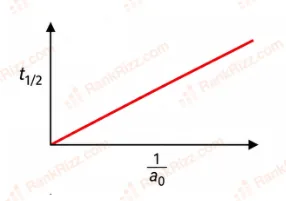
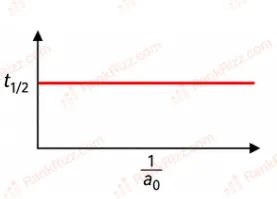
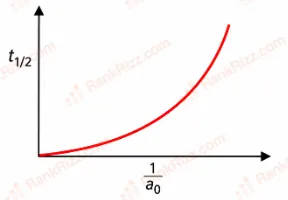
Which of the following graphs is correct for a second-order reaction?

  1. A
    Screenshot 2026-09-01 3
  2. B
    Screenshot 2026-09-01 3
  3. C
    Screenshot 2026-09-01 3
  4. D

    None of these

JEE MAIN 2026 · 04 APR S1Integrated rate laws and half-life (zero and first order)TRANSCRIBED

Consider the first order reaction R→PR \to P. The fraction of molecules decomposed in the given first order reaction can be expressed as :

  1. A

    1−ek1t1 - e^{k_1 t}

  2. B

    1+ek1t1 + e^{k_1 t}

  3. C

    1+e−k1t1 + e^{-k_1 t}

  4. D

    1−e−k1t1 - e^{-k_1 t}

JEE MAIN 2026 · 05 APR S1Integrated rate laws and half-life (zero and first order)TRANSCRIBED

First order gas phase reaction
A→B+CA \to B + C
pip_i = initial pressure of gas A, ptp_t = total pressure of the reaction mixture at time tt
Expression of rate constant (k) is

  1. A

    1tln⁡pi2pi−pt\frac{1}{t} \ln \frac{p_i}{2p_i - p_t}

  2. B

    1tln⁡2pipi−pt\frac{1}{t} \ln \frac{2p_i}{p_i - p_t}

  3. C

    1tln⁡pi3pi−2pt\frac{1}{t} \ln \frac{p_i}{3p_i - 2p_t}

  4. D

    1tln⁡3pt4pi−pt\frac{1}{t} \ln \frac{3p_t}{4p_i - p_t}

JEE MAIN 2026 · 02 APR S1Integrated rate laws and half-life (zero and first order)TRANSCRIBED

t100%t_{100\%} is the time required for the 100% completion of the reaction while t1/2t_{1/2} is the time required for 50% of the reaction to be completed. Which of the following option correctly represents the relation between t100%t_{100\%} and t1/2t_{1/2} for zero and first order reactions respectively?

  1. A

    t100%=(t1/2)2t_{100\%} = (t_{1/2})^2 and t100%=(t1/2)−∞t_{100\%} = (t_{1/2})^{-\infty}

  2. B

    t100%=2t1/2t_{100\%} = 2t_{1/2} and t100%=(t1/2)∞t_{100\%} = (t_{1/2})^{\infty}

  3. C

    t100%=2t1/2t_{100\%} = 2t_{1/2} and t100%=(2t1/2)2t_{100\%} = (2t_{1/2})^2

  4. D

    t100%=(t1/2)∞t_{100\%} = (t_{1/2})^{\infty} and t100%=2t1/2t_{100\%} = 2t_{1/2}

JEE MAIN 2026 · 28 JAN S1Integrated rate laws and half-life (zero and first order)TRANSCRIBED

An organic compound undergoes first order decomposition. The time taken for decomposition to (18)th\left(\frac{1}{8}\right)^{th} and (110)th\left(\frac{1}{10}\right)^{th} of its initial concentration are t1/8t_{1/8} and t1/10t_{1/10} respectively. What is the value of t1/8t1/10×10\frac{t_{1/8}}{t_{1/10}}\times 10 ?
(log⁡2=0.3)(\log{2}=0.3)

  1. A

    0.9

  2. B

    3

  3. C

    9

  4. D

    30

JEE MAIN 2026 · 04 APR S2Integrated rate laws and half-life (zero and first order)TRANSCRIBED

Consider the given graph showing variation of reactant concentration with time. Three different reactions were started with identical initial concentration of reactants. Which of the following statement is correct?
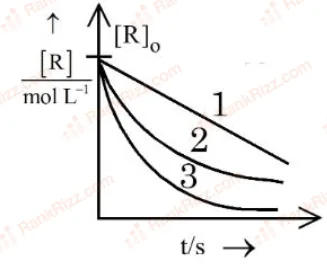
Figure for JEE Main 2026 Chemistry question on Integrated rate laws and half-life (zero and first order)
  1. A

    The order of all the three reactions is same.

  2. B

    The rate constant of reaction 3 is larger than the rate constant of reaction 2 if the order of reaction is same for both.

  3. C

    The SI unit of rate constant of reaction 1 is s−1^{-1}.

  4. D

    Thermal decomposition of HI on gold surface is an example of reaction 2.

JEE MAIN 2026 · 21 JAN S2Integrated rate laws and half-life (zero and first order)TRANSCRIBED

Decompasition of A is a first order reaction at T(K) and is given by A(g)→B(g)+C(g)A(g) \rightarrow B(g)+C(g).
In a closed 1 L vessel, 1 bar A(g) is allowed to decompose at T(K). After 100 minutes, the total pressure was 1.5bar. What is the rate constant (in min−1)min^{-1}) of the reaction ? (log 2 = 0.3)

  1. A

    6.9×10−16.9 \times 10^{-1}

  2. B

    6.9×10−46.9 \times 10^{-4}

  3. C

    6.9×10−36.9 \times 10^{-3}

  4. D

    6.9×10−26.9 \times 10^{-2}

JEE MAIN 2026 · 04 APR S2Integrated rate laws and half-life (zero and first order)TRANSCRIBED

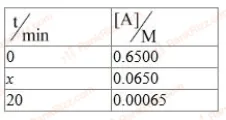
For a first order reaction A →\to B

Figure for JEE Main 2026 Chemistry question on Integrated rate laws and half-life (zero and first order)

xx = _________ min. (Nearest integer)

JEE MAIN 2026 · 06 APR S1Integrated rate laws and half-life (zero and first order)TRANSCRIBED

Sucrose hydrolyses in acidic medium into glucose and fructose by first order rate law with t1/2=3t_{1/2} = 3 hour. The percentage of sucrose remaining after 6 hours is _______. (Nearest integer)
(Given: log 2 = 0.3010 and log 3 = 0.4771)

JEE MAIN 2026 · 23 JAN S1Integrated rate laws and half-life (zero and first order)TRANSCRIBED

For the thermal decomposition of reactant AB(g), the following plot is constructed.
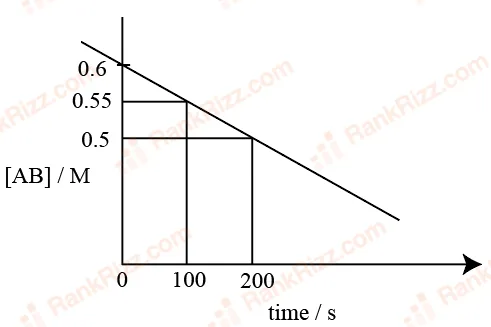
Figure for JEE Main 2026 Chemistry question on Integrated rate laws and half-life (zero and first order)


The half life of the reaction is 'x' min.
x= ____ min. (Nearest integer)

JEE MAIN 2026 · 05 APR S1Integrated rate laws and half-life (zero and first order)TRANSCRIBED

If the half life of a first order reaction is 6.93 minutes then the time required for completion of 99% of the reaction will be _______ minutes. (Given: log 2 = 0.3010)

JEE MAIN 2026 · 02 APR S2Integrated rate laws and half-life (zero and first order)TRANSCRIBED

Consider the following gas phase reaction being carried out in a closed vessel at 25°C.
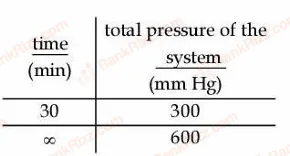
2A(g)→4B(g)+C(g)2A(g) \to 4B(g) + C(g) 

Figure for JEE Main 2026 Chemistry question on Integrated rate laws and half-life (zero and first order)


The pressure of C(g)C(g) at 30 minutes time interval would be _____ mm Hg. (nearest integer)

JEE MAIN 2025 · 08 APR S2Integrated rate laws and half-life (zero and first order)TRANSCRIBED

In a first order decomposition reaction, the time taken for the decomposition of reactant to one fourth and one eighth of its initial concentration are t1t_1 and t2t_2 (s), respectively. The ratio t1/t2t_1/t_2 will :

  1. A

    43\frac{4}{3}

  2. B

    32\frac{3}{2}

  3. C

    34\frac{3}{4}

  4. D

    23\frac{2}{3}

JEE MAIN 2025 · 29 JAN S2Integrated rate laws and half-life (zero and first order)TRANSCRIBED

Drug X becomes ineffective after 50% decomposition. The original concentration of drug in a bottle was 16mg/mL which becomes 4mg/mL in 12 months. The expiry time of the drug in months is _________
Assume that the decomposition of the drug follows first order kinetics.

  1. A

    2

  2. B

    6

  3. C

    12

  4. D

    3

JEE MAIN 2025 · 07 APR S1Integrated rate laws and half-life (zero and first order)TRANSCRIBED

Reaction A(g)→2B(g)+C(g)A(g) \rightarrow 2B(g) + C(g) is a first order reaction. It was started with pure A.
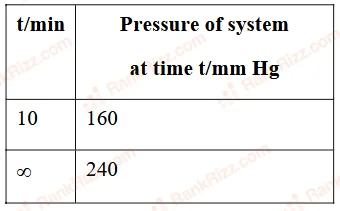
Figure for JEE Main 2025 Chemistry question on Integrated rate laws and half-life (zero and first order)

Which of the following option is incorrect?

  1. A

    Initial pressure of A is 80 mm Hg

  2. B

    The reaction never goes to completion

  3. C

    Rate constant of the reaction is 1.693 min−1^{-1}

  4. D

    Partial pressure of A after 10 minute is 40 mm Hg

JEE MAIN 2025 · 23 JAN S2Integrated rate laws and half-life (zero and first order)TRANSCRIBED

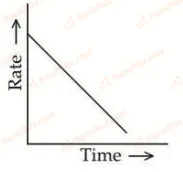
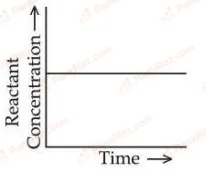
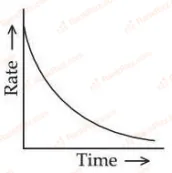
Which of the following graphs most appropriately represents a zero order reaction ?
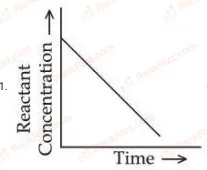
  1. A
    page9_img1
  2. B
    page9_img2
  3. C
    page9_img3
  4. D
    page9_img4
JEE MAIN 2025 · 07 APR S2Integrated rate laws and half-life (zero and first order)TRANSCRIBED

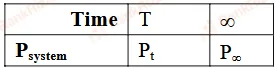
A(g)→B(g)+C(g)A(g) \to B(g) + C(g) is a first order reaction.

Figure for JEE Main 2025 Chemistry question on Integrated rate laws and half-life (zero and first order)

The reaction was started with reactant A only. Which of the following expression is correct for rate constant k?

  1. A

    k=1tln⁡2(p∞−Pt)Ptk = \frac{1}{t} \ln \frac{2(p_\infty - P_t)}{P_t}

  2. B

    k=1tln⁡p∞Ptk = \frac{1}{t} \ln \frac{p_\infty}{P_t}

  3. C

    k=1tln⁡p∞2(p∞−Pt)k = \frac{1}{t} \ln \frac{p_\infty}{2(p_\infty - P_t)}

  4. D

    k=1tln⁡p∞(p∞−Pt)k = \frac{1}{t} \ln \frac{p_\infty}{(p_\infty - P_t)}

JEE MAIN 2025 · 03 APR S1Integrated rate laws and half-life (zero and first order)TRANSCRIBED

In a reaction A+B→CA + B \to C, initial concentrations of A and B are related as [A]0=8[B]0[A]_0 = 8[B]_0. The half lives of A and B are 10 min and 40 min respectively. If they start to disappear at the same time, both following first order kinetics, after how much time will the concentration of both the reactants be same?

  1. A

    6060 min

  2. B

    8080 min

  3. C

    2020 min

  4. D

    4040 min

JEE MAIN 2025 · 24 JAN S2Integrated rate laws and half-life (zero and first order)TRANSCRIBED
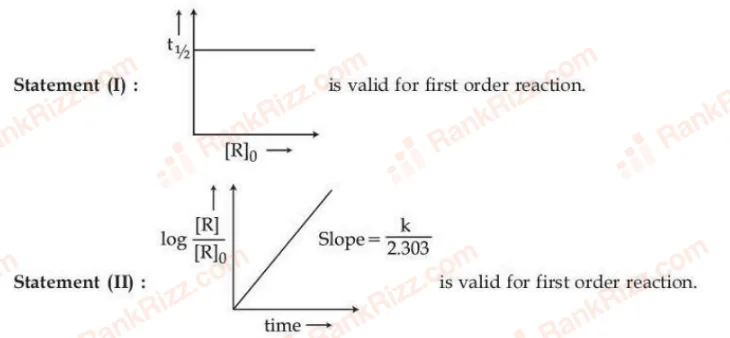
page12_img1

Given below are two statements :
In the light of the above statements, choose the correct answer from the options given below :

  1. A

    Both Statement I and Statement II are true

  2. B

    Statement I is false but Statement II is true

  3. C

    Statement I is true but Statement II is false

  4. D

    Both Statement I and Statement II are false

JEE MAIN 2025 · 07 APR S1Integrated rate laws and half-life (zero and first order)TRANSCRIBED

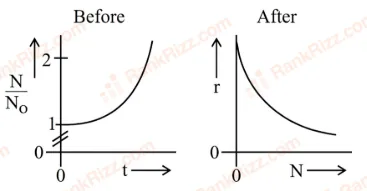
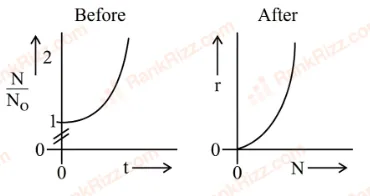
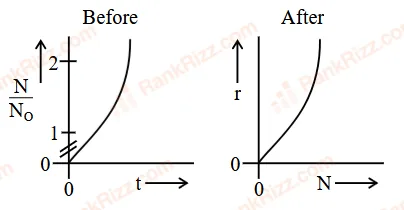
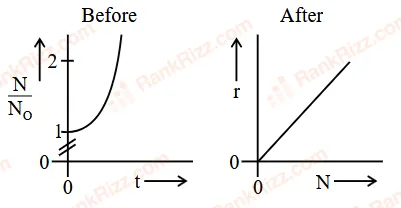
A person's wound was exposed to some bacteria and then bacteria growth started to happen at the same place. The wound was later treated with some antibacterial medicine and the rate of bacterial decay (r) was found to be proportional with the square of the existing number of bacteria at any instance. Which of the following set of graphs correctly represents the 'before' and 'after' situation of the application of the medicine?
[Given : N = No. of bacteria, t = time, bacteria growth follows IstI^{st} order kinetics.]

  1. A
    Figure for JEE Main 2025 Chemistry question on Integrated rate laws and half-life (zero and first order)
  2. B
    Figure for JEE Main 2025 Chemistry question on Integrated rate laws and half-life (zero and first order)
  3. C
    Figure for JEE Main 2025 Chemistry question on Integrated rate laws and half-life (zero and first order)
  4. D
    Figure for JEE Main 2025 Chemistry question on Integrated rate laws and half-life (zero and first order)