RankRizz
JEE MAIN 2026 · 02 APR S2+4 / −1MEDIUMTRANSCRIBED

JEE Main 2026 Chemistry question — Integrated rate laws and half-life (zero and first order)

Consider the following gas phase reaction being carried out in a closed vessel at 25°C.
2A(g)→4B(g)+C(g)2A(g) \to 4B(g) + C(g) 

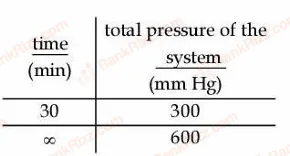
Figure for JEE Main 2026 Chemistry question on Integrated rate laws and half-life (zero and first order)


The pressure of C(g)C(g) at 30 minutes time interval would be _____ mm Hg. (nearest integer)

SOLUTION

Let the reaction be carried out in a rigid closed vessel (constant volume) at constant temperature 25 °C. Under these conditions, pressure is directly proportional to the total number of moles of gas present.

Assume the initial amount of AA is n0n_0 moles, with no BB or CC present.

Define the extent of reaction after time tt as ξt\xi_t. Using the stoichiometry

2A  ⟶  4B+C2A \;\longrightarrow\; 4B + C

the number of moles of each species at time tt is

nA=n0−2ξt,nB=4ξt,nC=ξt.\begin{aligned} n_A &= n_0 - 2\xi_t, \\ n_B &= 4\xi_t, \\ n_C &= \xi_t. \end{aligned}

The total number of moles at time tt is therefore

ntot,t=nA+nB+nC=n0−2ξt+4ξt+ξt=n0+3ξt.n_{\text{tot},t} = n_A + n_B + n_C = n_0 - 2\xi_t + 4\xi_t + \xi_t = n_0 + 3\xi_t. Final state (time ∞\infty)
At completion all AA has reacted, so nA=0⇒n0=2ξ∞n_A = 0 \Rightarrow n_0 = 2\xi_{\infty}, giving ξ∞=n02.\xi_{\infty} = \dfrac{n_0}{2}.

The total moles then are

ntot,∞=n0+3(n02)=n0+3n02=5n02=2.5 n0.n_{\text{tot},\infty} = n_0 + 3\left(\dfrac{n_0}{2}\right) = n_0 + \dfrac{3n_0}{2} = \dfrac{5n_0}{2} = 2.5\,n_0.

This final state corresponds to the given total pressure of 600 mm Hg:

P∞∝ntot,∞=2.5 n0⇒P∞=600 mm Hg.P_{\infty} \propto n_{\text{tot},\infty} = 2.5\,n_0 \quad \Rightarrow \quad P_{\infty} = 600\text{ mm Hg}. State after 30 min
Let ξ30\xi_{30} be the extent after 30 min. The total moles are

ntot,30=n0+3ξ30n_{\text{tot},30} = n_0 + 3\xi_{30}

and the corresponding pressure is 300 mm Hg.

Because pressure is proportional to total moles (same TT and VV),

P30P∞=ntot,30ntot,∞  ⟹  300600=n0+3ξ302.5 n0.\frac{P_{30}}{P_{\infty}} = \frac{n_{\text{tot},30}}{n_{\text{tot},\infty}} \;\Longrightarrow\; \frac{300}{600} = \frac{n_0 + 3\xi_{30}}{2.5\,n_0}.

Simplifying:

12=n0+3ξ302.5 n0  ⟹  n0+3ξ30=1.25 n0  ⟹  3ξ30=0.25 n0  ⟹  ξ30=n012.\frac{1}{2} = \frac{n_0 + 3\xi_{30}}{2.5\,n_0} \;\Longrightarrow\; n_0 + 3\xi_{30} = 1.25\,n_0 \;\Longrightarrow\; 3\xi_{30} = 0.25\,n_0 \;\Longrightarrow\; \xi_{30} = \frac{n_0}{12}.

Partial pressure of CC after 30 min

Number of moles of CC: nC=ξ30=n012.n_C = \xi_{30} = \dfrac{n_0}{12}.

Mole fraction of CC:

xC=nCntot,30=n0/12n0+3ξ30=n0/12n0+n0/4=1/121+1/4=1/121.25=115.x_C = \frac{n_C}{n_{\text{tot},30}} = \frac{n_0/12}{n_0 + 3\xi_{30}} = \frac{n_0/12}{n_0 + n_0/4} = \frac{1/12}{1 + 1/4} = \frac{1/12}{1.25} = \frac{1}{15}.

Therefore the partial pressure of CC is

PC=xC×P30=115×300 mm Hg=20 mm Hg.P_C = x_C \times P_{30} = \frac{1}{15} \times 300 \text{ mm Hg} = 20 \text{ mm Hg}.

Hence, the pressure of C(g)C(g) at 30 minutes is 20 mm Hg.

Tagged Integrated rate laws and half-life (zero and first order). Machine-assigned, so read it as a strong shortlist rather than a verdict.

SubjectChemistry
TopicIntegrated rate laws and half-life (zero and first order)
TypeNumerical answer