A first order reaction is 50% completed in 20 minutes at 27 °C and in 5 minutes at 47 °C. The energy of activation of the reaction is:
(Given: ln 4=1.386)
- A
43.85 kJ/mol
- B
55.31 kJ/mol
- C
11.91 kJ/mol
- D
6.65 kJ/mol
Every JEE Main question on Arrhenius equation and activation energy, one of the ideas inside Chemical Kinetics: 62 questions from 2005–2026, 32 of them in the last five years. Newest first, answer key on every one. Free to read.
Questions
62
Years asked
16
Since
2005
Of the chapter
27%
Questions on Arrhenius equation and activation energy in each year it was asked, the latest 12 of 16.
1–20 OF 62 · NEWEST FIRST
A first order reaction is 50% completed in 20 minutes at 27 °C and in 5 minutes at 47 °C. The energy of activation of the reaction is:
(Given: ln 4=1.386)
43.85 kJ/mol
55.31 kJ/mol
11.91 kJ/mol
6.65 kJ/mol
At 27 °C in presence of a catalyst, activation energy of a reaction is lowered by . The logarithm of ratio of is......
(Consider that the frequency factor for both the reactions is same)
3.482
17.41
0.1741
1.741
Given below are two statements :
J K mol and 1 cal = 4.2 J
Statement I : When kcal/mol, at the room temperature rate constant is doubled by a 10 C increase in temperature (298 K to 308 K)
Statement II : For a first order reactions ,
Here is the initial concentration of A and is half life of reaction.
In the light of the above statements, choose the correct answer from the options given below :
Both Statement I and Statement II are true
Both Statement I and Statement II are false
Statement I is true but Statement II is false
Statement I is false but Statement II is true
Correct statements regarding Arrhenius equation among the following are :
A. Factor corresponds to fraction of molecules having kinetic energy less than Ea.
B. At a given temperature, lower the Ea, faster is the reaction.
C. Increase in temperature by about doubles the rate of reaction.
D. Plot of log k vs gives a straight line with slope = .
Choose the correct answer from the options given below :
A and B Only
A and C Only
B and D Only
B and C Only
Pre-exponential factors of two different reactions of same order are identical. Let activation energy of first reaction exceeds the activation energy of second reaction by 20 kJ . If are the rate constants of first and second reaction respectively at 300 K, then In will be ___.
(nearest integer)
Consider and are two reactions. If the rate constant () of the reaction can be expressed by the followmg equation and activation energy reaction () is of the reaction (), then the value of () is _____________kJ . (Nearest Integer)
The temperature at which the rate constants of the given below two gaseous reactions become equal is ______ K. (Nearest integer)
Given: ln 10 = 2.303
For reaction A P, rate constant k = 1.5 × 10 s at 27°C. If activation energy for the above reaction is 60 kJ mol, then the temperature (in °C) at which rate constant, k = 4.5 × 10 s is __________. (Nearest integer) Given : log 2 = 0.30, log 3 = 0.48, R = 8.3 J K mol, ln 10 = 2.3
(first reaction)
(second reaction)
Consider the above two first-order reactions. The rate constant for first reaction at 500 K is double of the same at 300 K. At 500 K, 50% of the reaction becomes complete in 2 hour. The activation energy of the second reaction is half of that of first reaction. lf the rate constant at 500 K of the second reaction becomes double of the rate constant of first reaction at the same temperature; then rate constant for the second reaction at 300 K is______ (nearest integer).
Decomposition of a hydrocarbon follows the equation . The activation energy of reaction is __________ kJ mol. (Nearest Integer) Given : R = 8.3 J K mol
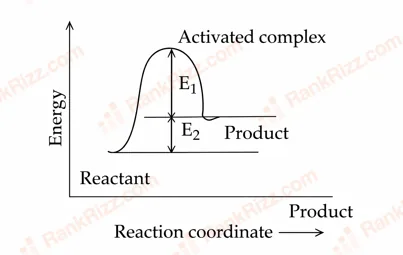
Consider the given figure and choose the correct option :

Activation energy of both forward and backward reaction is and reactant is more stable than product.
Activation energy of forward reaction is and product is less stable than reactant.
Activation energy of backward reaction is and product is more stable than reactant.
Activation energy of forward reaction is and product is more stable than reactant.
For . for forward and backward reaction are 180 and 200 kJ mol respectively. If catalyst lowers for both reaction by 100 kJ mol. Which of the following statement is correct?
Catalyst does not alter the Gibbs energy change of a reaction.
Catalyst can cause non-spontaneous reactions to occur.
The enthalpy change for the reaction is +20 kJ mol.
The enthalpy change for the catalysed reaction is different from that of uncatalysed reaction.
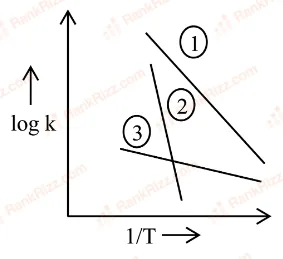
Consider the following plots of log of rate constant k (log k) vs for three different reactions. The correct order of activation energies of these reactions is :

Consider the following statements related to temperature dependence of rate constants. Identify the correct statements:
A. The Arrhenius equation holds true only for an elementary homogenous reaction.
B. The unit of A is same as that of k in Arrhenius equation.
C. At a given temperature, a low activation energy means a fast reaction.
D. A and Ea as used in Arrhenius equation depend on temperature.
E. When , A and become interdependent.
Choose the correct answer from the options given below :
A, C and D Only
B, D and E Only
B and C Only
A and B Only
The molecule A changes into its isomeric form B by following a first order kinetics at a temperature
of 1000 K . If the energy barrier with respect to reactant energy for such isomeric transformation is and the frequency factor is the time required for 50% molecules of A to become B is
_________ picoseconds (nearest integer).
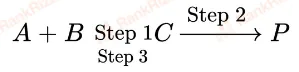
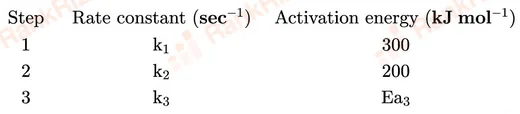
Consider a complex reaction taking place in three steps with rate constants respectively. The overall rate constant is given by . If the activation energies of the three steps are and respectively, then the overall energy of activation in is (Nearest integer)
Consider the following transformation involving first order elementary reaction in each step at constant
temperature as shown below.
Some details of the above reactions are listed below.

For a reaction taking place in three steps at same temperature, overall rate constant . If and are and kJ/mol respectively, the overall is _______ kJ/mol.
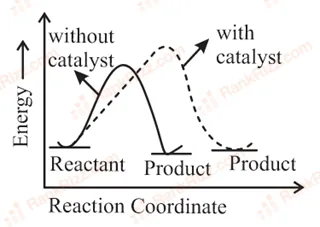
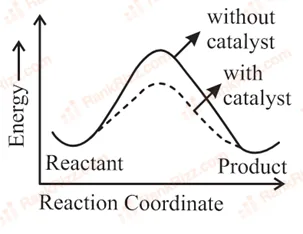
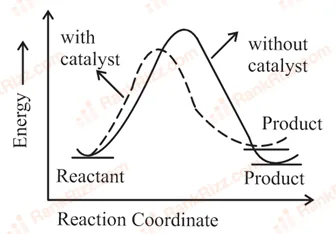
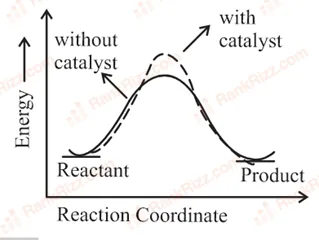
The correct reaction profile diagram for a positive catalyst reaction.


For a reversible reaction A B, the forward reaction kJ mol. The activation energy of the uncatalyzed forward reaction is kJ mol. When the reaction is catalysed keeping the reactant concentration same, the rate of the catalysed forward reaction at C is found to be same as that of the uncatalyzed reaction at C. The activation energy of the catalysed backward reaction is _____ kJ mol.