JEE Main 2025 Chemistry question — Integrated rate laws and half-life (zero and first order)
Reaction is a first order reaction. It was started with pure A.
Which of the following option is incorrect?
SOLUTION
The stoichiometry is and the reaction is first-order in .
Let the initial partial pressure of be mm Hg.
At any time , let mm Hg of have decomposed.
Pressures at time :
• Unreacted :
• Product : (because 2 mol per mol )
• Product :
Hence total pressure at time is
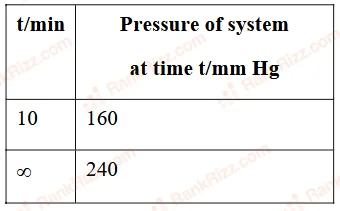
Case 1: Pressure at
All of is consumed, so .
Using with mm Hg:
Thus the initial pressure is 80 mm Hg Option A is correct.
Case 2: Pressure after 10 min
Given mm Hg.
Insert mm Hg into :
Partial pressure of after 10 min:
Hence Option D is correct.
Case 3: Rate constant
For a first-order reaction, .
Substituting mm Hg, mm Hg and min:
, so
The value quoted in Option C (1.693 min) is therefore wrong.
Case 4: Does the reaction go to completion?
For a first-order kinetics equation, never becomes exactly zero in a finite time; it only approaches zero as . Hence one may say the reaction “never actually reaches completion.” This matches Option B.
Summary:
Option A - correct (initial pressure 80 mm Hg)
Option B - correct (strictly never reaches completion in finite time)
Option C - incorrect (true value 0.0693 min)
Option D - correct (40 mm Hg of after 10 min)
The incorrect statement is Option C.
Tagged Integrated rate laws and half-life (zero and first order). Machine-assigned, so read it as a strong shortlist rather than a verdict.