JEE MAIN 2026 · 24 JAN S2Radioactivity and nuclear reactionsTRANSCRIBED
The half-life of is 245 days. After x days, 75% of original activity remained. The value of x in days is ___ . (Nearest integer)
(Given: log 3 = 0.4771 and log 2 = 0.3010)
Every JEE Main question on Radioactivity and nuclear reactions, one of the ideas inside Chemical Kinetics: 16 questions from 2004–2026, 6 of them in the last five years. Newest first, answer key on every one. Free to read.
Questions
16
Years asked
11
Since
2004
Of the chapter
7%
Questions on Radioactivity and nuclear reactions in each year it was asked.
1–16 OF 16 · NEWEST FIRST
The half-life of is 245 days. After x days, 75% of original activity remained. The value of x in days is ___ . (Nearest integer)
(Given: log 3 = 0.4771 and log 2 = 0.3010)
For bacterial growth in a cell culture, growth law is very similar to the law of radioactive decay. Which of the following graphs is most suitable to represent bacterial colony growth ? Where N - Number of Bacteria at any time, - Initial number of Bacteria.
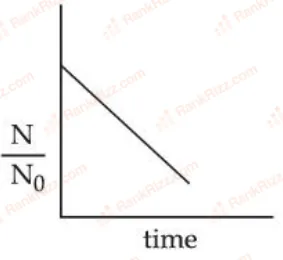
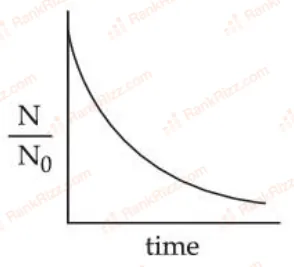
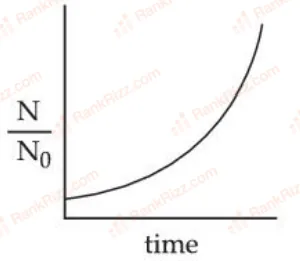
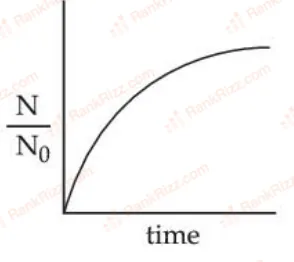
Which of the following statement is not true for radioactive decay?
Decay constant increases with increase in temperature.
Amount of radioactive substance remained after three half lives is of original amount.
Decay constant does not depend upon temperature.
Half life is times of
The ratio of in a piece of wood is part that of atmosphere. If half life of is years, the age of wood sample is _____ years.
The half-life of radioisotopic bromine-82 is hours. The fraction which remains after one day is ______ .
(Given antilog )
Assuming 1 g of trace radioactive element X with a half life of 30 years is absorbed by a growing tree. The amount of X remaining in the tree after 100 years is _____ g. [Given: ; ]
Which of the following forms of hydrogen emits low energy particles?
Deuterium
Proton
Tritium
Protium
During the nuclear explosion, one of the products is Sr with half life of 6.93 years. If 1g of Sr was absorbed in the bones of a newly born baby in place of Ca, how much time, in years, is required to reduce it by 90% if it is not lost metabolically
A radioactive isotope having a half-life period of 3 days was received after 12 days. If 3 g of the isotope is left in the container, what would be the initial mass of the isotope?
12 g
36 g
48 g
24 g
A radioactive element gets spilled over the floor of a room. Its half-life period is 30 days. If the initial activity is ten times the permissible value, after how many days will it be safe to enter the room?
1000 days
300 days
10 days
100 days
Which of the following nuclear reactions will generate an isotope?
neutron particle emission
positron emission
-particle emission
-particle emission
In the transformation of to , if one emission is an -particle, what should be the other emission(s)?
Two
Two and one
One and one
One and one
The photon of hard gamma radiation knocks a proton out of Mg nucleus to form
the isotope of parent nucleus
the isobar of parent nucleus
the nuclide Na
the isobar of Na
Hydrogen bomb is based on the principle of
Nuclear fission
Natural radioactivity
Nuclear fusion
Artificial radioactivity
Consider the following nuclear reactions ; . The number of neutrons in the element is
The half-life of a radioisotope is four hours. If the initial mass of the isotope was g, the mass remaining after hours undecayed is
g
g
g
g