t is the time required for the reaction to undergo completion and t is the time required for the reaction to undergo completion. The relation between t and t for a first order reaction is
t = x t
The value of x is _____. (Nearest integer)
Every JEE Main question on Integrated rate laws and half-life (zero and first order), one of the ideas inside Chemical Kinetics: 85 questions from 2004–2026, 53 of them in the last five years. Newest first, answer key on every one. Free to read.
Questions
85
Years asked
18
Since
2004
Of the chapter
37%
41–60 OF 85 · NEWEST FIRST
t is the time required for the reaction to undergo completion and t is the time required for the reaction to undergo completion. The relation between t and t for a first order reaction is
t = x t
The value of x is _____. (Nearest integer)
A molecule undergoes two independent first order reactions whose respective half lives are 12 min and 3 min. If both the reactions are occurring then the time taken for the 50% consumption of the reactant is _______ min. (Nearest integer)
The number of incorrect statement/s from the following is _______
A. The successive half lives of zero order reactions decreases with time.
B. A substance appearing as reactant in the chemical equation may not affect the rate of reaction
C. Order and molecularity of a chemical reaction can be a fractional number
D. The rate constant units of zero and second order reaction are mol L s and mol L s respectively
A(g) 2B(g) + C(g) is a first order reaction. The initial pressure of the system was found to be mm Hg which increased to mm Hg after min. The total pressure of the system after min will be _____ mm Hg. (Nearest integer)
At , the half life for the decomposition of is and is independent of the initial concentration of . The time required for of the to decompose is (Given: ; )
For a first order reaction, the time required for completion of reaction is '' times the half life of the reaction. The value of '' is
(Given: and )
1.12
2.43
3.32
33.31
A flask is filled with equal moles of A and B. The half lives of A and B are s and s respectively and are independent of the initial concentration. The time required for the concentration of A to be four times that of B is ______ s.
(Given : )
A radioactive element has a half life of 200 days. The percentage of original activity remaining after 83 days is ______ (Nearest integer)
(Given: antilog 0.125 = 1.333, antilog 0.693 = 4.93)
Reactant Product
If formation of compound [B] follows the first order of kinetics and after 70 minutes the concentration of [A] was found to be half of its initial concentration. Then the rate constant of the reaction is . The value of is ____
For the given first order reaction the half life of the reaction is 0.3010 min. The ratio of the initial concentration of reactant to the concentration of reactant at time 2.0 min will be equal to _____. (Nearest integer)
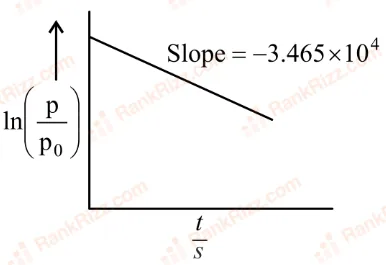
For the decomposition of azomethane , a first order reaction, the variation in partial pressure with time at is given as shown.
The half life of the reaction is ______ s.
For a first order reaction A B, the rate constant, s. The time required for completion of reaction is times the half life of reaction. The value of is ______ Nearest integer) (Given : )
For a reaction , the half lives are and when the concentration of reactant A is and respectively. The order of the reaction is ______.
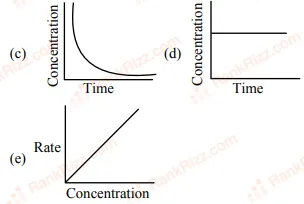
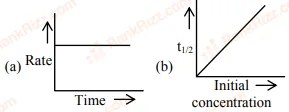
For the following graphs,
Choose from the options given below, the correct one regarding order of reaction is:
(b) zero order (c) and (e) First order
(a) and (b) Zero order (e) First order
(b) and (d) Zero order (e) First order
(a) and (b) Zero order (c) and (e) First order
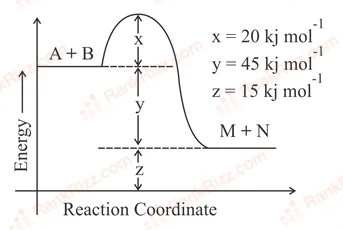
According to the following figure, the magnitude of the enthalpy change of the reaction A + B M + N in kJ mol is equal to _________. (Integer answer)

The inactivation rate of a viral preparation is proportional to the amount of virus. In the first minute after preparation, 10% of the virus is inactivated. The rate constant for viral inactivation is ___ min.
(Nearest integer) [Use : ln 10 = 2.303; property of logarithm: ]
For a first order reaction, the ratio of the time for 75% completion of a reaction to the time for 50% completion is _________. (Integer answer)
A reaction has a half life of 1 min. The time required for 99.9% completion of the reaction is ___ min.
(Round off to the Nearest integer)
[Use : ln 2 = 0.69, ln 10 = 2.3]
Sucrose hydrolyses in acid solution into glucose and fructose following first order rate law with a half-life of 3.33 h at 25°C. After 9 h, the fraction of sucrose remaining is f. The value of is ______ .
(Rounded off to the nearest integer)
[Assume: ln10 = 2.303, ln 2 = 0.693]
PCl(g) PCl(g) + Cl(g)
In the above first order reaction the concentration of PCl reduces from initial concentration 50 mol L to 10 mol L in 120 minutes at 300 K. The rate constant for the reaction at 300 K is x min. The value of x is ___.
[Given log 5 = 0.6989]