RankRizz

Rate law, order and molecularity — JEE Main Previous Year Questions

Every JEE Main question on Rate law, order and molecularity, one of the ideas inside Chemical Kinetics: 40 questions from 2004–2026, 14 of them in the last five years. Newest first, answer key on every one. Free to read.

Questions

40

Years asked

18

Since

2004

Of the chapter

17%

When JEE Main asked it

Questions on Rate law, order and molecularity in each year it was asked, the latest 12 of 18.

20264
20255
20243
20231
20221
20215
20202
20194
20162
20151
20144
20131

Every Rate law, order and molecularity question

1–20 OF 40 · NEWEST FIRST

JEE MAIN 2026 · 22 JAN S1Rate law, order and molecularityTRANSCRIBED

A→\rightarrow product (First order reaction).
Three sets of experiment were performed for a reaction under similar experimental conditions:

Run 1 ⇒\Rightarrow 100 mL of 10 M solution of reactant A

Run 2 ⇒\Rightarrow 200 mL of 10 M solution of reactant A

Run 3 ⇒\Rightarrow 100 mL of 10 M solution of reactant A + 100 mL of H2OH_{2}O added.

The correct variation of rate of reaction is

  1. A

    Rum l = Run 2 = Run 3

  2. B

    Run 1 < Run 2 < Run 3

  3. C

    Rum 3 < Run 1 < Run 2

  4. D

    Run 3 < Run 1 = Run 2

JEE MAIN 2026 · 02 APR S2Rate law, order and molecularityTRANSCRIBED

Consider the reaction aX→bYaX \to bY, for which the rate constant at 30°C is 1×10⁻³¹ \times 10^{-3} mol−1^{-1} L s−1^{-1}. Which of the following statements are true?
A. When concentration of 'X' is increased to four times, the rate of reaction becomes 16 times.
B. The reaction is a second order reaction.
C. The half-life period is independent of the concentration of X.
D. Decomposition of N2O5N_2O_5 is an example of the above reaction.
E.

Figure for JEE Main 2026 Chemistry question on Rate law, order and molecularity

is valid for the above reaction.
Choose the correct answer from the option given below:

  1. A

    A and B Only

  2. B

    A, B and C Only

  3. C

    A, B, D and E Only

  4. D

    C and D Only

JEE MAIN 2026 · 23 JAN S2Rate law, order and molecularityTRANSCRIBED

Observe the following reactions at T(K).

I. A→A\rightarrowproducts
II. 5Br−(aq)+BrO3 −(aq)→3Br2(aq)+3H2O(l)5Br^{-}(aq)+BrO_{3}\text{ } ^{-}(aq)\rightarrow 3Br_2(aq)+3H_2O(l)

Both the reactions are started at 10.00 am. The rates of these reactions at 10.10 am are same. The value of −△[Br−]△t-\frac{\triangle[Br^{-}]}{\triangle t} at 10.10am. is 2×10⁻⁴mol L−1min−12\times 10^{-4} mol \text{ }L^{-1}min^{-1}. The concentration of A at 10.10am is 10−1mol L−110^{-1}mol \text{ } L^{-1}. What is the first order rate constant (in min−1min^{-1}) of reaction I?

  1. A

    10−310^{-3}

  2. B

    2×10⁻³²\times 10^{-3}

  3. C

    10−210^{-2}

  4. D

    4×10⁻³⁴\times10^{-3}

JEE MAIN 2026 · 24 JAN S1Rate law, order and molecularityTRANSCRIBED

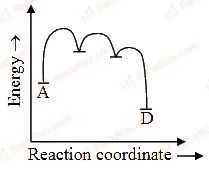
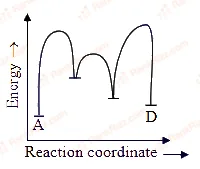
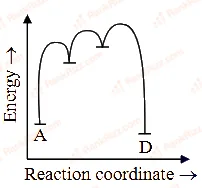
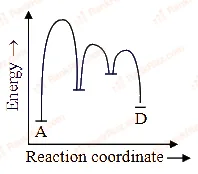
A→DA\rightarrow D is an endothermic reaction occurring in three steps ( elementary).
(i) A→B△Hi=+veA\rightarrow B \triangle H_{i}=+ve
(ii) B→C△Hii=−veB\rightarrow C \triangle H_{ii}=-ve
(iii) C→D△Hiii=−veC\rightarrow D \triangle H_{iii}=-ve
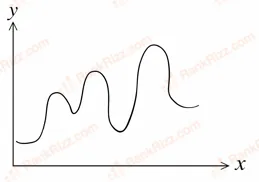
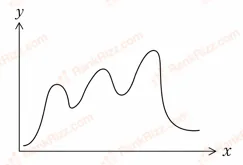
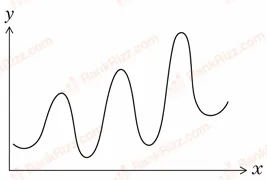
Which of the following graphs between potential energy (y-axis) vs reaction coordinate (x-axis) correctly represents the reaction profile of A-> D?

  1. A
    Figure for JEE Main 2026 Chemistry question on Rate law, order and molecularity
  2. B
    Figure for JEE Main 2026 Chemistry question on Rate law, order and molecularity
  3. C
    Figure for JEE Main 2026 Chemistry question on Rate law, order and molecularity
  4. D
    Figure for JEE Main 2026 Chemistry question on Rate law, order and molecularity
JEE MAIN 2025 · 04 APR S1Rate law, order and molecularityTRANSCRIBED

Rate law for a reaction between A and B is given by R=k[A]n[B]mR = k[A]^n[B]^m. If concentration of A is doubled and concentration of B is halved from their initial value, the ratio of new rate of reaction to the initial rate of reaction (r2r1)\left(\dfrac{r_2}{r_1}\right) is

  1. A

    2(n−m)2^{(n-m)}

  2. B

    (n−m)(n - m)

  3. C

    (m+n)(m + n)

  4. D

    12m+n\dfrac{1}{2^{m+n}}

JEE MAIN 2025 · 28 JAN S2Rate law, order and molecularityTRANSCRIBED

Consider an elementary reaction A(g)+B(g)→C(g)+D(g)A(g)+B(g)\rightarrow C(g)+D(g) If the volume of reaction mixture is suddenly reduced to 13\frac{1}{3} of its initial volume, the reaction rate will become 'x' times of the original reaction rate. The value of x is :

  1. A

    3

  2. B

    19\frac{1}{9}

  3. C

    9

  4. D

    13\frac{1}{3}

JEE MAIN 2025 · 29 JAN S1Rate law, order and molecularityTRANSCRIBED

The reaction A2+B2→2ABA_{2}+B_{2}\rightarrow 2AB follows the mechanism
A2k1A+A(fast)     k−1A+B2→k2AB+B(slow)A+B→AB(fast)A_{2}k_{1}A+A(fast)\\ \text{     }{_{k_{-1}}}\\ \\A+B_{2}\xrightarrow{k_{2}}AB+B(slow)\\A+B \rightarrow AB(fast)
The overall order of the reaction is :

  1. A

    2

  2. B

    2.5

  3. C

    3

  4. D

    1.5

JEE MAIN 2025 · 02 APR S2Rate law, order and molecularityTRANSCRIBED

Reactant A converts to product D through the given mechanism (with the net evolution of heat) :
A→BA \to B   slow ; ΔH=+ve\Delta H = +ve
B→CB \to C   fast ; ΔH=−ve\Delta H = -ve
C→DC \to D   fast ; ΔH=−ve\Delta H = -ve

Which of the following represents the above reaction mechanism ?

  1. A
    Figure for JEE Main 2025 Chemistry question on Rate law, order and molecularity
  2. B
    Figure for JEE Main 2025 Chemistry question on Rate law, order and molecularity
  3. C
    Figure for JEE Main 2025 Chemistry question on Rate law, order and molecularity
  4. D
    Figure for JEE Main 2025 Chemistry question on Rate law, order and molecularity
JEE MAIN 2025 · 02 APR S2Rate law, order and molecularityTRANSCRIBED

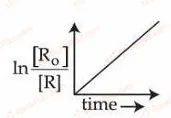
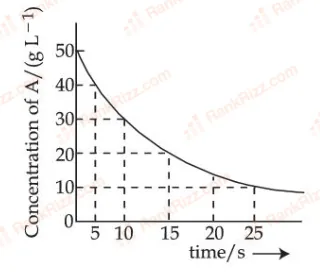
For the reaction A→BA \to B the following graph was obtained. The time required (in seconds) for the concentration of A to reduce to 2.5 g L−1^{-1} (if the initial concentration of A was 50 g L−1^{-1}) is _________.
(Nearest integer)
Given : log⁡2=0.3010\log 2 = 0.3010

Figure for JEE Main 2025 Chemistry question on Rate law, order and molecularity
JEE MAIN 2024 · 08 APR S2Rate law, order and molecularityTRANSCRIBED

For a reaction A→K1B→K2CA \xrightarrow{K_1} B \xrightarrow{K_2} C. If the rate of formation of BB is set to be zero then the concentration of BB is given by :

  1. A

    (K1+K2)[A](K_1 + K_2)[A]

  2. B

    (K1/K2)[A](K_1/K_2)[A]

  3. C

    (K1−K2)[A](K_1 - K_2)[A]

  4. D

    K1K2[A]K_1 K_2[A]

JEE MAIN 2024 · 30 JAN S2Rate law, order and molecularityTRANSCRIBED

NO2NO_2 required for a reaction is produced by decomposition of N2O5N_2O_5 in CCl4CCl_4 as by equation:
2N2O5(g)→4NO2(g)+O2(g)2N_2O_{5(g)} \rightarrow 4NO_{2(g)} + O_{2(g)}
The initial concentration of N2O5N_2O_5 is 3 mol L−1^{-1} and it is 2.75 mol L−1^{-1} after 30 minutes. The rate of formation of NO2NO_2 is x×10−3x \times 10^{-3} mol L−1^{-1} min−1^{-1}, value of xx is ________.

JEE MAIN 2024 · 05 APR S2Rate law, order and molecularityTRANSCRIBED

Consider the following single step reaction in gas phase at constant temperature. 2A(g)+B(g)→C(g)2A_{(g)} + B_{(g)} \rightarrow C_{(g)}. The initial rate of the reaction is recorded as r1r_1 when the reaction starts with 1.51.5 atm pressure of A and 0.70.7 atm pressure of B. After some time, the rate r2r_2 is recorded when the pressure of C becomes 0.50.5 atm. The ratio r1:r2r_1 : r_2 is ______ ×10−1\times 10^{-1}. (Nearest integer)

JEE MAIN 2023 · 11 APR S1Rate law, order and molecularityTRANSCRIBED

KClO3_3 + 6FeSO4_4 + 3H2_2SO4_4 →\to KCl + 3Fe2_2(SO4_4)3_3 + 3H2_2O
The above reaction was studied at 300 K by monitoring the concentration of FeSO4_4 in which initial concentration was 10 M and after half an hour became 8.8 M. The rate of production of Fe2_2(SO4_4)3_3 is _______ ×10−6\times 10^{-6} mol L−1^{-1} s−1^{-1} (Nearest integer)

JEE MAIN 2022 · 25 JUN S1Rate law, order and molecularityTRANSCRIBED

For a given chemical reaction γ1A+γ2B→γ3C+γ4D\gamma_1 A + \gamma_2 B \to \gamma_3 C + \gamma_4 D. Concentration of C changes from 1010 mmol dm−3^{-3} to 2020 mmol dm−3^{-3} in 1010 s. Rate of appearance of D is 1.51.5 times the rate of disappearance of B which is twice the rate of disappearance of A. The rate of appearance of D has been experimentally determined to be 99 mmol dm−3^{-3} s−1^{-1}. Therefore the rate of reaction is ______ mmol dm−3^{-3} s−1^{-1}. (Nearest Integer)

JEE MAIN 2021 · 27 JUL S1Rate law, order and molecularityTRANSCRIBED

For a reaction of order n, the unit of the rate constant is:

  1. A

    mol1−n L1−n smol^{1-n} \, L^{1-n} \, s

  2. B

    mol1−n L2n s−1mol^{1-n} \, L^{2n} \, s^{-1}

  3. C

    mol1−n Ln−1 s−1mol^{1-n} \, L^{n-1} \, s^{-1}

  4. D

    mol1−n L1−n s−1mol^{1-n} \, L^{1-n} \, s^{-1}

JEE MAIN 2021 · 27 AUG S1Rate law, order and molecularityTRANSCRIBED

The reaction that occurs in a breath analyser, a device used to determine the alcohol level in a person's blood stream is
2K2Cr2O7+8H2SO4+3C2H6O→2Cr2(SO4)3+3C2H4O2+2K2SO4+11H2O2K_2Cr_2O_7 + 8H_2SO_4 + 3C_2H_6O \rightarrow 2Cr_2(SO_4)_3 + 3C_2H_4O_2 + 2K_2SO_4 + 11H_2O
If the rate of appearance of Cr2(SO4)3Cr_2(SO_4)_3 is 2.67 mol min−1^{-1} at a particular time, the rate of disappearance of C2H6OC_2H_6O at the same time is _________ mol min−1^{-1}. (Nearest integer)

JEE MAIN 2021 · 26 AUG S2Rate law, order and molecularityTRANSCRIBED

The reaction rate for the reaction
[PtCl4]2−+H2O⇌[Pt(H2O)Cl3]−+Cl−[PtCl_4]^{2-} + H_2O \rightleftharpoons [Pt(H_2O)Cl_3]^- + Cl^-
was measured as a function of concentrations of different species. It was observed that
−d[PtCl4]2−dt=4.8×10⁻⁵[PtCl4]2−−2.4×10⁻³[Pt(H2O)Cl3]−][Cl−]\frac{-d[PtCl_4]^{2-}}{dt} = 4.8 \times 10^{-5}[PtCl_4]^{2-} - 2.4 \times 10^{-3}[Pt(H_2O)Cl_3]^-][Cl^-]
where square brackets are used to denote molar concentrations.
The equilibrium constant Kc_c = X (Nearest integer). Value of 1X\frac{1}{X} is _________ 
Kc=XK_c = X (Nearest integer)

JEE MAIN 2021 · 17 MAR S2Rate law, order and molecularityTRANSCRIBED

The reaction 2A+B2→2AB2A + B_2 \to 2AB is an elementary reaction. For a certain quantity of reactants, if the volume of the reaction vessel is reduced by a factor of 3, the rate of the reaction increases by a factor of ________. (Round off to the Nearest Integer).

JEE MAIN 2021 · 25 JUL S2Rate law, order and molecularityTRANSCRIBED

For a chemical reaction A →\rightarrow B, it was found that concentration of B is increased by 0.2 mol L−1^{-1} in 30 min. The average rate of the reaction is _________ ×10−1\times 10^{-1} mol L−1^{-1} h−1^{-1}. (in nearest integer)

JEE MAIN 2020 · 03 SEP S2Rate law, order and molecularityTRANSCRIBED

For the reaction 2A+3B+32C→3P2A + 3B + \frac{3}{2}C \to 3P, which statement is correct?

  1. A

    dnAdt=32dnBdt=34dnCdt\frac{dn_A}{dt} = \frac{3}{2}\frac{dn_B}{dt} = \frac{3}{4}\frac{dn_C}{dt}

  2. B

    dnAdt=dnBdt=dnCdt\frac{dn_A}{dt} = \frac{dn_B}{dt} = \frac{dn_C}{dt}

  3. C

    dnAdt=23dnBdt=43dnCdt\frac{dn_A}{dt} = \frac{2}{3}\frac{dn_B}{dt} = \frac{4}{3}\frac{dn_C}{dt}

  4. D

    dnAdt=23dnBdt=34dnCdt\frac{dn_A}{dt} = \frac{2}{3}\frac{dn_B}{dt} = \frac{3}{4}\frac{dn_C}{dt}