RankRizz

Integrated rate laws and half-life (zero and first order) — JEE Main Previous Year Questions

Every JEE Main question on Integrated rate laws and half-life (zero and first order), one of the ideas inside Chemical Kinetics: 85 questions from 2004–2026, 53 of them in the last five years. Newest first, answer key on every one. Free to read.

Questions

85

Years asked

18

Since

2004

Of the chapter

37%

Every Integrated rate laws and half-life (zero and first order) question

21–40 OF 85 · NEWEST FIRST

JEE MAIN 2025 · 04 APR S2Integrated rate laws and half-life (zero and first order)TRANSCRIBED

Half life of zero order reaction A→A \rightarrow product is 1 hour, when initial concentration of reaction is 2.0 mol L−1^{-1}. The time required to decrease concentration of A from 0.50 to 0.25 mol L−1^{-1} is:

  1. A

    0.5 hour

  2. B

    4 hour

  3. C

    15 min

  4. D

    60 min

JEE MAIN 2025 · 23 JAN S1Integrated rate laws and half-life (zero and first order)TRANSCRIBED

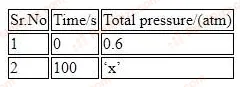
For the thermal decomposition of N2O5(g)N_{2}O_{5}(g) at constant volume, the following table can be formed, for the reaction mentioned below. 2N2O5(g)→2N2O4(g)+O2(g)2 N_{2}O_{5}(g)\rightarrow 2 N_{2}O_{4}(g)+O_{2}(g)
x=....×10−3x= .... \times 10^{-3} atm [nearest integer] Given : Rate constant for the reaction is 4.606×10⁻²s−1.4.606 \times 10^{-2} s^{-1}.

page12_img2
JEE MAIN 2025 · 02 APR S1Integrated rate laws and half-life (zero and first order)TRANSCRIBED

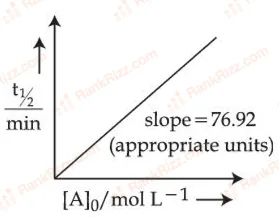
For the reaction A→A \rightarrow products.

Figure for JEE Main 2025 Chemistry question on Integrated rate laws and half-life (zero and first order)

The concentration of A at 10 minutes is _______ ×10−3\times 10^{-3} mol L−1^{-1}. (nearest integer).

The reaction was started with 2.5 mol L−1^{-1} of A.

JEE MAIN 2024 · 31 JAN S1Integrated rate laws and half-life (zero and first order)TRANSCRIBED

Integrated rate law equation for a first order gas phase reaction is given by (where PiP_i is initial pressure and PtP_t is total pressure at time tt)

  1. A

    k=2.303t×log⁡Pi2Pi−Ptk = \frac{2.303}{t} \times \log\frac{P_i}{2P_i - P_t}

  2. B

    k=2.303t×log⁡2Pi2Pi−Ptk = \frac{2.303}{t} \times \log\frac{2P_i}{2P_i - P_t}

  3. C

    k=2.303t×log⁡2Pi−PtPik = \frac{2.303}{t} \times \log\frac{2P_i - P_t}{P_i}

  4. D

    k=2.303t×Pi2Pi−Ptk = \frac{2.303}{t} \times \frac{P_i}{2P_i - P_t}

JEE MAIN 2024 · 06 APR S2Integrated rate laws and half-life (zero and first order)TRANSCRIBED

Consider the two different first order reactions given below A+B→CA + B \rightarrow C (Reaction 1) P→QP \rightarrow Q (Reaction 2). The ratio of the half life of Reaction 1 : Reaction 2 is 5:25 : 2. If t1t_1 and t2t_2 represent the time taken to complete 23rd\frac{2}{3}^{rd} and 45th\frac{4}{5}^{th} of Reaction 1 and Reaction 2, respectively, then the value of the ratio t1:t2t_1 : t_2 is ___________ ×10−1\times 10^{-1} (nearest integer). [Given : log⁡10(3)=0.477\log_{10}(3) = 0.477 and log⁡10(5)=0.699\log_{10}(5) = 0.699]

JEE MAIN 2024 · 31 JAN S2Integrated rate laws and half-life (zero and first order)TRANSCRIBED

r=kAr = kA for a reaction, 50% of A is decomposed in 120 minutes. The time taken for 90% decomposition of A is ______ minutes.

JEE MAIN 2024 · 04 APR S2Integrated rate laws and half-life (zero and first order)TRANSCRIBED

Consider the following reaction, the rate expression of which is given below: 

A+B→CA + B \rightarrow C, rate=k[A]1/2[B]1/2= k[A]^{1/2}[B]^{1/2}.
The reaction is initiated by taking concentration of 11M of AA and BB each. If the rate constant (k)(k) is 4.6×10−24.6 \times 10^{-2} s−1^{-1}, then the time taken for AA to become 0.10.1M is ______ sec. (nearest integer)

JEE MAIN 2024 · 06 APR S1Integrated rate laws and half-life (zero and first order)TRANSCRIBED

Time required for 99.9% completion of a first order reaction is _______ times the time required for completion of 90% reaction. (nearest integer)

JEE MAIN 2024 · 09 APR S2Integrated rate laws and half-life (zero and first order)TRANSCRIBED

Consider the following first order gas phase reaction at constant temperature A(g)→2B(g)+C(g)A(g) \to 2B(g) + C(g). If the total pressure of the gases is found to be 200 torr after 23 sec. and 300 torr upon the complete decomposition of A after a very long time, then the rate constant of the given reaction is ______ ×10−2 s−1\times 10^{-2} \text{ s}^{-1} (nearest integer) [Given : log⁡10(2)=0.301\log_{10}(2) = 0.301]

JEE MAIN 2024 · 01 FEB S2Integrated rate laws and half-life (zero and first order)TRANSCRIBED

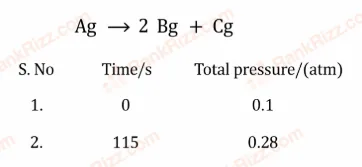
The following data were obtained during the first order thermal decomposition of a gas A at constant volume:

Figure for JEE Main 2024 Chemistry question on Integrated rate laws and half-life (zero and first order)


The rate constant of the reaction is ______ ×10−2 s−1\times 10^{-2} \text{ s}^{-1} (nearest integer)

JEE MAIN 2024 · 27 JAN S2Integrated rate laws and half-life (zero and first order)TRANSCRIBED

Time required for completion of 99.9% of first order reaction is _____ times of half life (t1/2t_{1/2}) of the reaction

JEE MAIN 2024 · 30 JAN S1Integrated rate laws and half-life (zero and first order)TRANSCRIBED

The rate of first order reaction is 0.04 mol L−1s−10.04 \text{ mol L}^{-1} \text{s}^{-1} at 1010 minutes and 0.03 mol L−1s−10.03 \text{ mol L}^{-1} \text{s}^{-1} at 2020 minutes after initiation. Half life of the reaction is ______ minutes. (Given log⁡2=0.3010\log 2 = 0.3010, log⁡3=0.4771\log 3 = 0.4771)
Round off your answer to the nearest integer.

JEE MAIN 2023 · 06 APR S2Integrated rate laws and half-life (zero and first order)TRANSCRIBED

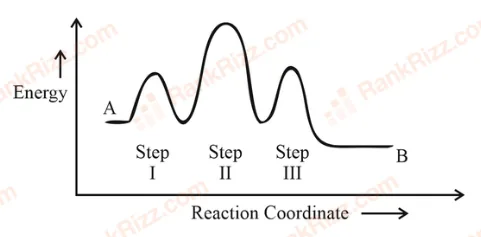
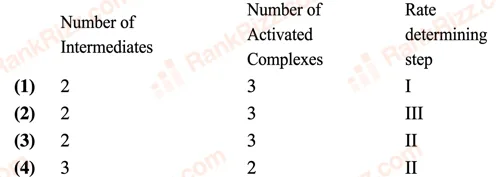
Consider the following reaction that goes from A to B in three steps as shown below:

Figure for JEE Main 2023 Chemistry question on Integrated rate laws and half-life (zero and first order)


Choose the correct option

Figure for JEE Main 2023 Chemistry question on Integrated rate laws and half-life (zero and first order)
  1. A

    (1)

  2. B

    (2)

  3. C

    (3)

  4. D

    (4)

JEE MAIN 2023 · 25 JAN S2Integrated rate laws and half-life (zero and first order)TRANSCRIBED

A first order reaction has the rate constant, k = 4.6 ×10⁻³\times 10^{-3} s−1^{-1}. The number of correct statement/s from the following is/are Given: log 3 = 0.48.
A. Reaction completes in 1000 s.
B. The reaction has a half-life of 500 s.
C. The time required for 10% completion is 25 times the time required for 90% completion.
D. The degree of dissociation is equal to (1−e−kt)(1 - e^{-kt}).
E. The rate and the rate constant have the same unit.

JEE MAIN 2023 · 01 FEB S2Integrated rate laws and half-life (zero and first order)TRANSCRIBED

A→B\text{A} \to \text{B}
The above reaction is of zero order. Half life of this reaction is 5050 min. The time taken for the concentration of A to reduce to one-fourth of its initial value is ______ min. (Nearest integer)

JEE MAIN 2023 · 25 JAN S1Integrated rate laws and half-life (zero and first order)TRANSCRIBED

For the first order reaction A →\to B the half life is 30 min. The time taken for 75% completion of the reaction is _____ min. (Nearest integer)
Given: log 2 = 0.3010
log 3 = 0.4771
log 5 = 0.6989

JEE MAIN 2023 · 30 JAN S2Integrated rate laws and half-life (zero and first order)TRANSCRIBED

An organic compound undergoes first order decomposition. If the time taken for the 60%60\% decomposition is 540540 s, then the time required for 90%90\% decomposition will be ______ s. (Nearest integer).
Given: ln⁡10=2.3\ln 10 = 2.3; log⁡2=0.3\log 2 = 0.3

JEE MAIN 2023 · 31 JAN S2Integrated rate laws and half-life (zero and first order)TRANSCRIBED

The rate constant for a first order reaction is 20 min−1^{-1}. The time required for the initial concentration of the reactant to reduce to its 132\dfrac{1}{32} level is ______ ×10−2\times 10^{-2} min. (Nearest integer)

JEE MAIN 2023 · 30 JAN S1Integrated rate laws and half-life (zero and first order)TRANSCRIBED

If compound A reacts with B following first order kinetics with rate constant 2.011×10−32.011 \times 10^{-3} s−1^{-1}. The time taken by A (in seconds) to reduce from 77 g to 22 g will be ______. (Nearest Integer)
log5 = 0.698, log7 = 0.845, log2 = 0.301

JEE MAIN 2023 · 01 FEB S1Integrated rate laws and half-life (zero and first order)TRANSCRIBED

A and B are two substances undergoing radioactive decay in a container. The half life of A is 15 min and that of B is 5 min. If the initial concentration of B is 4 times that of A and they both start decaying at the same time, how much time will it take for the concentration of both of them to be same? _____ min.