RankRizz
JEE MAIN 2026 · 04 APR S2+4 / −1EASYTRANSCRIBED

JEE Main 2026 Chemistry question — Integrated rate laws and half-life (zero and first order)

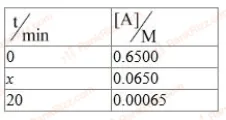
For a first order reaction A →\to B

Figure for JEE Main 2026 Chemistry question on Integrated rate laws and half-life (zero and first order)

xx = _________ min. (Nearest integer)

SOLUTION

For a first-order reaction the integrated rate law is
ln⁡ ⁣([A]0[A])=kt\ln\!\left(\frac{[A]_0}{[A]}\right)=kt

Here [A]0=0.6500 M[A]_0=0.6500\text{ M} at t=0t=0.
We first evaluate the rate constant kk using the data at t=20 mint=20\ \text{min},
[A]=0.00065 M[A]=0.00065\text{ M}.

ln⁡ ⁣(0.65000.00065)=k(20)\ln\!\left(\frac{0.6500}{0.00065}\right)=k(20)

Since
0.65000.00065=1000\dfrac{0.6500}{0.00065}=1000, and
ln⁡(1000)=ln⁡(103)=3ln⁡10=3(2.302585)=6.907755\ln(1000)=\ln(10^3)=3\ln10=3(2.302585)=6.907755,
we get
k=6.90775520=0.3454 min−1k=\frac{6.907755}{20}=0.3454\ \text{min}^{-1}

Next, let xx be the time (in minutes) when [A]=0.0650 M[A]=0.0650\text{ M}.
Applying the same rate law:

ln⁡ ⁣(0.65000.0650)=k x\ln\!\left(\frac{0.6500}{0.0650}\right)=k\,x

The ratio is 0.65000.0650=10\dfrac{0.6500}{0.0650}=10, hence ln⁡10=2.302585\ln10=2.302585.
Therefore
x=ln⁡10k=2.3025850.3454=6.67 minx=\frac{\ln10}{k}=\frac{2.302585}{0.3454}=6.67\ \text{min}

Rounding to the nearest whole number gives x≈7 minutesx\approx7\ \text{minutes}.

Final Answer: 7

Tagged Integrated rate laws and half-life (zero and first order). Machine-assigned, so read it as a strong shortlist rather than a verdict.

SubjectChemistry
TopicIntegrated rate laws and half-life (zero and first order)
TypeNumerical answer