RankRizz

Integrated rate laws and half-life (zero and first order) — JEE Main Previous Year Questions

Every JEE Main question on Integrated rate laws and half-life (zero and first order), one of the ideas inside Chemical Kinetics: 85 questions from 2004–2026, 53 of them in the last five years. Newest first, answer key on every one. Free to read.

Questions

85

Years asked

18

Since

2004

Of the chapter

37%

Every Integrated rate laws and half-life (zero and first order) question

61–80 OF 85 · NEWEST FIRST

JEE MAIN 2021 · 16 MAR S2Integrated rate laws and half-life (zero and first order)TRANSCRIBED

A and B decompose via first order kinetics with half-lives 54.0 min and 18.0 min respectively. Starting from an equimolar non-reactive mixture of A and B, the time taken for the concentration of A to become 16 times that of B is ________ min. (Round off to the Nearest Integer).
JEE MAIN 2021 · 17 MAR S1Integrated rate laws and half-life (zero and first order)TRANSCRIBED

For a certain first order reaction 32% of the reactant is left after 570 s. The rate constant of this reaction is ________ ×10−3\times 10^{-3} s−1^{-1}. (Round off to the Nearest Integer).
[Given: log⁡102=0.301\log_{10} 2 = 0.301, ln⁡10=2.303\ln 10 = 2.303]

JEE MAIN 2021 · 27 JUL S2Integrated rate laws and half-life (zero and first order)TRANSCRIBED

For the first order reaction A →\rightarrow 2B, 1 mole of reactant A gives 0.2 moles of BB after 100 minutes. The half life of the reaction is _________ min. (Round off to nearest integer).
[Use:ln2=0.69,ln10=2.3Use: ln 2 = 0.69, ln 10 = 2.3
Properties of logarithms: ln⁡xy=yln⁡x\ln x^y = y \ln x
ln⁡(xy)=ln⁡x−ln⁡y\ln\left(\frac{x}{y}\right)=\ln x-\ln y]
(Round off to the nearest integer)

JEE MAIN 2021 · 22 JUL S1Integrated rate laws and half-life (zero and first order)TRANSCRIBED

N2_2O5(g)→_{5(g)} \to 2NO2(g)_{2(g)} + 12\frac{1}{2}O2(g)_{2(g)}
In the above first order reaction the initial concentration of N2_2O5_5 is 2.40×10−22.40 \times 10^{-2} mol L−1^{-1} at 318 K. The concentration of N2_2O5_5 after 1 hour was 1.60×10−21.60 \times 10^{-2} mol L−1^{-1}. The rate constant of the reaction at 318 K is ___ ×10−3\times 10^{-3} min−1^{-1} (Nearest integer):
[Given : log 3 = 0.477, log 5 = 0.699]

JEE MAIN 2021 · 24 FEB S1Integrated rate laws and half-life (zero and first order)TRANSCRIBED

Gaseous cyclobutene isomerizes to butadiene in a first order process which has a 'K' value of 3.3×10−43.3 \times 10^{-4} s−1^{-1} at 153°C. The time in minutes it takes for the isomerization to proceed 40% to completion at this temperature is ______ (Rounded off to the nearest integer)

JEE MAIN 2020 · 05 SEP S1Integrated rate laws and half-life (zero and first order)TRANSCRIBED

A flask contains a mixture of compounds A and B. Both compounds decompose by first-order kinetics. The half-lives for A and B are 300 s300\,\text{s} and 180 s180\,\text{s}, respectively. If the concentrations of A and B are equal initially, the time required for the concentration of A to be four times that of B (in s) is: (Use ln⁡2=0.693\ln 2 = 0.693)

  1. A

    180

  2. B

    900

  3. C

    300

  4. D

    120

JEE MAIN 2020 · 03 SEP S1Integrated rate laws and half-life (zero and first order)TRANSCRIBED

It is true that:

  1. A

    A second order reaction is always a multistep reaction

  2. B

    A zero order reaction is a multi-step reaction

  3. C

    A first order reaction is always a single step reaction

  4. D

    A zero order reaction is a single step reaction

JEE MAIN 2020 · 04 SEP S1Integrated rate laws and half-life (zero and first order)TRANSCRIBED

If 75% of a first order reaction was completed in 90 minutes, 60% of the same reaction would be completed in approximately (in minutes) __________ (Take: log 2 = 0.30; log 2.5 = 0.40)

JEE MAIN 2019 · 10 APR S1Integrated rate laws and half-life (zero and first order)TRANSCRIBED

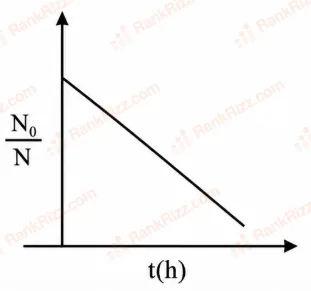
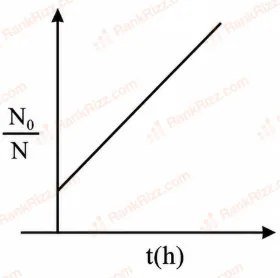
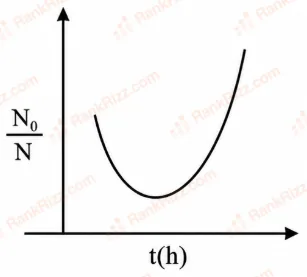
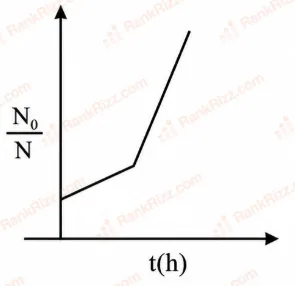
A bacterial infection in an internal wound grows as N'(t) = N0_0exp(t), where the time t is in hours. A dose of antibiotic, taken orally, needs 1 hour to reach the wound. Once it reaches there, the bacterial population goes down as dNdt=−5N2\frac{dN}{dt} = -5N^2. What will be the plot of N0N\frac{N_0}{N} vs t after 1 hour?

  1. A
    Figure for JEE Main 2019 Chemistry question on Integrated rate laws and half-life (zero and first order)
  2. B
    Figure for JEE Main 2019 Chemistry question on Integrated rate laws and half-life (zero and first order)
  3. C
    Figure for JEE Main 2019 Chemistry question on Integrated rate laws and half-life (zero and first order)
  4. D
    Figure for JEE Main 2019 Chemistry question on Integrated rate laws and half-life (zero and first order)
JEE MAIN 2019 · 11 JAN S2Integrated rate laws and half-life (zero and first order)TRANSCRIBED

The reaction 2X→B2X \to B is a zeroth order reaction. If the initial concentration of X is 0.2M, the half-life is 6 h. When the initial concentration of X is 0.5M, the time required to reach its final concentration of 0.2M will be

  1. A

    9.0 h

  2. B

    12.0 h

  3. C

    18.0 h

  4. D

    7.2 h

JEE MAIN 2019 · 09 APR S1Integrated rate laws and half-life (zero and first order)TRANSCRIBED

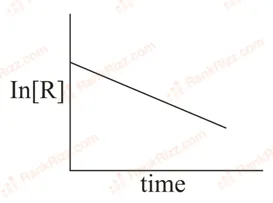
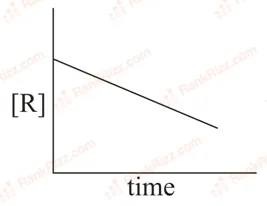
The given plots represent the variation of the concentration of a reactant R with time for two different reactions (i) and (ii). The respective orders of the reaction are:

Figure for JEE Main 2019 Chemistry question on Integrated rate laws and half-life (zero and first order) Figure for JEE Main 2019 Chemistry question on Integrated rate laws and half-life (zero and first order)
  1. A

    1, 1

  2. B

    0, 1

  3. C

    1, 0

  4. D

    0, 2

JEE MAIN 2019 · 12 JAN S1Integrated rate laws and half-life (zero and first order)TRANSCRIBED

Decomposition of X exhibits a rate constant of 0.05 μ\mug/year. How many years are required for the decomposition of 5 μ\mug of X into 2.5 μ\mug?

  1. A

    20

  2. B

    40

  3. C

    25

  4. D

    50

JEE MAIN 2018 · 16 APR ONLINEIntegrated rate laws and half-life (zero and first order)TRANSCRIBED

If 50% of a reaction occurs in 100 second and 75% of the reaction occurs in 200 second, the order of this reaction is:

  1. A

    2

  2. B

    3

  3. C

    Zero

  4. D

    1

JEE MAIN 2018 · 15 APR S2Integrated rate laws and half-life (zero and first order)TRANSCRIBED

For a first order reaction, A →\rightarrow P, t1/2_{1/2} (half-life) is 10 days. The time required for 14\frac{1}{4}th conversion of A (in days) is: (ln 2 = 0.693, ln 3 = 1.1)

  1. A

    3.2

  2. B

    2.5

  3. C

    4.1

  4. D

    5

JEE MAIN 2018 · 15 APR S1Integrated rate laws and half-life (zero and first order)TRANSCRIBED

N2_2O5_5 decomposes to NO2_2 and O2_2 and follows first order kinetics. After 50 minutes, the pressure inside the vessel increases from 50 mm Hg to 87.5 mm Hg. The pressure of the gaseous mixture after 100 minutes at constant temperature will be:

  1. A

    136.25 mm Hg

  2. B

    106.25 mm Hg

  3. C

    175.0 mm Hg

  4. D

    116.25 mm Hg

JEE MAIN 2016 · 03 APR OFFLINEIntegrated rate laws and half-life (zero and first order)TRANSCRIBED

Decomposition of H2O2H_2O_2 follows a first order reaction. In fifty minutes the concentration of H2O2H_2O_2 decreases from 0.5 to 0.125 M in one such decomposition. When the concentration of H2O2H_2O_2 reaches 0.05 M, the rate of formation of O2O_2 will be:

  1. A

    2.662.66 L min−1^{-1} at STP

  2. B

    1.34×10−21.34 \times 10^{-2} mol min−1^{-1}

  3. C

    6.93×10−26.93 \times 10^{-2} mol min−1^{-1}

  4. D

    6.93×10−46.93 \times 10^{-4} mol min−1^{-1}

JEE MAIN 2015 · 04 APR OFFLINEIntegrated rate laws and half-life (zero and first order)TRANSCRIBED

Higher order (>3) reactions are rare due to:

  1. A

    Loss of active species on collision.

  2. B

    Low probability of simultaneous collision of all the reacting species.

  3. C

    Increase in entropy and activation energy as more molecules are involved.

  4. D

    Shifting of equilibrium towards reactants due to elastic collisions.

JEE MAIN 2015 · 10 APR ONLINEIntegrated rate laws and half-life (zero and first order)TRANSCRIBED

The reaction 2N2O5(g)→4NO2(g)+O2(g)2N_2O_5(g) \rightarrow 4NO_2(g) + O_2(g) follows first order kinetics. The pressure of a vessel containing only N2O5N_2O_5 was found to increase from 50 mm Hg to 87.5 mm Hg in 30 min. The pressure exerted by the gases after 60 min. will be (Assume temperature remains constant):

  1. A

    106.25 mm Hg

  2. B

    125 mm Hg

  3. C

    116.25 mm Hg

  4. D

    150 mm Hg

JEE MAIN 2014 · 09 APR ONLINEIntegrated rate laws and half-life (zero and first order)TRANSCRIBED

The half-life period of a first-order reaction is 15 minutes. The amount of substance left after one hour will be:

  1. A

    116\frac{1}{16} of the original amount

  2. B

    18\frac{1}{8} of the original amount

  3. C

    132\frac{1}{32} of the original amount

  4. D

    14\frac{1}{4} of the original amount

JEE MAIN 2013 · 23 APR ONLINEIntegrated rate laws and half-life (zero and first order)TRANSCRIBED

The rate constant of a zero order reaction is 2.0×10−22.0 \times 10^{-2} mol L−1^{-1} s−1^{-1}. If the concentration of the reactant after 25 seconds is 0.5M. What is the initial concentration?

  1. A

    0.5M

  2. B

    1.25M

  3. C

    12.5M

  4. D

    1.0M