RankRizz
JEE MAIN 2025 · 07 APR S2+4 / −1MEDIUMTRANSCRIBED

JEE Main 2025 Chemistry question — Integrated rate laws and half-life (zero and first order)

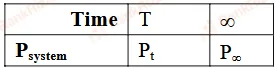
A(g)→B(g)+C(g)A(g) \to B(g) + C(g) is a first order reaction.

Figure for JEE Main 2025 Chemistry question on Integrated rate laws and half-life (zero and first order)

The reaction was started with reactant A only. Which of the following expression is correct for rate constant k?

SOLUTION

For the gas-phase decomposition A(g)→B(g)+C(g)A(g) \rightarrow B(g)+C(g) at constant temperature and volume, the total pressure is directly proportional to the total number of moles present at any instant.

Let the reaction start with aa moles of AA and no BB or CC.
At time tt, let xx moles of AA decompose.

Moles present at time tt:
A:a−xA : a-x
B:xB : x
C:xC : x

Total moles at time tt are nt=a−x+x+x=a+xn_t = a-x + x + x = a + x.

If f=RTVf = \dfrac{RT}{V} (a common proportionality factor), then

initial pressure, P0=faP_0 = f a,
pressure at time tt, Pt=f(a+x)=P0+fxP_t = f (a + x) = P_0 + f x −(1)-(1)

From (1)(1), x=Pt−P0fx = \dfrac{P_t - P_0}{f} −(2)-(2)

When the reaction goes to completion (t→∞t \rightarrow \infty), x=ax = a.
Total moles then are a+a=2aa + a = 2a, so the final pressure is

P∞=f(2a)=2P0P_{\infty} = f(2a) = 2 P_0 ⟹P0=P∞2\Longrightarrow P_0 = \dfrac{P_{\infty}}{2} −(3)-(3)

The first-order rate law is k=1tln⁡initial concentration of Aconcentration of A at time tk = \dfrac{1}{t} \ln \dfrac{\text{initial concentration of }A}{\text{concentration of }A\text{ at time }t}, i.e.

k=1tln⁡aa−xk = \dfrac{1}{t} \ln \dfrac{a}{a - x} −(4)-(4)

Using (2)(2), a−x=P0f−Pt−P0f=2P0−Ptfa - x = \dfrac{P_0}{f} - \dfrac{P_t - P_0}{f} = \dfrac{2P_0 - P_t}{f}.

Thus,
aa−x=P0f2P0−Ptf=P02P0−Pt\dfrac{a}{a - x} = \dfrac{\dfrac{P_0}{f}}{\dfrac{2P_0 - P_t}{f}} = \dfrac{P_0}{2P_0 - P_t} −(5)-(5)

Substitute P0=P∞2P_0 = \dfrac{P_{\infty}}{2} from (3)(3) into (5)(5):

aa−x=P∞2P∞−Pt=P∞2(P∞−Pt)\dfrac{a}{a - x} = \dfrac{\dfrac{P_{\infty}}{2}}{P_{\infty} - P_t} = \dfrac{P_{\infty}}{2(P_{\infty} - P_t)} −(6)-(6)

Insert (6)(6) into the rate law (4)(4):

k=1tln⁡[P∞2(P∞−Pt)]k = \dfrac{1}{t} \ln \left[ \dfrac{P_{\infty}}{2(P_{\infty} - P_t)} \right]

This matches Option C.

Hence, the correct expression for the first-order rate constant is
Case C:   k=1tln⁡p∞2(p∞−Pt)\;k = \dfrac{1}{t} \ln \dfrac{p_{\infty}}{2(p_{\infty} - P_t)}.

Tagged Integrated rate laws and half-life (zero and first order). Machine-assigned, so read it as a strong shortlist rather than a verdict.

SubjectChemistry
TopicIntegrated rate laws and half-life (zero and first order)
TypeMultiple choice