JEE MAIN 2026 · 24 JAN S2+4 / −1MEDIUMTRANSCRIBED
JEE Main 2026 Chemistry question — Distinguishing tests for aldehydes and ketones
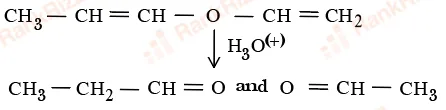
The unsaturated ether On acidic hydrolysis produces carbonyl compom1ds as shown below:-
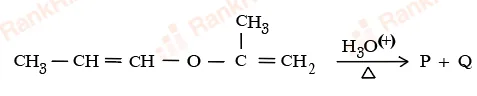
Based On this, predict the solution/reagent that will help to distillguish "P" and "Q" obtained in the following reaction:-
SOLUTION
1. Hydrolysis Reaction
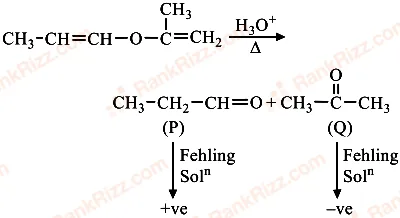
Acidic hydrolysis of the unsaturated vinyl ether cleaves the oxygen-carbon bonds, converting both enol fragments into their stable tautomeric carbonyl forms:
- The left portion () hydrolyzes and tautomerizes to form propanal (an aldehyde):
- The right portion () hydrolyzes and tautomerizes to form acetone (a ketone):
2. Option Analysis
- Fehling's Solution (Option B):
- Reaction with P (Propanal): Reduces Fehling's reagent, yielding a characteristic red precipitate ().
- Reaction with Q (Acetone): Ketones do not reduce Fehling's solution.
- Can distinguish P and Q.
- 2,4-DNP Reagent (Option A):
- Reacts positively with both aldehydes and ketones to produce yellow, orange, or red precipitates of 2,4-dinitrophenylhydrazones.
- Cannot distinguish P and Q.
- Saturated Solution (Option C):
- Forms white crystalline bisulfite addition products with both aliphatic aldehydes (propanal) and methyl ketones (acetone).
- Cannot distinguish P and Q.
- Lucas Reagent (Option D):
- Used to classify primary, secondary, and tertiary alcohols based on cloudiness/turbidity rates; it does not react with carbonyl compounds.
- Cannot distinguish P and Q.
Conclusion:
Because Fehling's solution reacts selectively with aliphatic aldehydes (propanal) and not ketones (acetone), it is the correct reagent to distinguish the two products.
Answer: Option B — Fehling solution
Tagged Distinguishing tests for aldehydes and ketones. Machine-assigned, so read it as a strong shortlist rather than a verdict.