JEE Main 2026 Chemistry question — Distinguishing tests for aldehydes and ketones
Given below are the four isomeric compounds (P, Q, R, S)
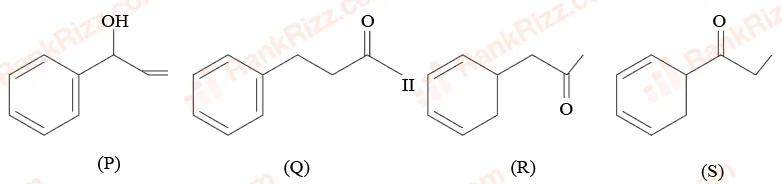
Identify correct statements from below
A. Q, R and S will give precipitate with 2, 4 - DNP.
B. P and Q will give positive Bayer's test.
C. Q and R will give sooty flame.
D. Rand S will give yellow precipitate with .
E. Q alone will deposit silver with Tollen's reagent.
Choose the correct option.
SOLUTION
From the structures supplied in the question one can recognise the following functional groups present in the four isomeric compounds.
P : contains a carbon-carbon double bond but no group (it is an alkene / unsaturated alcohol).
Q : contains an aldehydic group.
R : contains a ketonic group (no present).
S : contains a (methyl-ketone) group.
Case 1: Reaction with 2,4-dinitrophenylhydrazine (2,4-DNP)
Only compounds that possess a carbonyl group give the orange-red 2,4-DNP precipitate. Hence Q, R and S will respond, whereas P will not. Statement A is CORRECT.
Case 2: Baeyer’s test (alkaline )
Baeyer’s reagent is decolourised only by compounds that possess unsaturation ( or ). Out of the four isomers, the double bond is present only in P. Q is a saturated aldehyde, so it does not decolourise the reagent. Therefore P alone, not “P and Q”, will give a positive test. Statement B is INCORRECT.
Case 3: Nature of flame on ignition
Substances having a high carbon-to-hydrogen ratio (for example aromatic systems or highly conjugated ketones) burn with a sooty flame. Q and R show this behaviour, whereas P (small aliphatic molecule) and S (methyl-ketone with lower C : H ratio) do not. Hence Statement C is CORRECT.
Case 4: Iodoform test ()
The iodoform reaction is given only by compounds that contain the group (or can be oxidised to it). That group is present in S only; R lacks the requisite -methyl carbon. Thus a yellow precipitate of is obtained from S alone, not from “R and S”. Statement D is INCORRECT.
Case 5: Tollens’ test
Tollens’ reagent is reduced exclusively by aldehydes under ordinary conditions. Because only Q carries an aldehydic group, it alone will give the silver-mirror test. Statement E is CORRECT.
Hence the statements that are true are A, C and E.
Therefore, the correct answer is:
Option C which is: A, C and E only.
Tagged Distinguishing tests for aldehydes and ketones. Machine-assigned, so read it as a strong shortlist rather than a verdict.