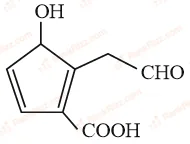
JEE MAIN 2026Preparation of aldehydes and ketonesTRANSCRIBED
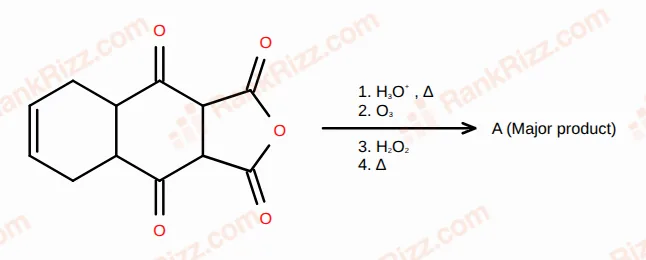
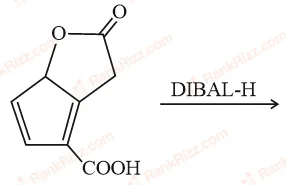
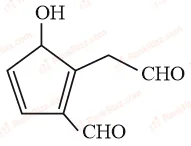
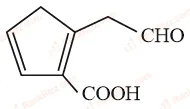
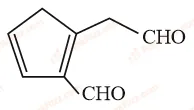
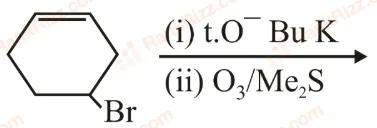
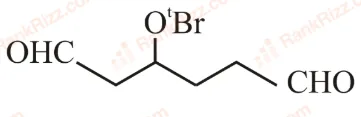
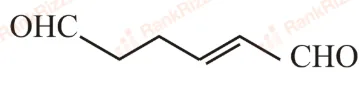
The ratio of number of keto groups to the number of carbons in the major product is:
- A
3 : 1
- B
3 : 8
- C
1 : 3
- D
2 : 3
Every JEE Main question on Preparation of aldehydes and ketones, one of the ideas inside Aldehydes and Ketones: 25 questions from 2007–2026, 11 of them in the last five years. Newest first, answer key on every one. Free to read.
Questions
25
Years asked
12
Since
2007
Of the chapter
12%
Questions on Preparation of aldehydes and ketones in each year it was asked.
1–20 OF 25 · NEWEST FIRST
The ratio of number of keto groups to the number of carbons in the major product is:
3 : 1
3 : 8
1 : 3
2 : 3
Match List - I with List - II.
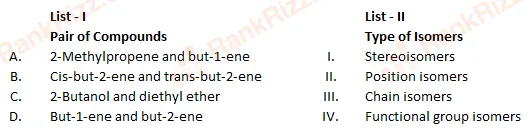
Choose the correct answer from the options given below :
A-III, B-I, C-IV, D-II
A-III, B-I, C-II, D-IV
A-II, B-I, C-IV, D-III
A-I, B-IV, C-III, D-II
In the given reactions identify the reagent and reagent
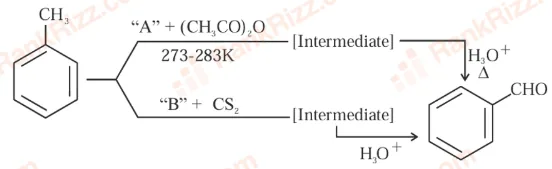
,
,
,
,
Identify A and B in the following sequence of reaction:
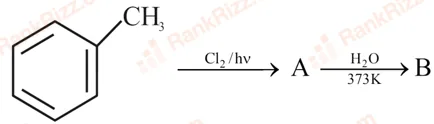
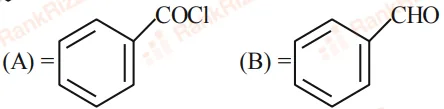
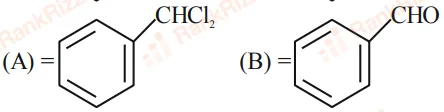
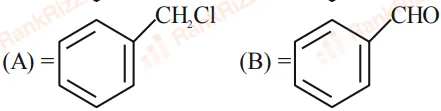
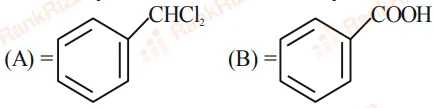
Identify major product 'P' formed in the following reaction:
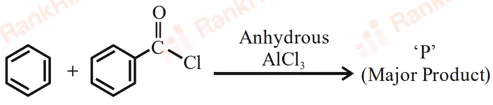
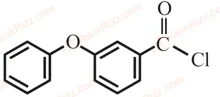
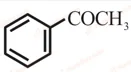
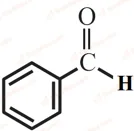
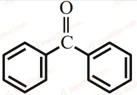
Identify major product "X" formed in the following reaction :
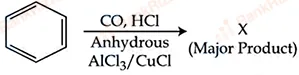
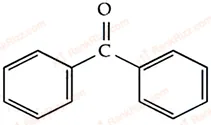
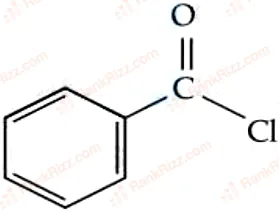
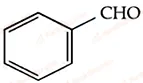
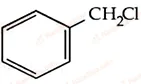
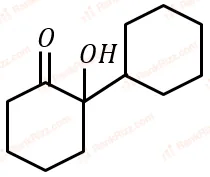
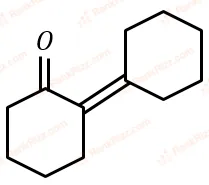
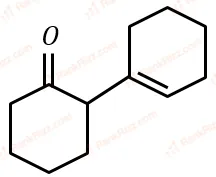
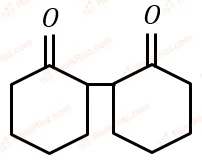
Cyclohexylamine when treated with nitrous acid yields (P). On treating (P) with PCC results in (Q). When (Q) is heated with dil. NaOH we get (R). The final product (R) is:
(1) 
(2) 
(3) 
(4) 
Structure (1)
Structure (2)
Structure (3)
Structure (4)
A trisubstituted compound 'A', CHO gives neutral FeCl test positive. Treatment of compound 'A' with NaOH and CHBr gives CHO, with hydroiodic acid gives methyl iodide and with hot conc. NaOH gives a compound B, CHO. Compound 'A' also decolourises alkaline KMnO. The number of bond/s present in the compound 'A' is ______.
'A' and 'B' respectively are
A Ethane-1,2-dicarbaldehyde + Glyoxal/Oxaldehyde
B 5-oxohexanal
1-methylcyclohex-1,3-diene & cyclopentene
Cyclohex-1,3-diene & cyclopentene
Cyclohex-1,3-diene & 1-methylcyclopent-1-ene
1-methylcyclohex-1,4-diene & 1-methylcyclopent-1-ene
Which one of the following reactions does not represent correct combination of substrate and product under the given conditions?
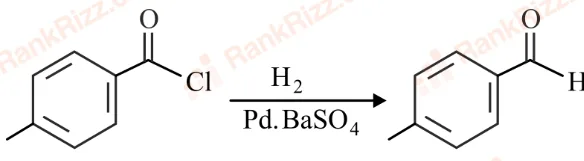
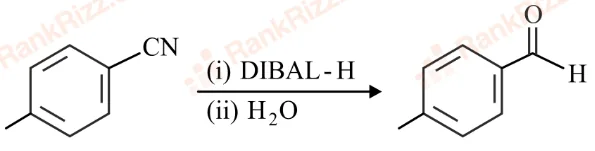
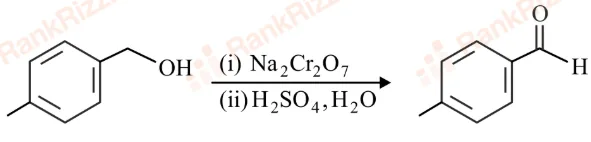
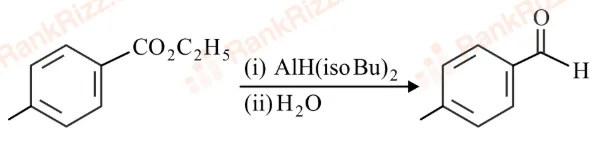
Match List-I with List-II.
| List-I | List-II |
|---|---|
A
 | I. Gatterman Koch reaction |
B
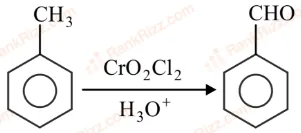 | II. Etard reaction |
C
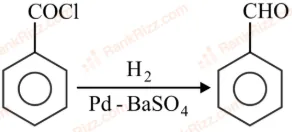 | III. Stephen reaction |
D
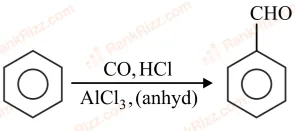 | IV. Rosenmund reaction |
A-IV, B-III, C-II, D-I
A-I, B-II, C-III, D-IV
A-II, B-III, C-IV, D-I
A-III, B-II, C-I, D-IV
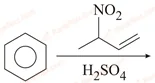
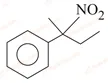
The major product of the following reaction is:

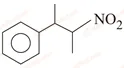
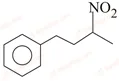
Which one of the following reactions will not form acetaldehyde?
>
>
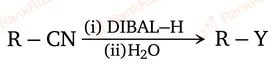
Consider the above reaction and identify "Y"
In the following reaction A is:
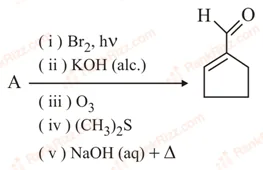


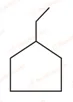
The correct match between Item-I (starting material) and Item-II (reagent) for the preparation of benzaldehyde is:
Item-I Item-II
(I) Benzene (P) HCl and ,
(II) Benzonitrile (Q) , , S and quinoline
(III) Benzoyl Chloride (R) Co, HCl and
(I)-(Q), (II)-(R) and (III)-(P)
(I)-(P), (II)-(Q) and (III)-(R)
(I)-(R), (II)-(P) and (III)-(Q)
(I)-(R), (II)-(Q) and (III)-(P)
The major product(s) obtained in the following reaction is/are:

CHO and OHC-CHO
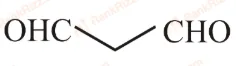
The major product of the following reaction is:
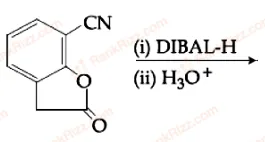
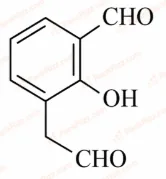
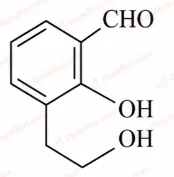
The reagent(s) required for the following conversion are:
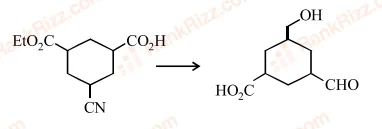
(i) NaBH, (ii) Raney Ni/H, (iii) HO
(i) LiAlH, (ii) HO
(i) BH, (ii) DIBAL-H, (iii) HO
(i) BH, (ii) SnCl/HCl, (iii) HO
The major product obtained in the following reaction is