RankRizz

Galvanometer conversion to ammeter and voltmeter — JEE Main Previous Year Questions

Every JEE Main question on Galvanometer conversion to ammeter and voltmeter, one of the ideas inside Current Electricity: 60 questions from 2005–2026, 29 of them in the last five years. Newest first, answer key on every one. Free to read.

Questions

60

Years asked

14

Since

2005

Of the chapter

16%

Every Galvanometer conversion to ammeter and voltmeter question

41–60 OF 60 · NEWEST FIRST

JEE MAIN 2019 · 12 JAN S2Galvanometer conversion to ammeter and voltmeterTRANSCRIBED

A galvanometer, whose resistance is 50 ohm, has 25 divisions in it. When a current of 4×10−44 \times 10^{-4} A passes through it, its needle (pointer) deflects by one division. To use this galvanometer as a voltmeter of range 2.5 V it should be connected to a resistance of:

  1. A

    6250 ohm

  2. B

    250 ohm

  3. C

    6200 ohm

  4. D

    200 ohm

JEE MAIN 2019 · 11 JAN S2Galvanometer conversion to ammeter and voltmeterTRANSCRIBED

A galvanometer having a resistance of 20Ω20\Omega and 30 division on both sides has figure of merit 0.005 ampere/division. The resistance that should be connected in series such that it can be used as a voltmeter upto 15 volt, is:

  1. A

    100Ω100\Omega

  2. B

    120Ω120\Omega

  3. C

    80Ω80\Omega

  4. D

    125Ω125\Omega

JEE MAIN 2019 · 12 APR S1Galvanometer conversion to ammeter and voltmeterTRANSCRIBED

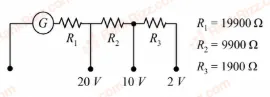
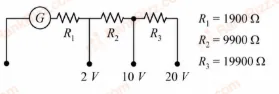
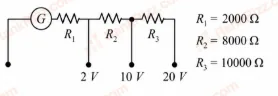
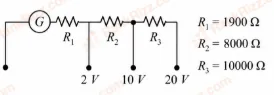
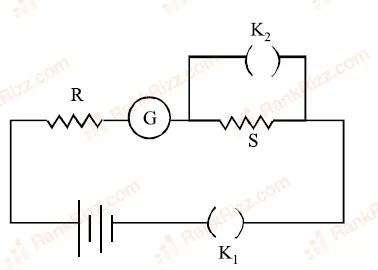
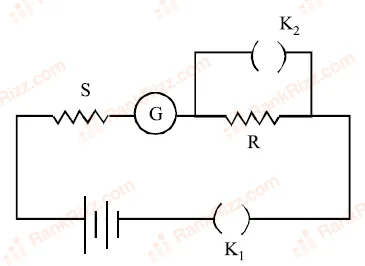
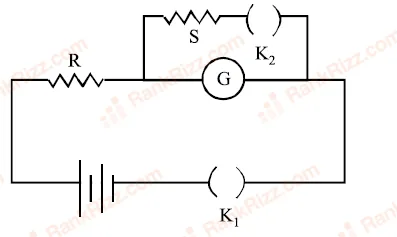
A galvanometer of resistance 100 Ω has 50 divisions on its scale and has sensitivity of 20 μA/division. It is to be converted to voltmeter with three ranges, of 0 - 2 V, 0 - 10 V and 0 - 20 V. The appropriate circuit to do so is:

  1. A
    Figure for JEE Main 2019 Physics question on Galvanometer conversion to ammeter and voltmeter
  2. B
    Figure for JEE Main 2019 Physics question on Galvanometer conversion to ammeter and voltmeter
  3. C
    Figure for JEE Main 2019 Physics question on Galvanometer conversion to ammeter and voltmeter
  4. D
    Figure for JEE Main 2019 Physics question on Galvanometer conversion to ammeter and voltmeter
JEE MAIN 2019 · 09 APR S2Galvanometer conversion to ammeter and voltmeterTRANSCRIBED

The resistance of a galvanometer is 50 ohm and the maximum current which can be passed through it is 0.002 A. What resistance must be connected to it in order to convert it into an ammeter of range 0 - 0.5 A?

  1. A

    0.2 ohm

  2. B

    0.5 ohm

  3. C

    0.002 ohm

  4. D

    0.02 ohm

JEE MAIN 2019 · 12 APR S2Galvanometer conversion to ammeter and voltmeterTRANSCRIBED

A moving coil galvanometer, having a resistance G, produces full scale deflection when a current IG_G flows through it. This galvanometer can be converted into (i) an ammeter of range 0 to I0_0 (I0_0 > Ig_g) by connecting a shunt resistance RA_A to it and (ii) into a voltmeter of range 0 to V (V = GI0_0) by connecting a series resistance RV_V to it. Then,

  1. A

    RA_ARV_V = G2(I0−IgIg)^2\left(\frac{I_0 - I_g}{I_g}\right) and RARV=(IgI0−Ig)2\frac{R_A}{R_V} = \left(\frac{I_g}{I_0-I_g}\right)^2

  2. B

    RA_ARV_V = G2^2 and RARV=Ig(I0−Ig)\frac{R_A}{R_V} = \frac{I_g}{(I_0 - I_g)}

  3. C

    RA_ARV_V = G2(IgI0−Ig)^2\left(\frac{I_g}{I_0 - I_g}\right) and RARV=(I0−IgIg)2\frac{R_A}{R_V} = \left(\frac{I_0 - I_g}{I_g}\right)^2

  4. D

    RA_ARV_V = G2^2 and RARV=(IgI0−Ig)2\frac{R_A}{R_V} = \left(\frac{I_g}{I_0 - I_g}\right)^2

JEE MAIN 2019 · 10 JAN S2Galvanometer conversion to ammeter and voltmeterTRANSCRIBED

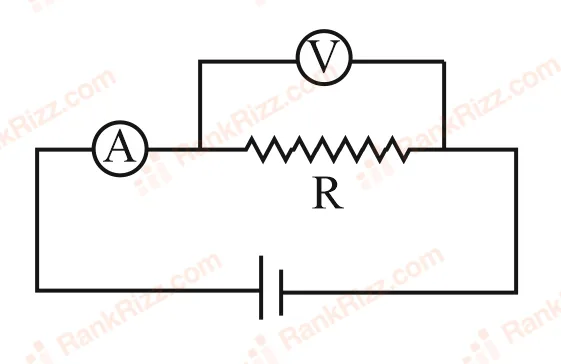
The actual value of resistance RR, shown in the figure is 30Ω\Omega. This is measured in an experiment as shown using the standard formula R=VIR = \frac{V}{I}, where V and I are the readings of the voltmeter and ammeter, respectively. If the measured value of RR is 5% less, then the internal resistance of the voltmeter is:

Figure for JEE Main 2019 Physics question on Galvanometer conversion to ammeter and voltmeter
  1. A

    35 Ω\Omega

  2. B

    600 Ω\Omega

  3. C

    570 Ω\Omega

  4. D

    350 Ω\Omega

JEE MAIN 2019 · 09 APR S1Galvanometer conversion to ammeter and voltmeterTRANSCRIBED

A moving coil galvanometer has resistance 50 Ω\Omega and it indicates full deflection at 4 mA current. A voltmeter is made using this galvanometer and a 5 kΩ\Omega resistance. The maximum voltage, that can be measured using this voltmeter, will be close to:

  1. A

    40 V

  2. B

    15 V

  3. C

    20 V

  4. D

    10 V

JEE MAIN 2018 · 16 APR ONLINEGalvanometer conversion to ammeter and voltmeterTRANSCRIBED

A galvanometer with its coil resistance 25 Ω\Omega requires a current of 1 mA for its full deflection. In order to construct an ammeter to read up to a current of 2 A the approximate value of the shunt resistance should be:

  1. A

    1.25×10−21.25 \times 10^{-2} Ω\Omega

  2. B

    2.5×10−32.5 \times 10^{-3} Ω\Omega

  3. C

    2.5×10−22.5 \times 10^{-2} Ω\Omega

  4. D

    1.25×10−31.25 \times 10^{-3} Ω\Omega

JEE MAIN 2018 · 16 APR ONLINEGalvanometer conversion to ammeter and voltmeterTRANSCRIBED

In a circuit for finding the resistance of a galvanometer by half deflection method, a 6 V battery and a high resistance of 11 kΩ\Omega are used. The figure of merit of the galvanometer is 60 μ\muA division−1^{-1}. In the absence of shunt resistance, the galvanometer produces a deflection of θ\theta = 9 divisions when current flows in the circuit. The value of the shunt resistance that can cause the deflection of θ2\frac{\theta}{2}, is closest to:

  1. A

    550 Ω\Omega

  2. B

    220 Ω\Omega

  3. C

    55 Ω\Omega

  4. D

    110 Ω\Omega

JEE MAIN 2017 · 08 APR ONLINEGalvanometer conversion to ammeter and voltmeterTRANSCRIBED
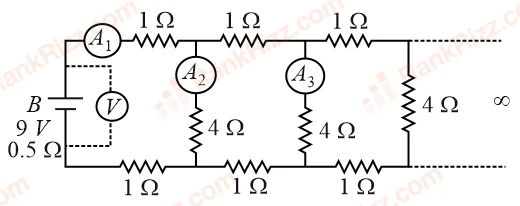
Figure for JEE Main 2017 Physics question on Galvanometer conversion to ammeter and voltmeter


A 9 V battery with an internal resistance of 0.5 Ω\Omega is connected across an infinite network, as shown in the figure. All ammeters A1A_1, A2A_2, A3A_3 and voltmeter VV are ideal. Choose the correct statement.

  1. A

    Reading of A1A_1 is 18 A

  2. B

    Reading of VV is 9 V

  3. C

    Reading of VV is 7 V

  4. D

    Reading of A1A_1 is 2 A

JEE MAIN 2017 · 02 APR OFFLINEGalvanometer conversion to ammeter and voltmeterTRANSCRIBED

When a current of 5 mA is passed through a galvanometer having a coil of resistance 15 Ω, it shows full-scale deflection. The value of the resistance to be put in series with the galvanometer to convert it into a voltmeter of range 0 - 10 V is:

  1. A

    4.005×1034.005 \times 10^{3} Ω

  2. B

    1.985×1031.985 \times 10^{3} Ω

  3. C

    2.045×1032.045 \times 10^{3} Ω

  4. D

    2.535×1032.535 \times 10^{3} Ω

JEE MAIN 2016 · 03 APR OFFLINEGalvanometer conversion to ammeter and voltmeterTRANSCRIBED

A galvanometer having a coil resistance of 100 Ω\Omega gives a full scale deflection, when a current of 1 mA is passed through it. The value of the resistance, which can convert this galvanometer into ammeter giving a full scale deflection for a current of 10 A, is:

  1. A

    0.1 Ω\Omega

  2. B

    3 Ω\Omega

  3. C

    0.01 Ω\Omega

  4. D

    2 Ω\Omega

JEE MAIN 2016 · 10 APR ONLINEGalvanometer conversion to ammeter and voltmeterTRANSCRIBED

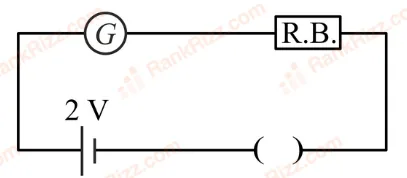
A galvanometer has a 50 division scale. Battery has no internal resistance. It is found that there is deflection of 40 divisions when R.B. = 2400 Ω\Omega. Deflection becomes 20 divisions when resistance taken from resistance box is 4900 Ω\Omega. Then we can conclude:

Figure for JEE Main 2016 Physics question on Galvanometer conversion to ammeter and voltmeter


Note: This question is awarded as the bonus. Now the question is corrected.

  1. A

    Current sensitivity of galvanometer is 20 μA/division\mu A/division

  2. B

    Resistance of galvanometer is 200 Ω\Omega.

  3. C

    Resistance required on R.B. for a deflection of 10 divisions is 9800 Ω\Omega.

  4. D

    Full scale deflection current is 2 mA.

JEE MAIN 2016 · 09 APR ONLINEGalvanometer conversion to ammeter and voltmeterTRANSCRIBED

To know the resistance GG of a galvanometer by half deflection method, a battery of emf VEV_E and resistance RR is used to deflect the galvanometer by angle θ\theta. If a shunt of resistance SS is needed to get half deflection the GG, RR and SS are related by the equation:

  1. A

    S(R+G)=RGS(R + G) = RG

  2. B

    2S(R+G)=RG2S(R + G) = RG

  3. C

    2G=S2G = S

  4. D

    2S=G2S = G

JEE MAIN 2016 · 09 APR ONLINEGalvanometer conversion to ammeter and voltmeterTRANSCRIBED

A 50 Ω\Omega resistance is connected to a battery of 5 V. A galvanometer of resistance 100 Ω\Omega is to be used as an ammeter to measure current through the resistance, for this a resistance rSr_S is connected to the galvanometer. Which of the following connections should be employed if the measured current is with in 1% of the current without the ammeter in the circuit?

  1. A

    rS=0.5Ωr_S = 0.5\Omega in series with galvanometer

  2. B

    rS=1 Ωr_S = 1\,\Omega in series with galvanometer

  3. C

    rS=1 Ωr_S = 1\,\Omega in parallel with galvanometer

  4. D

    rS=0.5 Ωr_S = 0.5\,\Omega in parallel with the galvanometer

JEE MAIN 2014 · 11 APR ONLINEGalvanometer conversion to ammeter and voltmeterTRANSCRIBED

In the circuit diagrams (A, B, C and D) shown below, R is a high resistance and S is a resistance of the order of galvanometer resistance G. The correct circuit, corresponding to the half deflection method for finding the resistance and figure of merit of the galvanometer, is the circuit labelled as:

Figure for JEE Main 2014 Physics question on Galvanometer conversion to ammeter and voltmeter

(a)

Figure for JEE Main 2014 Physics question on Galvanometer conversion to ammeter and voltmeter

(b)

Figure for JEE Main 2014 Physics question on Galvanometer conversion to ammeter and voltmeter

(c)

Figure for JEE Main 2014 Physics question on Galvanometer conversion to ammeter and voltmeter

(d)

  1. A

    Circuit A with G=RS(R−S)G = \frac{RS}{(R-S)}

  2. B

    Circuit B with G = S

  3. C

    Circuit C with G = S

  4. D

    Circuit D with G=RS(R−S)G = \frac{RS}{(R-S)}

JEE MAIN 2013 · 07 APR ONLINEGalvanometer conversion to ammeter and voltmeterTRANSCRIBED

This question has Statement I and Statement II. Of the four choices given after the Statements, choose the one that best describes the two Statements.
Statement - I : Higher the range, greater is the resistance of ammeter.
Statement - II : To increase the range of ammeter, additional shunt needs to be used across it.

  1. A

    Statement-I is true, Statement-II is false.

  2. B

    Statement-I is false, Statement-II is true.

  3. C

    Statement-I is true, Statement-II is true, Statement-II is the correct explanation of Statement-I.

  4. D

    Statement-I is true, Statement-II is true, Statement-II is not the correct explanation of Statement-I.

JEE MAIN 2013 · 09 APR ONLINEGalvanometer conversion to ammeter and voltmeterTRANSCRIBED

A shunt of resistance 1 Ω\Omega is connected across a galvanometer of 120 Ω\Omega resistance. A current of 5.5 ampere gives full scale deflection in the galvanometer. The current that will give full scale deflection in the absence of the shunt is nearly :

  1. A

    5.5 ampere

  2. B

    0.5 ampere

  3. C

    0.004 ampere

  4. D

    0.045 ampere

JEE MAIN 2013 · 22 APR ONLINEGalvanometer conversion to ammeter and voltmeterTRANSCRIBED

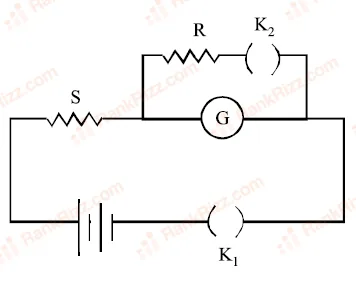
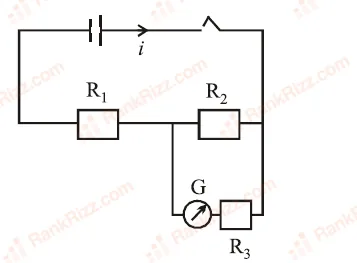
To find the resistance of a galvanometer by the half deflection method, the following circuit is used with resistances R1=9970R_1 = 9970 Ω\Omega, R2=30R_2 = 30 Ω\Omega and R3=0R_3 = 0. The deflection in the galvanometer is d. With R3=107R_3 = 107 Ω\Omega, the deflection changed to d2\frac{d}{2}. The galvanometer resistance is approximately:

Figure for JEE Main 2013 Physics question on Galvanometer conversion to ammeter and voltmeter
  1. A

    107Ω\Omega

  2. B

    137Ω\Omega

  3. C

    107/2Ω\Omega

  4. D

    77Ω\Omega

JEE MAIN 2005Galvanometer conversion to ammeter and voltmeterTRANSCRIBED

A moving coil galvanometer has 150150 equal divisions. Its current sensitivity is 1010 divisions per milliampere and voltage sensitivity is 22 divisions per millivolt. In order that each division reads 11 volt, the resistance in ohms needed to be connected in series with the coil will be

  1. A

    10310^3

  2. B

    10510^5

  3. C

    9999599995

  4. D

    99959995