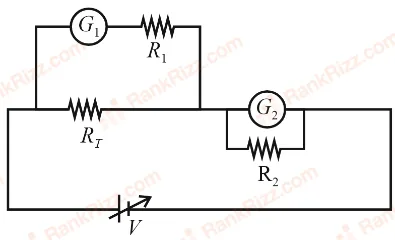
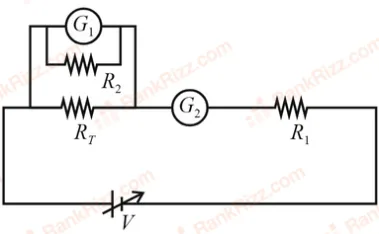
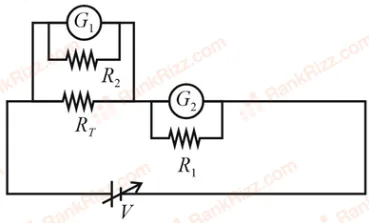
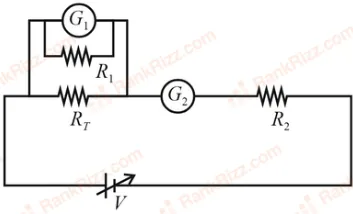
A student is provided with a variable voltage source , a test resistor , two identical galvanometers and and two additional resistors, and . For conducting an experiment to verify ohm's law, the most suitable circuit is:
- A
- B
- C
- D
Every JEE Main question on Galvanometer conversion to ammeter and voltmeter, one of the ideas inside Current Electricity: 60 questions from 2005–2026, 29 of them in the last five years. Newest first, answer key on every one. Free to read.
Questions
60
Years asked
14
Since
2005
Of the chapter
16%
21–40 OF 60 · NEWEST FIRST
A student is provided with a variable voltage source , a test resistor , two identical galvanometers and and two additional resistors, and . For conducting an experiment to verify ohm's law, the most suitable circuit is:


When a resistance of is shunted with a moving coil galvanometer, it shows a full scale deflection for a current of mA, however when resistance is connected with it in series, it gives full scale deflection for volt. The resistance of galvanometer is _____ .
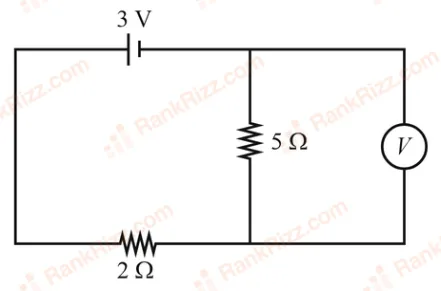
As shown in the figure below, the voltmeter reads 2 V across the 5 resistor. The resistance of the voltmeter is ______ .

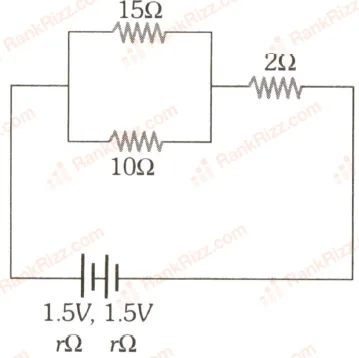
Two identical cells each of emf 1.5 V are connected in series across a 10 resistance. An ideal voltmeter connected across 10 resistance reads 1.5 V. The internal resistance of each cell is _______ .
A teacher in his physics laboratory allotted an experiment to determine the resistance a galvanometer. Students took the observations for deflection in the galvanometer. Which of the below is true for measuring value of ?
deflection method cannot be used for determining the resistance of the galvanometer.
deflection method can be used and in this case the equals to twice the value of shunt resistance(s).
deflection method can be used and in this case, the equals to three times the value of shunt resistance(s).
deflection method can be used and in this case the value equals to the shunt resistance(s).
If represents the actual number of deflections in a converted galvanometer of resistance and shunt resistance . Then the total current when its figure of merit is will be
A galvanometer is shunted by a resistance of . The percentage of the total current which passes through the galvanometer is
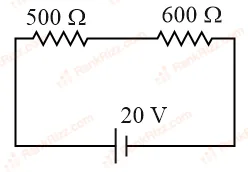
Two resistors are connected in series across a battery as shown in figure. If a voltmeter of resistance 2000 is used to measure the potential difference across 500 resister, the reading of the voltmeter will be ______ V.

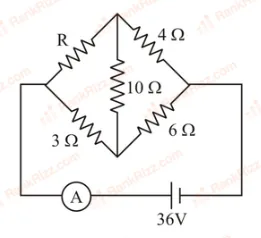
Current measured by the ammeter in the reported circuit when no current flows through resistance, will be ______ A.

Consider a galvanometer shunted with 5 resistance and 2% of current passes through it. What is the resistance of the given galvanometer?
245
344
300
226
For full scale deflection of total 50 divisions, 50 mV voltage is required in galvanometer. The resistance of galvanometer if its current sensitivity is 2 div / mA will be:
1
2
5
4
Two resistors 400 and 800 are connected in series across a 6V battery. The potential difference measured by a voltmeter of 10 k across 400 resistor is close to:
2 V
1.8 V
2.05 V
1.95 V
A galvanometer is used in laboratory for detecting the null point in electrical experiments. If, on passing a current of it produces a deflection of , its figure of merit is close to:
A galvanometer having a coil resistance 100 gives a full scale deflection when a current of 1 mA is passed through it. What is the value of the resistance which can convert this galvanometer into a voltmeter giving full scale deflection for a potential difference of 10 V?
10 k
8.9 k
7.9 k
9.9 k
A galvanometer of resistance is converted into a voltmeter of range by connecting a resistance in series with it. The additional resistance that should be connected in series with to increase the range of the voltmeter to will be:
A circuit to verify Ohm's law uses ammeter and voltmeter in series or parallel connected correctly to the resistor. In the circuit:
ammeter is always used in parallel and voltmeter is series
Both ammeter and voltmeter must be connected in parallel
ammeter is always connected in series and voltmeter in parallel
Both ammeter and voltmeter must be connected in series
In the given circuit, an ideal voltmeter connected across the 10 Ω resistance reads 2 V. The internal resistance r, of each cell is:

0 Ω
1.5 Ω
0.5 Ω
1 Ω
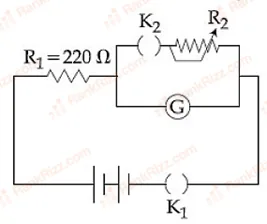
The galvanometer deflection, when key is closed but is open, equals (see figure). On closing also and adjusting to , the deflection in galvanometer becomes . The resistance of the galvanometer is, then, given by [Neglect the internal resistance of battery]:

A moving coil galvanometer allows a full scale current of A. A series resistance of Ω is required to convert the galvanometer into a voltmeter of range 0 - 5 V. Therefore, the value of shunt resistance required to convert the above galvanometer into an ammeter of range 0 - 10 mA is:
100 Ω
200 Ω
300 Ω
10 Ω
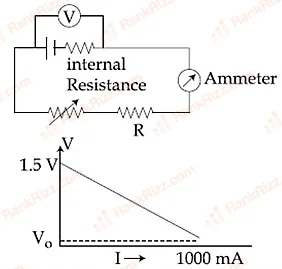
To verify Ohm's law, a student connects the voltmeter across the battery as shown in the figure. The measured voltage is plotted as a function of the current, and the following graph is obtained.
If V is almost zero, identify the correct statement:
The emf of the battery is 1.5 V and its internal resistance is 1.5 Ω
The value of the resistance R is 1.5 Ω
The potential difference across the battery is 1.5 V when it sends a current of 1000 mA
The emf of the battery is 1.5 V and the value of R is 1.5 Ω
RELATED CURRENT ELECTRICITY TOPICS