JEE MAIN 2019 · 11 JAN S2Aluminium and its compoundsTRANSCRIBED
The hydride that is NOT electron deficient is:
- A
- B
- C
- D
Every p-Block Elements: Groups 13 and 14 question JEE Main has set from 2004–2026, grouped by the idea it tests rather than the order of the syllabus. 92 questions across 5 distinct ideas. Free to read, answer key on every one.
Questions
92
Distinct ideas
5
Share of marks
1.4%
Difficulty
EASY
A chapter is not one subject — it is a handful of procedures the examiner reuses. These are the ones p-Block Elements: Groups 13 and 14 questions actually test.
61–80 OF 92 · NEWEST FIRST
The hydride that is NOT electron deficient is:
C, an allotrope of carbon contains:
12 hexagons and 20 pentagons.
16 hexagons and 16 pentagons.
18 hexagons and 14 pentagons.
20 hexagons and 12 pentagons.
The correct statements among I to III regarding group 13 element oxides are,
(I) Boron trioxide is acidic.
(II) Oxides of aluminum and gallium are amphoteric.
(III) Oxides of indium and thallium are basic.
(I) and (III) only
(I) and (II) only
(I), (II) and (III)
(II) and (III) only
The relative stability of +1 oxidation state of group 13 elements follows the order
Al < Ga < Tl < In
Tl < In < Ga < Al
Ga < Al < In < Tl
Al < Ga < In < Tl
The amorphous form of silica is:
quartz
kieselguhr
tridymite
cristobalite
The C - C bond length is maximum in:
C
C
graphite
diamond
Diborane BH reacts independently with O and HO to produce, respectively:
HBO and HBO
HBO and BO
BO and [BH]
BO and HBO
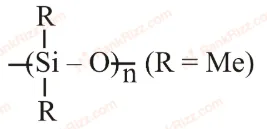
Correct statements among regarding silicones are:
(a) They are polymers with hydrophobic character.
(b) They are biocompatible.
(c) In general, they have high thermal stability and low dielectric strength.
(d) Usually, they are resistant to oxidation and used as greases.
(a), (b) and (c) only
(a) and (b) only
(a), (b), (c) and (d)
(a), (b) and (d) only
The correct order of catenation is:
Ge > Sn > Si > C
C > Sn > Si ≈ Ge
C > Si > Ge ≈ Sn
Si > Sn > C > Ge
The basic structural unit of feldspar, zeolites, mica, and asbestos is:
SiO
SiO
SiO
The one that is extensively used as a piezoelectric material is:
Tridymite
Quartz
Amorphous silica
Mica
The chloride that CANNOT get hydrolysed is:
In graphite and diamond, the percentage of p characters of the hybrid orbitals in hybridization are respectively:
33 and 25
67 and 75
50 and 75
33 and 75
Lithium aluminium hydride reacts with silicon tetrachloride to form:
LiCl, AlH and SiH
LiCl, AlCl and SiH
LiH, AlCl and SiCl
LiH, AlH and SiH
A group 13 element 'X' reacts with chlorine gas to produce a compound XCl. XCl is electron deficient and easily reacts with NH to form ClX NH adduct; however, XCl does not dimerize. X is:
B
Al
In
Ga
Assertion: Among the carbon allotropes, diamond is an insulator, whereas, graphite is a good conductor of electricity.
Reason: Hybridization of carbon in diamond and graphite are sp and sp respectively.
Both assertion and reason are correct, but the reason is not the correct explanation for the assertion.
Both assertion and reason are correct, but the reason is the correct explanation for the assertion.
Both assertion and reason are incorrect.
Assertion is incorrect statement, but the reason is correct.
Match the items in Column I with its main use listed in Column II:
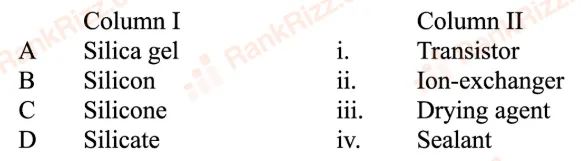
A - iii, B - i, C - iv, D - ii
A - iv, B - i, C - ii, D - iii
A - ii, B - i, C - iv, D - iii
A - ii, B - iv, C - i, D - iii
In the following sets of reactants which two sets best exhibit the amphoteric character of AlO · xHO?
Set I: AlO · xHO + OH
Set II: AlOx · HO + HO
Set III: AlOx · HO + H
Set IV: AlO · xHO + NH
2 and 4
1 and 2
1 and 3
3 and 4
Example of a three-dimensional silicate is:
Ultramarines
Feldspars
Zeolites
All of these
Which of these statements is not true?
LiAlH is versatile reducing agent in organic synthesis.
NO is isoelectronic with O
Boron is always covalent in its compounds
In aqueous solution, the Tl ion is much more stable than Tl (III)
JEE Advanced has set 14 p-Block Elements: Groups 13 and 14 questions too. p-Block Elements: Groups 13 and 14 JEE Advanced PYQs →
OTHER CHEMISTRY CHAPTERS