JEE MAIN 2021 · 26 FEB S2Electrode potentials, electrochemical series and cell EMFTRANSCRIBED
Emf of the following cell at 298 K in V is
The value of is ______ (Rounded off to the nearest integer)
[Given: V; V; ]
Every Electrochemistry question JEE Main has set, grouped by the idea it tests rather than the order of the syllabus. 227 questions across 8 distinct ideas. Free to read, answer key on every one.
Questions
227
Distinct ideas
8
Share of marks
4.4%
Difficulty
MEDIUM
A chapter is not one subject — it is a handful of procedures the examiner reuses. These are the ones Electrochemistry questions actually test.
141–160 OF 227 · NEWEST FIRST
Emf of the following cell at 298 K in V is
The value of is ______ (Rounded off to the nearest integer)
[Given: V; V; ]
Consider the cell at 25C
Zn|Zn aq, 1 M || Fe(aq), Feaq|Pt
The fraction of total iron present as Fe ion at the cell potential of 1.500 V is . The value of x is ___.
(Nearest integer)
Given: E = 0.77V, E = -0.76V
The equation that is incorrect is:
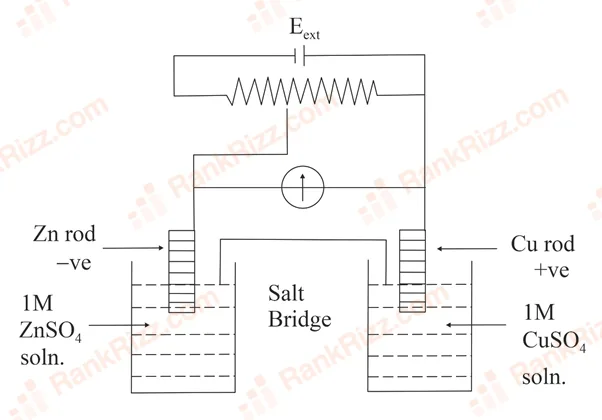
Identify the incorrect statement from the options below for the above cell:
V,
V
If E_{ext} > 1.1 V, e flow from Cu to Zn
If E_{ext} > 1.1 V, Zn dissolves at Zn electrode and Cu deposits at Cu electrode
If E_{ext} < 1.1 V, Zn dissolves at anode and Cu deposits at cathode
If V, no flow of e or current occurs
For the given cell;
change in Gibbs energy is negative, it:
Let and , be the conductances (in S) measured for saturated aqueous solutions of NaCl and respectively, at a temperature T. Which of the following is false?
Ionic mobilities of ions from both salts increase with T
C_{BaSO_4}(T_2) > C_{BaSO_4}(T_1) for T_2 > T_1
C_{NaCl}(T_2) > C_{NaCl}(T_1) for T_2 > T_1
at given T
250 mL of a waste solution obtained from the workshop of a goldsmith contains 0.1 M AgNO and 0.1 M AuCl. The solution was electrolyzed at 2 V by passing a current of 1 A for 15 minutes. The metal/metals electrodeposited will be:
only gold
silver and gold in proportion to their atomic weights
only silver
silver and gold in equal mass proportion
Given that the standard potentials (E) of Cu/Cu and Cu/Cu are 0.34V and 0.522V respectively, the E of Cu/Cu is:
0.182V
+0.158V
-0.182V
-0.158V
The variation of molar conductivity with concentration of an electrolyte (X) in aqueous solution is shown in the given figure.
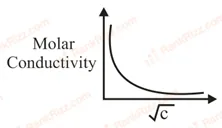
The electrolyte X is:
HCl
The Gibbs energy change (in J) for the given reaction at M and 298 K is:
;
An oxidation-reduction reaction in which 3 electrons are transferred has a of at . The value of (in V) is __________ . ()
An acidic solution of dichromate is electrolyzed for 8 minutes using 2 A current. As per the following equation
The amount of obtained was 0.104g. The efficiency of the process (in %) is (Take: F = 960000C, At. mass of chromium = 52)
108 g of silver (molar mass 108 ) is deposited at cathode from solution by a certain quantity of electricity. The volume (in L) of oxygen gas produced at 273 K and 1 bar pressure from water by the same quantity of electricity is ___________.
Potassium chlorate is prepared by the electrolysis of KCl in basic solution
. If only 60% of the current is utilized in the reaction, the time (rounded to the nearest hour) required to produce of using a current of is........ (Given: F = 96,500 C/mol; molar mass of = 122 g mol)
What would be the electrode potential for the given half-cell reaction at pH = 5?
2HO O + 4H + 4e; E V
(R = 8.314 J mol K; Temp = 298K; oxygen under standard atm. pressure of 1 bar)
For an electrochemical cell Sn(s)|Sn(aq, 1M)||Pb(aq, 1M)|Pb(s) the ratio when this cell attains equilibrium is __________.
(Given: E V, E V, )
The photoelectric current from Na (work function, eV) is stopped by the output voltage of the cell
Pt(s)|H(g, 1 bar)|HCl(aq, pH = 1)|AgCl(s)|Ag(s)
The pH of aq. HCl required to stop the photoelectric current from K( eV), all other conditions remaining the same, is ......... (to the nearest integer).
Given V; V
For the disproportionation reaction at 298K, ln K (where K is the equilibrium constant) is ___________ .
Given:
Given that,
V;
V;
V;
V
The strongest oxidizing agent is:
Given:
Co + e Co; E° = +1.81V
Pb + 2e Pb; E° = +1.67V
Ce + e Ce; E° = +1.61V
Bi + 3e Bi; E° = +0.20V
Oxidizing power of the species will increase in the order:
Co < Ce < Bi < Pb
Bi < Ce < Pb < Co
Co < Pb < Ce < Bi
Ce < Pb < Bi < Co
OTHER CHEMISTRY CHAPTERS