The standard electrode potential of M/M in aqueous solution does not depend on
- A
Hydration of a gaseous metal ion
- B
Sublimation of a solid metal
- C
Ionisation of a solid metal atom
- D
Ionisation of a gaseous metal atom
Every Electrochemistry question JEE Main has set, grouped by the idea it tests rather than the order of the syllabus. 227 questions across 8 distinct ideas. Free to read, answer key on every one.
Questions
227
Distinct ideas
8
Share of marks
4.4%
Difficulty
MEDIUM
A chapter is not one subject — it is a handful of procedures the examiner reuses. These are the ones Electrochemistry questions actually test.
81–100 OF 227 · NEWEST FIRST
The standard electrode potential of M/M in aqueous solution does not depend on
Hydration of a gaseous metal ion
Sublimation of a solid metal
Ionisation of a solid metal atom
Ionisation of a gaseous metal atom
The standard electrode potential (M/M) for V, Cr, Mn & Co are V, V, V and V, respectively. The metal ions which can liberate H from a dilute acid are
V and Mn
Cr and Co
V and Cr
Mn and Co
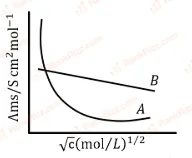
Following figure shows dependence of molar conductance of two electrolytes on concentration. is the limiting molar conductivity.
The number of Incorrect statement(s) from the following is ______
(A) for electrolyte A is obtained by extrapolation
(B) For electrolyte B, Vs graph is a straight line with intercept equal to
(C) At infinite dilution, the value of degree of dissociation approach zero for electrolyte B.
(D) for any electrolyte A or B can be calculated using for individual ions.
For lead storage battery pick the correct statements
A. During charging of battery, PbSO on anode is converted into PbO
B. During charging of battery, PbSO on cathode is converted into PbO
C. Lead storage battery consists of grid of lead packed with PbO as anode
D. Lead storage battery has ~38% solution of sulphuric acid as an electrolyte
Choose the correct answer from the options given below:
A, B, D only
B, C, D only
B, C only
B, D only
is V. The value of x is _______.
Pt(s)|H(g)(1 bar)|H(aq)(1M)||M(aq), M(aq)|Pt(s)
The E for the given cell is 0.1115 V at 298 K
When
The value of a is _____
Given: E = 0.2 V
= 0.059 V
The number of correct statements from the following is _____
(A) Conductivity always decreases with decrease in concentration for both strong and weak electrolytes.
(B) The number of ions per unit volume that carry current in a solution increases on dilution.
(C) Molar conductivity increases with decrease in concentration.
(D) The variation in molar conductivity is different for strong and weak electrolytes.
(E) For weak electrolytes, the change in molar conductivity with dilution is due to decrease in degree of dissociation.
M AgNO is added to L of saturated solution of AgBr. The conductivity of this solution at 298 K is _______ S m.
[Given: K(AgBr) at 298 K, Sm mol, Sm mol, Sm mol]
Consider the cell Pt(s)|H(s)(1atm)|H(aq, [H] = 1)||Fe(aq), Fe(aq)|Pt(s)
Given: E = 0.771 V and E = 0 V, T = 298 K
If the potential of the cell is 0.712 V the ratio of concentration of Fe to Fe is _____ (Nearest integer)
The electrode potential of the following half cell at 298 K
X|X(0.001M)||Y(0.01M)|Y is ______ V (Nearest integer)
Given: E V
E V
V
At 298 K, a 1 litre solution containing 10 mmol of and 100 mmol of shows a pH of 3.0. Given : ; V and V. The potential for the half cell reaction is V. The value of x is _____.
At 298 K, a 1 litre solution containing 10 mmol of CrO and 100 mmol of Cr shows a pH of 3.0. Given: CrO Cr; E V and V. The potential for the half cell reaction is V. The value of is _____.
The logarithm of equilibrium constant for the reaction is (Nearest integer)
Given: V
V
E^o = 0.65$$ V
The resistivity of a 0.8M solution of an electrolyte is cm. Its molar conductivity is cm mol. (Nearest integer)
The equilibrium constant for the reaction Zn(s) + Sn(aq) Zn(aq) + Sn(s) is at 298 K. The magnitude of standard electrode potential of Sn/Sn if E V is ______ V. (Nearest integer)
Given: V
Consider the cell
Pt, H(g, 1 atm) | H aq, 1M | Fe aq, Fe aq | Pt s
When the potential of the cell is 0.712 V at 298 K, the ratio Fe/Fe is ______ (Nearest integer)
Given: Fe + e = Fe, E° Fe, Fe Pt = 0.771, V
The standard reduction potentials at 295 K for the following half cells are given below:
NO + 4H + 3e NO(g) + 2HO E° = 0.97 V
V(aq) + 2e V(s) E° = -1.19 V
Fe(aq) + 3e Fe(s) E° = -0.04 V
Ag(aq) + e Ag(s) E° = 0.80 V
Au(aq) + 3e Au(s) E° = 1.40 V
The number of metal(s) which will be oxidised by NO in aqueous solution is ______.
At what pH, given half cell MnO(0.1M) | Mn(0.001 M) will have electrode potential of 1.282 V? (Nearest Integer)
Given E = 1.54 V, = 0.059 V
In an electrochemical reaction of lead, at standard temperature, if Volt and Volt, then the value of is given by . The value of x is _______ (Nearest integer).
A metal surface of cm area has to be coated with nickel layer of thickness mm. A current of 2A was passed through a solution of Ni(NO) for 'x' seconds to coat the desired layer. The value of x is _____. (Nearest integer)
(Ni (density of Nickel) is g mL, Molar mass of Nickel is g mol, F C mol)
OTHER CHEMISTRY CHAPTERS