The formal charges on the atoms marked as (1) to (4) in the Lew is representation
of molecule respectively are
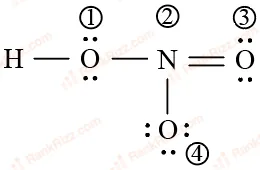
- A
0, +1, 0, -1
- B
+1, 0, 0, - 1
- C
0,0, - 1,+1
- D
0, -1, 0, +1

Every Chemical Bonding and Molecular Structure question JEE Main has set, grouped by the idea it tests rather than the order of the syllabus. 316 questions across 11 distinct ideas. Free to read, answer key on every one.
Questions
316
Distinct ideas
11
Share of marks
4.8%
Difficulty
MEDIUM
A chapter is not one subject — it is a handful of procedures the examiner reuses. These are the ones Chemical Bonding and Molecular Structure questions actually test.
1–20 OF 316 · NEWEST FIRST
The formal charges on the atoms marked as (1) to (4) in the Lew is representation
of molecule respectively are

0, +1, 0, -1
+1, 0, 0, - 1
0,0, - 1,+1
0, -1, 0, +1
Given below are two statements : **Statement (I) :** The correct sequence of bond lengths in the following species is : O_2^+ < O_2 < O_2^- < O_2^{2-} **Statement (II) :** The correct sequence of number of unpaired electrons in the following species is : O_2 > O_2^+ > O_2^- > O_2^{2-} In the light of the above statements, choose the correct answer from the options given below :
Both Statement I and Statement II are true
Both Statement I and Statement II are false
Statement I is true but Statement II is false
Statement I is false but Statement II is true
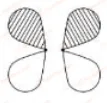
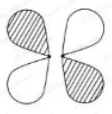
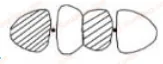
Which of the following pictorial diagram most correctly represents the ( - antibonding) molecular orbital between two atoms if the internuclear axis is taken to be in the z-direction ?


The covalent radii of atoms A and B are and respectively. The covalent bond length and total length of molecule are respectively :
,
,
,
,
Given below are two statements :
Statement I : The number of compounds among SO, SO, SF, SF and HS in which sulphur does not obey the Octet rule is 3.
Statement II : Among [HO, ClF, SF], [NH, BrF, SF], [BrF, ClF, XeF] and [XeF, ClF, HO], the number of sets in which all the molecules have one lone pair of electrons on the central atom is 1.
In the light of the above statements, choose the correct answer from the options given below :
Both Statement I and Statement II are true
Both Statement I and Statement II are false
Statement I is true but Statement II is false
Statement I is false but Statement II is true
Bromine trifluoride autoionizes to form and . The shapes of the cation and anion are respectively __________, and __________.
bent, square planar
linear, square planar
bent, see-saw
linear, tetrahedral
The pairs among
, , , and that do not have similar Lewis dot structure are:
A, B and E
A and E
B, C and D
C and D
is isostructural with :
A.
B.
C.
D.
E.
Choose the correct answer from the options given below :
C Only
C and E Only
A and D Only
B and E Only
Given below are two statements :
Statement I : F_2O < H_2O < Cl_2O is the correct trend in terms of bond angle.
Statement II : SiF, SnF and PbF are ionic in nature.
In the light of the above statements, choose the correct answer from the options given below :
Both Statement I and Statement II are true
Both Statement I and Statement II are false
Statement I is true but Statement II is false
Statement I is false but Statement II is true
Given below are statements about some molecules/ions.
Identify the CORRECT statements.
A The dipole moment value of is higher than that of .
B. The dipole moment value of is zero.
C. The bond order of and is same.
D. The formal charge on the central oxygen atom of ozone is -1 .
E. In , all the three atoms satisfy the octet rule, hence it is very stable.
Choose the correct answer from the options given below:
A, C & D Only
A, B, C, D &E
B & C Only
B, C & D Only
Given below are two statements:
Statement I: The correct order in terms of bond dissociation enthalpy is Cl_{2} > Br_{2} > F_{2} > I_{2}.
Statement II : The correct trend in the covalent character of the metal halides is [SnCl_{4} > SnCl_{2}], [PbCl_{4}> PbCl_{2}], and [UF_{4} > UF_{6}].
In The light oh the above statements, choose the correct answer from the options given below:
Both Statement I and Statement II are false
Both Statement I and Statement II are true
Statement I is true but Statement II is false
Statement I is false but Statement II is true
Match List - I with List - Il according to shape.
List - I List - II
A. I.
B. II.
C. III.
D. IV.
Choose the correct answer from the options given below:
A-II, B-III, C-I, D-IV
A-II, B-III, C-IV, D-I
A-III, B-Il, C-IV, D-I
A-II, B-I, C-III, D-IV
Among the following, the CORRECT combinations are
Choose the correct answer from the options given below:
B, C and D Only
A, B and C Only
A and B Only
A, B, C and D
Pair of species among the following having same bond order as well as paramagnetic character will be-
Among , , , and , identify the molecule (X) with lowest dipole moment value. The number of lone pairs of electrons present on the central atom of the molecule (X) is :
2
0
3
1
ldentify the molecule (X) with maximum number of lone pairs of electrons (obtained using Lewis dot structure) among . Choose the correct bond angle made by the central atom of the molecule (X).
The correct increasing order of C - H(A), C - 0 (B), C = O(C) and C ≡ N (D) bonds in terms of covalent bond length is :
A < D < C < B
D < C < A < B
D < C < B < A
A < B < C < D
Two p-block elements and form fluorides of the type . The fluoride compound is a Lewis acid and is a Lewis base. The hybridizations of the central atoms of and respectively are
Both
and
Both
and
Given below are two statements:
Statement I: The number of species among ,that have unequal E-F bond lengths is two. Here, E is the central atom.
Satement II: Among has the highest bond order.
In the light of the above statements, choose the correct answer from the options given below
Statement I is false but Statement II is true
Both Statement I and Statement II are true
Statement I is true but Statement II is false
Both Statement I and Statement II are false
Which statements are NOT TRUE about ?
A. It has a see-saw shape.
B. Xe has 5 electron pairs in its valence shell in .
C. The bond angle is close to .
D. The bond angle is close to .
E. has 16 valence electrons in .
Choose the correct answer from the options given below:
B, C and E Only
B and D Only
Aand D Only
B, D and E Only
OTHER CHEMISTRY CHAPTERS