Consider three metal chlorides x, y and z, where x is water soluble at room temperature, y is sparingly soluble in water at room temperature and z is soluble in hot water. x, y and z are respectively
- A
and
- B
and
- C
and
- D
and
Every Qualitative Salt Analysis question JEE Main has set, grouped by the idea it tests rather than the order of the syllabus. 69 questions across 4 distinct ideas. Free to read, answer key on every one.
Questions
69
Distinct ideas
4
Share of marks
1.8%
Difficulty
EASY
A chapter is not one subject — it is a handful of procedures the examiner reuses. These are the ones Qualitative Salt Analysis questions actually test.
1–20 OF 69 · NEWEST FIRST
Consider three metal chlorides x, y and z, where x is water soluble at room temperature, y is sparingly soluble in water at room temperature and z is soluble in hot water. x, y and z are respectively
and
and
and
and
Given below are two statements:
Statement I: Griss-Ilosvay test is used for the detection of nitrite ion, which involves the use of sulphanilic acid and reagent.
Statement II: In the above test, sulphanilic acid is diazotized by the acidified nitrite ion, which on further coupling with forms an azo-dye.
In the light of the above statements, choose the correct answer from the options given below
Statement I is true but Statement II is false
Statement I is false but Statement II is true
Both Statement I and Statement II are false
Both Statement I and Statement II are true
Consider the following reactions.
(Hot solution)
In the above reactions, A, Band X are respectively.
and
and
In the Group analysis of cations, & are precipitated respectively as
chromate & sulphide
hydroxide & carbonate
sulphide & sulphide
carbonate & carbonate
Consider the following reactions
The oxidation states of Cu in Z and Q, respectively are:
+ 2 and + 2
+ 2 and + 1
+ 1 and + 1
+ 1 and + 2
On heating a mixture of common salt and in equal amount along with concentrated in a test tube, a gas is evolved. Formula of the gas evolved and oxidation State of the central metal atom in the gas respectively are:
and +5
and +6
and +3
and +6
Among Fe, Pb, Cu and Mn, identify the one that gets precipitated out while passing HS in presence of NHOH as group reagent. The highest possible oxidation state of the corresponding metal is
A salt with few drops of conc. HCl gives apple green colour in flame test. The group precipitate of the salt is dissolved in acetic acid and treated with KCrO to give yellow precipitate. When the sodium carbonate extract of the salt solution is heated with conc. HNO and ammonium molybdate, it resulted a canary yellow precipitate. The cation and anion present in the salt are respectively,
Ca and SO
Ba and PO
Mn and PO
Ba and SO
Consider the following reactions:
In the product 'C, 'X' is the number of units, 'Y' is the total number oxygen atoms present and 'Z' is the oxidation state of Cr·. The value of X + Y + Z is ______
Formation of , a purple coloured complex formed by addition of sodium nitroprusside in sodium carbonate extract of salt indicates the presence of :
Sodium ion
Sulphate ion
Sulphide ion
Sulphite ion
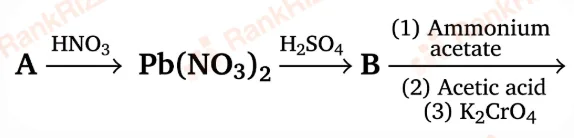
Find the compound ' A ' from the following reaction sequences.

yellow ppt
CoS
ZnS
NiS
MnS
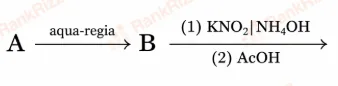
Identify A,B and C in the given below reaction sequence

When a salt is treated with sodium hydroxide solution it gives gas X. On passing gas X through reagent Y a brown coloured precipitate is formed. X and Y respectively, are
and
and
and
and
The metal ion whose electronic configuration is not affected by the nature of the ligand and which gives a violet colour in non-luminous flame under hot condition in borax bead test is
Choose the correct tests with respective observations.
(A) (acidified with acetic acid) + Chocolate brown precipitate.
(B) Prussian blue precipitate.
(C) , neutralised with White or bluish white precipitate.
(D) Blue precipitate.
(E) , neutralised with NaOH White precipitate.
Choose the correct answer from the options given below:
A, D and E only
B, D and E only
A, B and C only
C, D and E only
Identify the inorganic sulphides that are yellow in colour : (A) (B) (C) (D) (E) Choose the correct answer from the options given below :
(A), (D) and (E) only
(D) and (E) only
(A) and (B) only
(A) and (C) only
Among the following cations, the number of cations which will give characteristic precipitate in their identification tests with is .
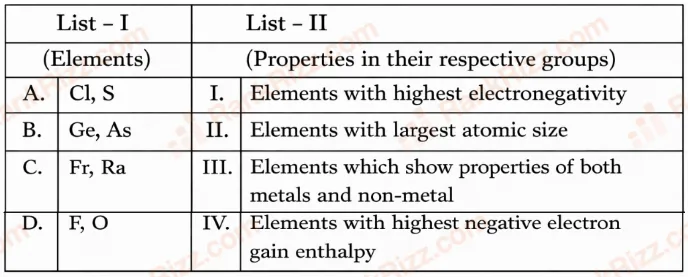
Match List I with List II

Choose the correct answer from the options given below:
A-II, B-I, C-IV, D-III
A-III, B-II, C-I, D-IV
A-IV, B-III, C-II, D-I
A-II, B-III, C-IV, D-I
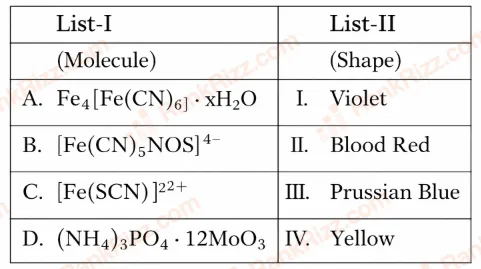
Match List I with List II
Choose the correct answer from the options given below:
A-III, B-I, C-II, D-IV
A-I, B-II, C-III, D-IV
A-IV, B-I, C-II, D-III
A-II, B-III, C-IV, D-I
NaCl reacts with conc. and to give reddish fumes (B), which react with NaOH to give yellow solution (C). (B) and (C) respectively are :
OTHER CHEMISTRY CHAPTERS