JEE MAIN 2024 · 09 APR S1Water pollutionTRANSCRIBED
The ions make the enamel on teeth much harder by converting hydroxyapatite (the enamel on the surface of teeth) into much harder fluoroapatite having the formula.
- A
- B
- C
- D
Every Environmental Chemistry question JEE Main has set, grouped by the idea it tests rather than the order of the syllabus. 113 questions across 4 distinct ideas. Free to read, answer key on every one.
Questions
113
Distinct ideas
4
Share of marks
0%
Difficulty
EASY
A chapter is not one subject — it is a handful of procedures the examiner reuses. These are the ones Environmental Chemistry questions actually test.
1–20 OF 113 · NEWEST FIRST
The ions make the enamel on teeth much harder by converting hydroxyapatite (the enamel on the surface of teeth) into much harder fluoroapatite having the formula.
How can photochemical smog be controlled?
By using tall chimneys
By complete combustion of fuel
By using catalytic converters in the automobiles/industry
By using catalyst
Match List I with List II
List-I (Species) List-2 (Maximum allowed concentration in ppm in drinking water)
A. F I. < 50 ppm
B. SO II. < 5 ppm
C. NO III. < 2 ppm
D. Zn IV. < 500 ppm
Choose the correct answer from the options given below.
A-I, B-II, C-III, D-IV
A-II, B-I, C-III, D-IV
A-IV, B-III, C-II, D-I
A-III, B-II, C-I, D-IV
Which of the following is true about freons?
These are chlorofluorocarbon compounds
These are chemicals causing skin cancer
These are radicals of chlorine and chlorine monoxide
All radicals are called freons
Which of the following is true about freons?
These are chlorofluorocarbon compounds
These are chemicals causing skin cancer
These are radicals of chlorine and chlorine monoxide
All radicals are called freons
Some reactions of NO relevant to photochemical smog formation are
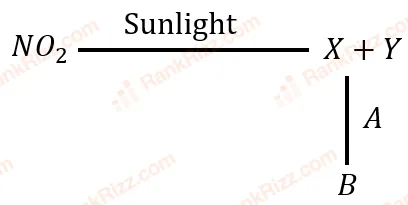
Identify A, B, X and Y
X = [O], Y = NO, A = O, B = O
X = NO, Y = [O], A = O, B = NO
X = O, Y = NO, A = O, B = O
X = NO, Y = [O], A = O, B = NO
The concentration of dissolved Oxygen in water for growth of fish should be more than X ppm and Biochemical Oxygen Demand in clean water should be less than Y ppm. X and Y in ppm are, respectively.
X=6, Y=5
X=4, Y=8
X=4, Y=15
X=6, Y=12
The possibility of photochemical smog formation is more at
Marshy lands
Industrial areas
Himalayan villages in winter
The places with healthy vegetation
Which of the following compounds is an example of Freon?
CHF
CF
CHF
CClF
Correct statement about smog is
NO is present in classical smog
Both NO and SO are present in classical smog
Photochemical smog has high concentration of oxidizing agents
Classical smog also has high concentration of oxidizing agents
The radical which mainly causes ozone depletion in the presence of UV radiations is :
Cl
NO
H
CH
Formation of photochemical smog involves the following reaction in which A, B and C are respectively.
(i) NO A + B
(ii) B + O C
(iii) A + C NO + O
Choose the correct answer from the options below:
O, NO and NO
O, NO and NO
N, O and O
NO, O and O
Identify X, Y and Z in the following reaction. (Equation not balanced)
X = ClONO, Y = HOCl, Z = NO
X = ClNO, Y = HCl, Z = HNO
X = ClONO, Y = HOCl, Z = HNO
X = ClNO, Y = Cl, Z = NO
The normal rain water is slightly acidic and its pH value is 5.6 because of which one of the following?
Which of the following are the Green house gases?
A. Water vapour
B. Ozone
C. I
D. Molecular hydrogen
Choose the most appropriate answer from the options given below :
A and D only
B and C only
A and B only
C and D only
The possibility of photochemical smog formation will be minimum at
Srinagar, Jammu and Kashmir in January
Kolkata in October
Mumbai in May
New-Delhi in August (Summer)
The group of chemicals used as pesticide is
Aldrin, Sodium Chlorate, Sodium arsinite
DDT, Aldrin
Sodium chlorate, DDT, PAN
Dieldrin, Sodium arsinite, Tetrachloroethene
Match List I with List II
| List I Industry | List II Waste Generated | ||
|---|---|---|---|
| (A) | Steel plants | (I) | Gypsum |
| (B) | Thermal power plants | (II) | Fly ash |
| (C) | Fertilizer Industries | (III) | Slag |
| (D) | Paper mills | (IV) | Bio-degradable wastes |
Choose the correct answer from the options below:
A-III, B-II, C-I, D-IV
A-III, B-IV, C-I, D-II
A-II, B-III, C-IV, D-I
A-IV, B-I, C-II, D-III
Given below are two statements:
Statement-I: If BOD is 4 ppm and dissolved oxygen is 8 ppm, then it is a good quality water.
Statement-II: If the concentration of zinc and nitrate salts are 5 ppm each, then it can be a good quality water.
In the light of the above statements, choose the most appropriate answer from the options below:
Statement I is correct but Statement II is incorrect
Statement I is incorrect but Statement II is correct
Both the statements I and II are incorrect
Both the statements I and II are correct
Match List I with List II
| List I | List II | ||
|---|---|---|---|
| A | Nitrogen oxides in air | I | Eutrophication |
| B | Methane in air | II | pH of rain water becomes 5.6 |
| C | Carbon dioxide | III | Global warming |
| D | Phosphate fertilisers in water | IV | Acid rain |
Choose the correct answer from the options given below :
A-II, B-III, C-I, D-IV
A-I, B-II, C-III, D-IV
A-IV, B-III, C-II, D-I
A-IV, B-II, C-III, D-I
OTHER CHEMISTRY CHAPTERS