JEE MAIN 2017 · 09 APR ONLINEElectrode potentials, electrochemical series and cell EMFTRANSCRIBED
To find the standard potential of M3+/M electrode, the following cell is constituted:
Pt | M/M3+ (0.001 mol L−1) / Ag+ (0.01 mol L−1) / Ag
The emf of the cell is found to be 0.421 volt at 298 K. The standard potential of half-reaction M3+ + 3e− → M at 298 K will be:
(Given: EAg+/Ag⊖ at 298 K = 0.80 volt)
- A
- B
- C
- D
JEE MAIN 2016 · 03 APR OFFLINEBatteries, fuel cells and corrosionTRANSCRIBED
Galvanization is applying a coating of:
- A
- B
- C
- D
JEE MAIN 2016 · 10 APR ONLINEConductance, conductivity and molar conductivityTRANSCRIBED
Oxidation of succinate ion produces ethylene and carbon dioxide gases. On passing 0.2 Faraday electricity through an aqueous solution of potassium succinate, what is the total volume of gases (at both cathode and anode) at STP (1 atm and 273 K)?
- A
- B
- C
- D
JEE MAIN 2016 · 09 APR ONLINEElectrode potentials, electrochemical series and cell EMFTRANSCRIBED
What will happen when a block of copper metal is dropped into a beaker containing a solution of 1 M ZnSO4?
- A
The copper metal will dissolve with evolution of oxygen gas.
- B
The copper metal will dissolve with evolution of hydrogen gas.
- C
- D
The copper metal will dissolve and zinc metal will be deposited.
JEE MAIN 2016 · 10 APR ONLINEBatteries, fuel cells and corrosionTRANSCRIBED
Identify the correct statement:
- A
Corrosion of iron can be minimised by forming a contact with another metal with a higher reduction potential
- B
Iron corrodes in oxygen-free water
- C
Corrosion of iron can be minimised by forming an impermeable barrier at its surface
- D
Iron corrodes more rapidly in salt water because its electrochemical potential is higher
JEE MAIN 2015 · 11 APR ONLINEElectrolysis and Faraday's lawsTRANSCRIBED
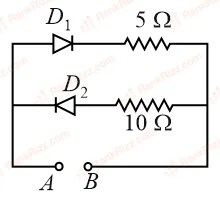
A 2 V battery is connected across AB as shown in the figure. The value of the current supplied by the battery when in first case battery's positive terminal is connected to A and in second case when positive terminal of battery is connected to B will respectively be:
- A
- B
- C
- D
JEE MAIN 2015 · 04 APR OFFLINEConductance, conductivity and molar conductivityTRANSCRIBED
Two Faraday of electricity is passed through a solution of CuSO4. The mass of copper deposited at the cathode is: (Atomic mass of Cu = 63.5 amu)
- A
- B
- C
- D
JEE MAIN 2015 · 10 APR ONLINEGalvanic cells, cell notation and salt bridgeTRANSCRIBED
A variable, the opposite external potential (Eext) is applied to the cell Zn | Zn2+ (1M) || Cu2+ (1M) | Cu, of potential 1.1 V. When E_{ext} < 1.1 V and E_{ext} > 1.1 V, respectively electrons flow from
- A
anode to cathode in both the cases.
- B
anode to cathode and cathode to anode.
- C
cathode to anode and anode to cathode.
- D
cathode to anode in both cases.
JEE MAIN 2015 · 11 APR ONLINENernst equation and concentration cellsTRANSCRIBED
At 298 K, the standard reduction potentials are 1.51 V for MnO4−∣Mn2+, 1.36 V for Cl2∣Cl−, 1.07 V for Br2∣Br−, 0.54 V for I2∣I−. At pH = 3, permanganate is expected to oxidize: (FRT=0.059)
- A
- B
- C
- D
JEE MAIN 2014 · 09 APR ONLINEElectrolysis and Faraday's lawsTRANSCRIBED
A current of 10.0 A flows for 2.00 h through an electrolytic cell containing a molten salt of metal X. This results in the decomposition of 0.250 mol of metal X at the cathode. The oxidation state of X in the molten salt is: (F = 96,500 C)
- A
- B
- C
- D
JEE MAIN 2014 · 06 APR OFFLINEConductance, conductivity and molar conductivityTRANSCRIBED
Resistance of 0.2 M solution of an electrolyte is 50 Ω. The specific conductance of the solution is 1.4 S m−1. The resistance of 0.5 M solution of the same electrolyte is 280 Ω. The molar conductivity of 0.5 M solution of the electrolyte in S m2 mol−1 is:
- A
- B
- C
- D
JEE MAIN 2014 · 09 APR ONLINEElectrode potentials, electrochemical series and cell EMFTRANSCRIBED
The standard electrode potentials (EM+/M∘) of four metals A, B, C and D are −1.2 V, 0.6 V, 0.85 V and −0.76 V, respectively. The sequence of deposition of metals on applying potential is:
- A
- B
- C
- D
JEE MAIN 2014 · 06 APR OFFLINEConductance, conductivity and molar conductivityTRANSCRIBED
The equivalent conductance of NaCl at concentration C and at infinite dilution are λC and λ∞, respectively. The correct relationship between λC and λ∞ is given as: (where the constant B is positive)
- A
- B
- C
- D
JEE MAIN 2014 · 06 APR OFFLINEElectrode potentials, electrochemical series and cell EMFTRANSCRIBED
Given below are the half-cell reactions:
Mn2++2e−→Mn; E∘=−1.18 V
2(Mn3++e−→Mn2+); E∘=+1.51 V
The E∘ for 3Mn2+→Mn+2Mn3+ will be:
- A
−2.69 V; the reaction will not occur
- B
−2.69 V; the reaction will occur
- C
−0.33 V; the reaction will not occur
- D
−0.33 V; the reaction will occur
JEE MAIN 2014 · 11 APR ONLINEElectrode potentials, electrochemical series and cell EMFTRANSCRIBED
Given:
Fe3+(aq) + e− → Fe2+(aq); E0 = +0.77 V
Al3+(aq) + 3e− → Al(s); E0 = −1.66 V
Br2(aq) + 2e− → 2Br−; E0 = +1.09 V
Considering the electrode potentials, which of the following represents the correct order of reducing power?
- A
- B
- C
- D
JEE MAIN 2014 · 12 APR ONLINEElectrolysis and Faraday's lawsTRANSCRIBED
How many electrons would be required to deposit 6.35 g of copper at the cathode during the electrolysis of an aqueous solution of copper sulphate? (Atomic mass of copper = 63.5u, NA = Avogadro's constant):
- A
- B
- C
- D
JEE MAIN 2014 · 12 APR ONLINEBatteries, fuel cells and corrosionTRANSCRIBED
Copper becomes green when exposed to moist air for a long period. This is due to:
- A
the formation of a layer of cupric oxide on the surface of copper.
- B
the formation of a layer of basic carbonate of copper on the surface of copper.
- C
the formation of a layer of cupric hydroxide on the surface of copper.
- D
the formation of basic copper sulphate layer on the surface of the metal.
JEE MAIN 2013 · 23 APR ONLINEElectrode potentials, electrochemical series and cell EMFTRANSCRIBED
Given :
E21Cl2/Cl−∘=1.36 V, ECr3+/Cr∘=−0.74 V
ECr2O72−/Cr3+∘=1.33 V, EMnO4−/Mn2+∘=1.51 V
The correct order of reducing power of the species (Cr, Cr3+, Mn2+ and Cl−) will be:
- A
- B
- C
- D
JEE MAIN 2013 · 09 APR ONLINEElectrode potentials, electrochemical series and cell EMFTRANSCRIBED
Electrode potentials (E°) are given below :
Cu+/Cu=+0.52 V,
Fe3+/Fe2+=+0.77 V,
21I2(s)/I−=+0.54 V,
Ag+/Ag=+0.88 V.
Based on the above potentials, strongest oxidizing agent will be :
- A
- B
- C
- D
JEE MAIN 2013 · 25 APR ONLINEElectrode potentials, electrochemical series and cell EMFTRANSCRIBED
The Gibbs energy for the decomposition of Al2O3 at 500°C is as follows :
32Al2O3→34Al+O2, ΔrG=+940 kJ mol−1
The potential difference needed for the electrolytic reduction of aluminium oxide at 500°C should be at least :
- A
- B
- C
- D