When 1 g of cmnpow1d (X) is subjected to Kjeldahl's method for estimation of nitrogen, 15 mL 1 M was neutrilized by ammonia evolved. The percentage of nitrogen in compound
(X) is :
- A
42
- B
0.42
- C
0.21
- D
21
Every Purification and Characterisation of Organic Compounds question JEE Main has set, grouped by the idea it tests rather than the order of the syllabus. 151 questions across 4 distinct ideas. Free to read, answer key on every one.
Questions
151
Distinct ideas
4
Share of marks
3.8%
Difficulty
EASY
A chapter is not one subject — it is a handful of procedures the examiner reuses. These are the ones Purification and Characterisation of Organic Compounds questions actually test.
1–20 OF 151 · NEWEST FIRST
When 1 g of cmnpow1d (X) is subjected to Kjeldahl's method for estimation of nitrogen, 15 mL 1 M was neutrilized by ammonia evolved. The percentage of nitrogen in compound
(X) is :
42
0.42
0.21
21
By usual analysis, 1.00 g of compound (X) gave 1.79 g of magnesium pyrophosphate. The percentage of phosphorus in compound (X) is: (nearest integer)
(Given, molar mass in : 0 = 16, Mg = 24, P = 31 )
40
20
30
50
Given below are two statements :
Statement I: Sublimation is used for the separation and purification of compounds with low melting Point.
Statement II: The boiling point of a liquid increases as the external pressure is reduced.
In the light of the above statements, choose the correct answer from the options given below :
Both Statement I and Statement II are true
Both Statement I and Statement II are false
Statement I is false but Statement II is true
Statement I is true but Statement II is false
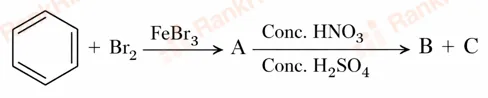
Method used for separation of mixture of products (B and C) obtained in the following reaction is

fractional distillation
sublimation
steam distillation
simple distillation
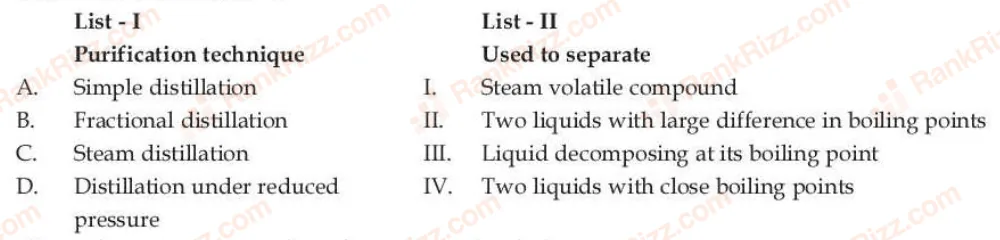
Match the List I with List II:
Choose the correct answer from the options given below:
A-II, B-III, C-I, D-IV
A-II, B-IV, C-I, D-III
A-II, B-IV, C-III, D-I
A-IV, B-III, C-II, D-I
Given below are two statements :
Statement I : A mixture of CHO (sugar) and NaCl can be separated by dissolving sugar in alcohol, due to differential solubility.
Statement II : Rose essence from rose petals is separated by steam distillation due to its high volatility and insolubility in HO.
In the light of the above statements, choose the correct answer from the options given below :
Both Statement I and Statement II are true
Both Statement I and Statement II are false
Statement I is true but Statement II is false
Statement I is false but Statement II is true
Given below are two statements :
Statement I : Vapours of the liquid with higher boiling point condense before vapours of the liquid with lower boiling points in fractional distillation.
Statement II : The vapours rising up in the fractionating column become richer in high boiling component of the mixture.
In the light of the above statements, choose the correct answer from the options given below :
Both Statement I and Statement II are true
Both Statement I and Statement II are false
Statement I is true but Statement II is false
Statement I is false but Statement II is true
Given below are two statements :
Statement (I) :1,2,3-Trihydroxypropane can be separated from water by simple distillation.
Statement (II) :An azeotropic mixture cannot be separated by fractional distillation.
In the light of the above statements, choose the correct answer from the options given below :
Both Statement I and Statement II are true
Both Statement I and Statement II are false
Statement I is true but Statement II is false
Statement I is false but Statement II is true
R value for 2-methylpropene in a solvent system (Ethyl acetate + ether) is 0.42. 2-methylpropene is treated with dilute HSO to give major organic product (X). R value for (X) in the same solvent system under identical condition will be:
0.42
0.82
0.62
0.12
In Carius method 0.2425 g of an organic compound gave 0.5253 g silver chloride.
The percentage of chlorine in the organic compound is
37.57%
53.58%
87.65%
34.79%
A student has been given 0.314 g of an organic compound and asked to estimate Sulphur. During the experiment, the student has obtained 0.4813 g of barium sulphate. The percentage of sulphur present in the compound is_______.{Given Molor mass in g S: 32, : 233)
48.24%
63.15%
42.10%
21.05%
Complete combustion of g of an organic compound gave 0.25 g of CO and 0.12 g of HO. If the % of carbon is 25% and of hydrogen is 4.89%, then _____ g. (Nearest integer) (Molar mass of C, H and O are 12, 1 and 16 g mol respectively.)
In Carius method, 0.75 g of an organic compound gave 1.2 g of barium sulphate, find percentage of sulphur (molar mass 32 g ) Molar mass of barium sulphate is 233 g
10.30%
16.48%
4.55%
21.97%
In Dumas method for estimation of nitrogen, 0.50 g of an organic compound gave 70 mL of nitrogen collected at 300 K and 715 mm pressure. The percentage of nitrogen in the organic compound is __ %.
(Aqueous tension at 300 K is 15 mm).
In an estimation of sulphur by Carius method 0.2 g of the substance gave 0.6 g of BaSO. The percentage of sulphur in the substance is _______%. (Given molar mass in g mol S: 32, BaSO: 231)
2.0 g of a bromo hydrocarbon was subjected to Carius analysis, gave 3.36 g of AgBr. The percentage of carbon in the compound is 26.7%. Total number of carbon atoms in the empirical formula for compound is _____.
( Given molar mass in g )
Sodium fusion extract of an organic compound (Y) with and chlorine water gives violet color to the layer. 0.15g of gave 0.12g of the silver halide precipitate in Carius method. Percentage of halogen in the compound is _______ . (Nearest integer)
(Given : molar mass g C : 12 , H : 1, Cl : 35.5, Br : 80 , I : 127)
In sulphur estimation, mol of an organic compound (X) (molar mass 76 g mol) gave 0.4813 g of barium sulphate (molar mass 233 g mol). The percentage of sulphur in the compound (X) is _________ % (Nearest integer)
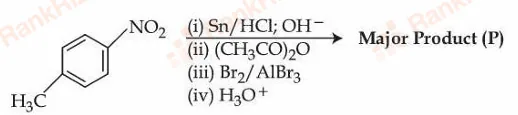
Consider the following reactions sequence.
When the product (P) is subjected to Carius analysis using AgNO, 1.0 g of the product (P) will produce _____ g of the precipitate of AgBr. (Nearest Integer)
(Given: molar mass in g mol C: 12, H: 1, O: 16, N: 14, Br: 80, Ag: 108)
Given below are two statements : Statement (I) : Nitrogen, sulphur, halogen and phosphorus present in an organic compound are detected by Lassaigne's Test. Statement (II) : The elements present in the compound are converted from covalent form into ionic form by fusing the compound with Magnesium in Lassaigne's test. In the light of the above statements, choose the correct anower from the options given below :
Statement I is false but Statement II is true
Both Statement I and Statement II are true
Both Statement I and Statement II are false
Statement I is true but Statement II is false
OTHER CHEMISTRY CHAPTERS