For a strong electrolyte, a plot of molar conductivity against (concentration) is a straight line, with a negative slope, the correct unit for the slope is:
- A
S cm mol L
- B
S cm mol L
- C
S cm mol L
- D
S cm mol L
Every Electrochemistry question JEE Main has set, grouped by the idea it tests rather than the order of the syllabus. 227 questions across 8 distinct ideas. Free to read, answer key on every one.
Questions
227
Distinct ideas
8
Share of marks
4.4%
Difficulty
MEDIUM
A chapter is not one subject — it is a handful of procedures the examiner reuses. These are the ones Electrochemistry questions actually test.
61–80 OF 227 · NEWEST FIRST
For a strong electrolyte, a plot of molar conductivity against (concentration) is a straight line, with a negative slope, the correct unit for the slope is:
S cm mol L
S cm mol L
S cm mol L
S cm mol L
For the electrochemical cell, if V and V. Which of the following is correct?
is a spontaneous reaction
V
V
is a spontaneous reaction
The reaction at cathode in the cells commonly used in clocks involves.
reduction of Mn from +7 to +2
reduction of Mn from +4 to +3
oxidation of Mn from +3 to +4
oxidation of Mn from +2 to +7
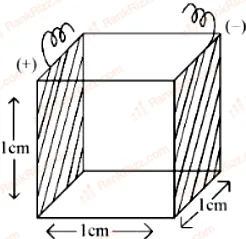
A conductivity cell with two electrodes (dark side) are half filled with infinitely dilute aqueous solution of a weak electrolyte. If volume is doubled by adding more water at constant temperature, the molar conductivity of the cell will -

decrease sharply
increase sharply
remain same or can not be measured accurately
depend upon type of electrolyte
Fuel cell, using hydrogen and oxygen as fuels: A. has been used in spaceship, B. has an efficiency of 40% to produce electricity, C. uses aluminum as catalysts, D. is eco-friendly, E. is actually a type of Galvanic cell only. Choose the correct answer from the options given below:
A, B, D, E only
A, D, E only
A, B, D only
A, B, C only
Molar ionic conductivities of divalent cation and anion are and respectively. The molar conductivity of solution of an electrolyte with the above cation and anion will be :
The values of conductivity of some materials at 298.15 K in S m are , , , , , , . The number of conductors among the materials is
The amount of electricity in Coulomb required for the oxidation of 1 mol of to is ______ C.
One Faraday of electricity liberates gram atom of copper from copper sulphate, is ______.
The standard reduction potentials at K for the following half cells are given below :
, V
, V
, V
, V
, V
Consider the given electrochemical reactions, The number of metal(s) which will be oxidized by , in aqueous solution is ______
The potential for the given half cell at 298K is V.
, M, atm.
(Given V, ). The value of is:
Consider the following redox reaction:
The standard reduction potentials are given as below:
V; V
If the equilibrium constant of the above reaction is given as , then the value of = ______ (nearest integer)
The mass of silver (Molar mass of Ag : ) displaced by a quantity of electricity which displaces mL of at S.T.P. will be ______ g.
The hydrogen electrode is dipped in a solution of pH = 3 at 25°C. The potential of the electrode will be _____ V.
V. Round off the answer to the nearest integer.
The mass of zinc produced by the electrolysis of zinc sulphate solution with a steady current of A for minutes is _______ g. (Atomic mass of zinc amu)
A constant current was passed through a solution of ion between gold electrodes. After a period of minutes, the increase in mass of cathode was g. The total charge passed through the solution is ______ F. (Given atomic mass of Au = 197)
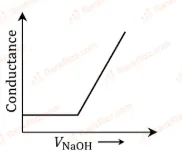
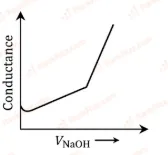
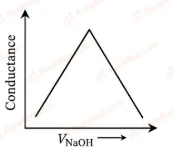
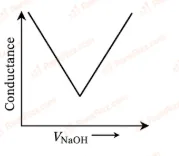
Choose the correct representation of conductometric titration of benzoic acid vs sodium hydroxide.


The incorrect statements from the following is:
A. The electrical work that a reaction can perform at constant pressure and temperature is equal to the reaction Gibbs energy.
B. is dependent on the pressure.
C.
D. A cell is operating reversibly if the cell potential is exactly balanced by an opposing source of potential difference.
Which one of the following statements is correct for electrolysis of brine solution?
Cl is formed at cathode
O is formed at cathode
H is formed at anode
OH is formed at cathode
The reaction occurs in which of the given galvanic cell?
Pt |H(g)| HCl(sol) |AgCl(s)| Ag
Ag |AgCl(s)| KCl(sol) |AgNO |Ag
Pt |H(g)| HCl(sol) |AgNO(sol) |Ag
Pt |H(g)| KCl(sol) |AgCl(s) |Ag
OTHER CHEMISTRY CHAPTERS