The mass of iron converted into FeO by the action of 18 g of steam is : (Given : Molar mass of H, O and Fe are 1, 16 and 56 g mol respectively) Assume iron is present in excess :
- A
g
- B
g
- C
g
- D
g
Every Some Basic Concepts of Chemistry question JEE Main has set, grouped by the idea it tests rather than the order of the syllabus. 252 questions across 5 distinct ideas. Free to read, answer key on every one.
Questions
252
Distinct ideas
5
Share of marks
4.4%
Difficulty
EASY
A chapter is not one subject — it is a handful of procedures the examiner reuses. These are the ones Some Basic Concepts of Chemistry questions actually test.
1–20 OF 252 · NEWEST FIRST
The mass of iron converted into FeO by the action of 18 g of steam is : (Given : Molar mass of H, O and Fe are 1, 16 and 56 g mol respectively) Assume iron is present in excess :
g
g
g
g
Number of moles and number of molecules in 1.4187 L of at STP respectively are :
The correct order of total number of atoms in: (A) 2 moles of cyclohexane, (B) 684 g of sucrose, (C) 90.8 L of dihydrogen at STP, is :
C > A > B
C > B > A
B > C > A
B > A > C
What volume of hydrogen gas at STP would be liberated by action of 50 mL of of 50% purity (density = 1.3 g mL) on 20 g of zinc?
Given : Molar mass of H, O, S, Zn are 1, 16, 32, 65 g mol respectively.
5.824 L
7.428 L
6.892 L
8.375 L
Which of the following contain the same number of atoms?
(Given : Molar mass in g mol of H, He, O and S are 1, 4, 16 and 32 respectively)
A. 2 g of O gas
B. 4 g of SO gas
C. 1400 mL of O at STP
D. 0.05 L of He at STP
E. 0.0625 mol of H gas
Choose the correct answer from the options given below :
A and B only
B and C only
C and D only
A, C and E only
An oxide of iron contains 69.9% iron, its empirical formula, is:
(Given: Molar mass of Fe and O are 56 and 16 g mol respectively.)
FeO
FeO
FeO
FeO
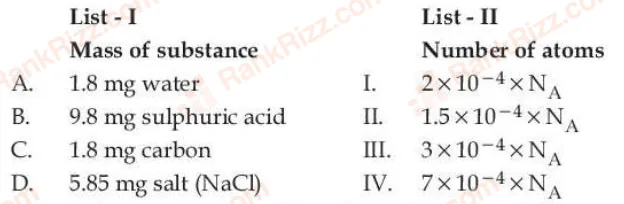
Match List - I with List - II.
Choose the correct answer from the options given below :
A-IV, B-III, C-I, D-II
A-III, B-II, C-IV, D-I
A-III, B-IV, C-II, D-I
A-III, B-IV, C-I, D-II
How many grams of residue is obtained by heating 2.76 g of silver carbonate? (Given: Molar mass of C, O and Ag are 12, 16 and 108 g mol respectively)
80 mL of a hydrocarbon on mixing with 264 mL of oxygen in a closed U-tube undergoes complete combustion. The residual gases after cooling to 273 K occupy 224 mL. When the system is treated with KOH solution, the volume decreases to 64 ml. The formula of the hydrocarbon is:
What is the mole fraction of water in 10% by weight (w/w) of aqueous urea solution? [Given: Molar mass of H, O, C and N are 1, 16, 12 and 14 g mol respectively.]
Aqueous HCI reacts with to form , and . What is the weight (in g) of liberated when 8.7 g of is reacted with excess aqueous HCI solution ?
(Given Molar mass in g Mn = 55, Cl = 35.5, 0 = 16, H = l )
14.2
21.3
71
7.1
36.0 g of ' A' (Molar mass : 60 g ) and 56.0 g of 'B' (Molar mass: 80 g ) are allowed to react. Which of the following statements are correct?
A. 'A' is the limiting reagent.
B. 77.0 g of is formed.
C. Molar mass of mol^{-1}$$
D. 15.0 g of A is left unreacted after the completion of reaction.
Choose the correct answer from the options given below :
C and D Only
A and B Only
B and D Only
A and C Only
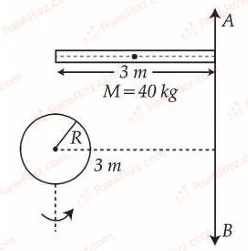
Moment of inertia about an axis for a rod of mass 40 kg and length 3 m is same as that of a solid sphere of mass 10 kg and radius about an axis parallel to axis with separation of 3 m as shown in figure. The value of is given as . The value of is _________.

The ratio of mass percentage (w/w) of C : H in a hydrocarbon is 12 : 1. It has two carbon atoms. The weight (in g) of CO(g) formed when 3.38 g of this hydrocarbon is completely burnt in oxygen is : (Given: Molar mass in g mol C : 12, H : 1, O : 16)
14.0 g of calcium metal is allowed to react with excess HCI at 1.0 atm pressure and 273 K
Which of the following statements is incorrect?
[Given : Molar mass in g of Ca-40, Cl-35.5, H-1]
The limiting reagent is calcimn metal
7.84 L of gas is evolved.
0.35 mol of gas is evolved.
33.3 g of is produced.
At T(K), 100 g of 98% (w /w) aqueous solution is mixed with 100 g of 49% (w /w) aqueous solution. What is the mole fraction of in the resultant solution?
(Given: Atomic mass H=1 u ; s=32 u ; 0 = 16 u).
(Assume that temperature after mixing remains constant)
0.9
0.1
0.663
0.337
For the given reaction;
If 90 g is added to 300 mL of HCI which contains 38.55% HCI by mass and has density 1.13 g , then which of the following option is correct ?
Given molar mass of H, Cl, Ca and Oare 1, 35.5, 40 and 16 g respectively.
32.85 g of remains unreacted
64. 97 g of HCl remains unreacted
97.30 g of HCl reacted
60.32 g of HCl remains unreacted
In the reaction,
is consumed for every produced.
is produced regardless of temperatur and pressure for every mole of Al that reacts.
at STP is produced for every mole of Al that reacts.
at STP is produced for every mole of HCl consumed.
0.25 g of an organic compound "A" containing carbon, hydrogen and oxygen was analysed using the combustion method. There was an increase in mass of tube and potash tube at the end of the experiment. The amount was found to be 0.15 g and 0.1837 g, respectively. The percentage of oxygen in compound A is __ %. (Nearest integer)
(Given: molar massing H : 1, C : 12, O : 16)
x mg of pure HCl was used to make an aqueous solution. 25.0 mL of 0.1 M solution is used when the HCl solution was titrated against it. The numerical value of x is ______. (nearest integer)
Given : Molar mass of HCl and are 36.5 and 171.0 g respectively.
OTHER CHEMISTRY CHAPTERS