JEE MAIN 2020 · 06 SEP S2Arrhenius equation and activation energyTRANSCRIBED
The rate of a reaction decreased by 3.555 times when the temperature was changed from to . The activation energy (in ) of the reaction is______.
Every Chemical Kinetics question JEE Main has set, grouped by the idea it tests rather than the order of the syllabus. 231 questions across 8 distinct ideas. Free to read, answer key on every one.
Questions
231
Distinct ideas
8
Share of marks
5.5%
Difficulty
MEDIUM
A chapter is not one subject — it is a handful of procedures the examiner reuses. These are the ones Chemical Kinetics questions actually test.
161–180 OF 231 · NEWEST FIRST
The rate of a reaction decreased by 3.555 times when the temperature was changed from to . The activation energy (in ) of the reaction is______.
If 75% of a first order reaction was completed in 90 minutes, 60% of the same reaction would be completed in approximately (in minutes) __________ (Take: log 2 = 0.30; log 2.5 = 0.40)
The number of molecules with energy greater than the threshold energy for a reaction increases five fold by a rise of temperature from 27°C to 42°C. Its energy of activation in J/mol is __________ (Take ln 5 = 1.6094; R = 8.314 J mol)
Consider the given plot of enthalpy of the following reaction between A and B.
A + B C + D. Identify the incorrect statement.
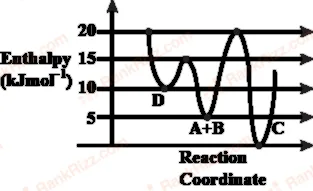
Formation of A and B from C has highest enthalpy of activation.
D is kinetically stable product.
C is the thermodynamically stable product.
Activation enthalpy to form C is 5 kJ mol less than that to form D.
For the reaction, products, when the concentration of and both were doubled, the rate of the reaction increased from 0.3 mol L s to 2.4 mol L s. When the concentration of alone is doubled, the rate increased from 0.3 mol L s to 0.6 mol L s. Which one of the following statements is correct?
Order of the reaction with respect to B is 2
Total order of the reaction is 4
Order of the reaction with respect to A is 2
Order of the reaction with respect to B is 1
For an elementary chemical reaction, , the expression for is:
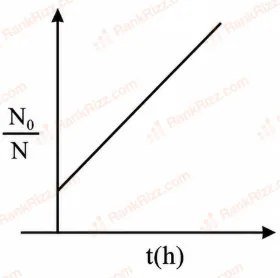
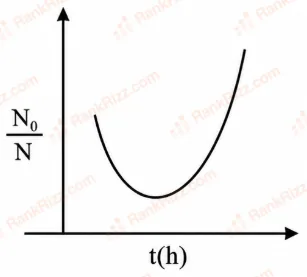
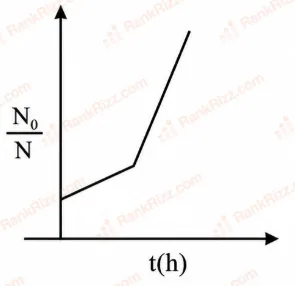
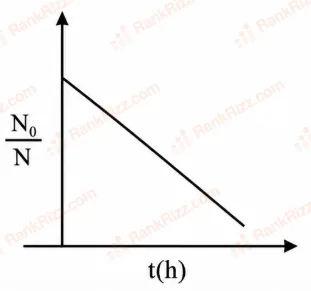
A bacterial infection in an internal wound grows as N'(t) = Nexp(t), where the time t is in hours. A dose of antibiotic, taken orally, needs 1 hour to reach the wound. Once it reaches there, the bacterial population goes down as . What will be the plot of vs t after 1 hour?
The reaction is a zeroth order reaction. If the initial concentration of X is 0.2M, the half-life is 6 h. When the initial concentration of X is 0.5M, the time required to reach its final concentration of 0.2M will be
9.0 h
12.0 h
18.0 h
7.2 h
For a reaction scheme A B C, if the net rate of formation of B is set to be zero then the concentration of B is given by:
The given plots represent the variation of the concentration of a reactant R with time for two different reactions (i) and (ii). The respective orders of the reaction are:
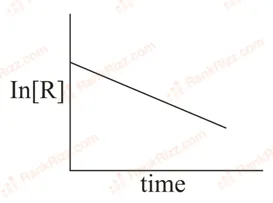
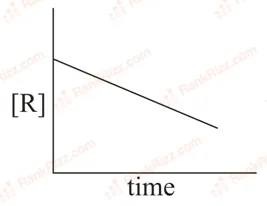
1, 1
0, 1
1, 0
0, 2
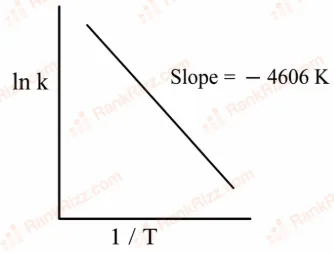
For a reaction, consider the plot of ln k versus 1/T given in the figure. If the rate constant of this reaction at 400 K is , then the rate constant at 500 K is:
For the reaction 2A + B C, the values of initial rate at different reactant concentrations are given in the table below.
[A] (mol L) [B] (mol L) Initial Rate (mol Ls)
0.05 0.05 0.045
0.10 0.05 0.090
0.20 0.10 0.72
The rate law for the reactions is:
Rate = k[A][B]
Rate = k[A][B]
Rate = k[A][B]
Rate = k[A][B]
If a reaction follows the Arrhenius equation, the plot vs gives straight line with a gradient unit. The energy required to activate the reactant is:
unit
unit
unit
unit
Decomposition of X exhibits a rate constant of 0.05 g/year. How many years are required for the decomposition of 5 g of X into 2.5 g?
20
40
25
50
NO required for a reaction is produced by the decomposition of NO in CCl as per the equation, 2NO(g) 4NO(g) + O(g). The initial concentration of NO is 3.00 mol L and it is 2.75 mol L after 30 minutes. The rate of formation of NO is:
mol L min
mol L min
mol L min
mol L min
The following results were obtained during kinetic studies of the reaction.
product
Experiment I: A = 0.10 mol L, B = 0.20 mol L, Rate = mol L min
Experiment II: A = 0.10 mol L, B = 0.25 mol L, Rate = mol L min
Experiment III: A = 0.20 mol L, B = 0.30 mol L, Rate = mol L min
The time (in minutes) required to consume half of A is:
100
10
5
1
For the reaction of H with I, the rate constant is dm mol s at 327°C and 1.0 dm mol s at 527°C. The activation energy for the reaction, in kJ mol is:
R = 8.314 JK mol
166
59
72
150
Consider the given plots for a reaction obeying Arrhenius equation (C < T < 300C): (K and are rate constant and activation energy, respectively)
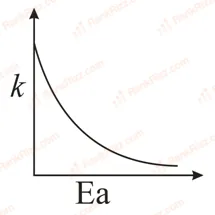
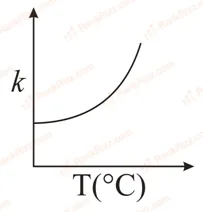
I is wrong but II is right
Both I and II are wrong
I is right but II is wrong
Both I and II are correct
In the following reaction; xA yB
'A' and 'B' respectively can be:
CH and CH
CH and CH
n-Butane and Iso-butane
NO and NO
If 50% of a reaction occurs in 100 second and 75% of the reaction occurs in 200 second, the order of this reaction is:
2
3
Zero
1
OTHER CHEMISTRY CHAPTERS