RankRizzStart free

Chemical Kinetics — JEE Main Previous Year Questions

Every Chemical Kinetics question JEE Main has set, grouped by the idea it tests rather than the order of the syllabus. 231 questions across 8 distinct ideas. Free to read, answer key on every one.

Questions

231

Distinct ideas

8

Share of marks

5.5%

Difficulty

MEDIUM

The ideas inside Chemical Kinetics

A chapter is not one subject — it is a handful of procedures the examiner reuses. These are the ones Chemical Kinetics questions actually test.

01Rate of reactionset 2×
02Rate law, order and molecularityset 40×
03Integrated rate laws and half-life (zero and first order)set 85×
04Methods to determine order of reactionset 24×
05Parallel, consecutive and reversible reactionsset 1×
06Arrhenius equation and activation energyset 62×
07Collision theory and effect of catalyst on rateset 1×
08Radioactivity and nuclear reactionsset 16×

Every Chemical Kinetics question

81–100 OF 231 · NEWEST FIRST

JEE MAIN 2023 · 01 FEB S2Integrated rate laws and half-life (zero and first order)TRANSCRIBED


The above reaction is of zero order. Half life of this reaction is min. The time taken for the concentration of A to reduce to one-fourth of its initial value is ______ min. (Nearest integer)
JEE MAIN 2023 · 12 APR S1Methods to determine order of reactionTRANSCRIBED

The reaction NO Br NOBr takes place through the mechanism given below
NO Br NOBr (fast)
NOBr NO NOBr (slow)
The overall order of the reaction is _____.

JEE MAIN 2023 · 24 JAN S2Methods to determine order of reactionTRANSCRIBED

A student has studied the decomposition of a gas at 25°C. He obtained the following data

p (mm Hg)50100200400
Relative (s)4210.5


The order of the reaction is

  1. A

    0.5

  2. B

    2

  3. C

    1

  4. D

    0

JEE MAIN 2023 · 25 JAN S1Integrated rate laws and half-life (zero and first order)TRANSCRIBED

For the first order reaction A B the half life is 30 min. The time taken for 75% completion of the reaction is _____ min. (Nearest integer)
Given: log 2 = 0.3010
log 3 = 0.4771
log 5 = 0.6989

JEE MAIN 2023 · 30 JAN S2Integrated rate laws and half-life (zero and first order)TRANSCRIBED

An organic compound undergoes first order decomposition. If the time taken for the decomposition is s, then the time required for decomposition will be ______ s. (Nearest integer).
Given: ;

JEE MAIN 2023 · 24 JAN S1Arrhenius equation and activation energyTRANSCRIBED

The number of correct statement/s from the following is _____.
A. Larger the activation energy, smaller is the value of the rate constant.
B. The higher is the activation energy, higher is the value of the temperature coefficient.
C. At lower temperatures, increase in temperature causes more change in the value of k than at higher temperature.
D. A plot of vs is a straight line with slope equal to

JEE MAIN 2023 · 24 JAN S1Arrhenius equation and activation energyTRANSCRIBED

The number of correct statement/s from the following is _____.
A. Larger the activation energy, smaller is the value of the rate constant.
B. The higher is the activation energy, higher is the value of the temperature coefficient.
C. At lower temperatures, increase in temperature causes more change in the value of k than at higher temperature.
D. A plot of ln k vs is a straight line with slope equal to

JEE MAIN 2023 · 31 JAN S1Arrhenius equation and activation energyTRANSCRIBED


The rate constants of the above reaction at 200 K and 300 K are 0.03 min and 0.05 min respectively. The activation energy for the reaction is J (Nearest integer)
(Given: ln 10 = 2.3, R = 8.3 J K mol, log 5 = 0.70, log 3 = 0.48, log 2 = 0.30)

JEE MAIN 2023 · 31 JAN S2Integrated rate laws and half-life (zero and first order)TRANSCRIBED

The rate constant for a first order reaction is 20 min. The time required for the initial concentration of the reactant to reduce to its level is ______ min. (Nearest integer)

JEE MAIN 2023 · 29 JAN S2Methods to determine order of reactionTRANSCRIBED

For conversion of compound A B, the rate constant of the reaction was found to be L mol s. The order of the reaction is ______.

JEE MAIN 2023 · 06 APR S1Arrhenius equation and activation energyTRANSCRIBED

For the adsorption of hydrogen on platinum, the activation energy is 30 kJ mol and for the adsorption of hydrogen on nickel, the activation energy is 41.4 kJ mol. The logarithm of the ratio of the rates of chemisorption on equal areas of the metals at 300 K is ______ (Nearest integer)
Given: ln10 = 2.3, R = 8.3 J K mol

JEE MAIN 2023 · 30 JAN S1Integrated rate laws and half-life (zero and first order)TRANSCRIBED

If compound A reacts with B following first order kinetics with rate constant s. The time taken by A (in seconds) to reduce from g to g will be ______. (Nearest Integer)
log5 = 0.698, log7 = 0.845, log2 = 0.301

JEE MAIN 2023 · 01 FEB S1Integrated rate laws and half-life (zero and first order)TRANSCRIBED

A and B are two substances undergoing radioactive decay in a container. The half life of A is 15 min and that of B is 5 min. If the initial concentration of B is 4 times that of A and they both start decaying at the same time, how much time will it take for the concentration of both of them to be same? _____ min.

JEE MAIN 2023 · 11 APR S1Rate law, order and molecularityTRANSCRIBED

KClO + 6FeSO + 3HSO KCl + 3Fe(SO) + 3HO
The above reaction was studied at 300 K by monitoring the concentration of FeSO in which initial concentration was 10 M and after half an hour became 8.8 M. The rate of production of Fe(SO) is _______ mol L s (Nearest integer)

JEE MAIN 2023 · 29 JAN S1Methods to determine order of reactionTRANSCRIBED

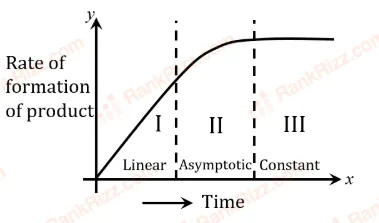
For certain chemical reaction X Y, the rate of formation of product is plotted against the time as shown in the figure. The number of Correct statement/s from the following is ______

image

(A) Over all order of this reaction is one
(B) Order of this reaction can't be determined
(C) In region-I and III, the reaction is of first and zero order respectively
(D) In region-II, the reaction is of first order
(E) In region-II, the order of reaction is in the range of 0.1 to 0.9.

JEE MAIN 2023 · 13 APR S1Integrated rate laws and half-life (zero and first order)TRANSCRIBED

t is the time required for the reaction to undergo completion and t is the time required for the reaction to undergo completion. The relation between t and t for a first order reaction is
t = x t
The value of x is _____. (Nearest integer)

JEE MAIN 2023 · 10 APR S1Integrated rate laws and half-life (zero and first order)TRANSCRIBED

A molecule undergoes two independent first order reactions whose respective half lives are 12 min and 3 min. If both the reactions are occurring then the time taken for the 50% consumption of the reactant is _______ min. (Nearest integer)

JEE MAIN 2023 · 08 APR S1Arrhenius equation and activation energyTRANSCRIBED

The number of given statement/s which is/are correct is______
(A) The stronger the temperature dependence of the rate constant, the higher is the activation energy.
(B) If a reaction has zero activation energy, its rate is independent of temperature.
(C) The stronger the temperature dependence of the rate constant, the smaller is the activation energy.
(D) If there is no correlation between the temperature and the rate constant then it means that the reaction has negative activation energy.

JEE MAIN 2023 · 10 APR S2Integrated rate laws and half-life (zero and first order)TRANSCRIBED

The number of incorrect statement/s from the following is _______
A. The successive half lives of zero order reactions decreases with time.
B. A substance appearing as reactant in the chemical equation may not affect the rate of reaction
C. Order and molecularity of a chemical reaction can be a fractional number
D. The rate constant units of zero and second order reaction are mol L s and mol L s respectively

JEE MAIN 2023 · 13 APR S2Integrated rate laws and half-life (zero and first order)TRANSCRIBED

A(g) 2B(g) + C(g) is a first order reaction. The initial pressure of the system was found to be mm Hg which increased to mm Hg after min. The total pressure of the system after min will be _____ mm Hg. (Nearest integer)