RankRizzStart free

Chemical Kinetics — JEE Main Previous Year Questions

Every Chemical Kinetics question JEE Main has set, grouped by the idea it tests rather than the order of the syllabus. 231 questions across 8 distinct ideas. Free to read, answer key on every one.

Questions

231

Distinct ideas

8

Share of marks

5.5%

Difficulty

MEDIUM

The ideas inside Chemical Kinetics

A chapter is not one subject — it is a handful of procedures the examiner reuses. These are the ones Chemical Kinetics questions actually test.

01Rate of reactionset 2×
02Rate law, order and molecularityset 40×
03Integrated rate laws and half-life (zero and first order)set 85×
04Methods to determine order of reactionset 24×
05Parallel, consecutive and reversible reactionsset 1×
06Arrhenius equation and activation energyset 62×
07Collision theory and effect of catalyst on rateset 1×
08Radioactivity and nuclear reactionsset 16×

Every Chemical Kinetics question

41–60 OF 231 · NEWEST FIRST

JEE MAIN 2025 · 28 JAN S1Methods to determine order of reactionTRANSCRIBED
page11_img1


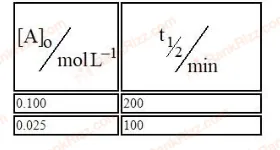
For a given reaction is related to as given in table. Given: Which of the following is true? A. The order of the reaction is 1/2.B.If is 1 M, then is C.The order of the reaction changes to 1 if the concentration of reactant changes from 0.100 M to 0.500 M . D. is 800 min for Choose the correct answer from the options given below: Options

  1. A

    A and C Only

  2. B

    A, B and D Only

  3. C

    C and D Only

  4. D

    A and B Only

JEE MAIN 2025 · 22 JAN S1Radioactivity and nuclear reactionsTRANSCRIBED

Which of the following statement is not true for radioactive decay?

  1. A

    Decay constant increases with increase in temperature.

  2. B

    Amount of radioactive substance remained after three half lives is of original amount.

  3. C

    Decay constant does not depend upon temperature.

  4. D

    Half life is times of

JEE MAIN 2025 · 28 JAN S2Rate law, order and molecularityTRANSCRIBED

Consider an elementary reaction If the volume of reaction mixture is suddenly reduced to of its initial volume, the reaction rate will become 'x' times of the original reaction rate. The value of x is :

  1. A

    3

  2. B

  3. C

    9

  4. D

JEE MAIN 2025 · 24 JAN S2Integrated rate laws and half-life (zero and first order)TRANSCRIBED
page12_img1

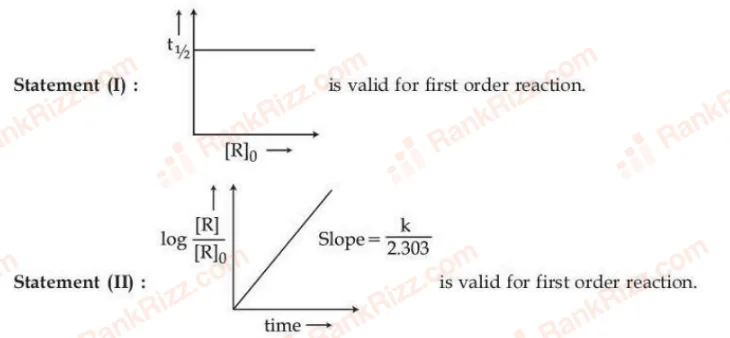
Given below are two statements :
In the light of the above statements, choose the correct answer from the options given below :

  1. A

    Both Statement I and Statement II are true

  2. B

    Statement I is false but Statement II is true

  3. C

    Statement I is true but Statement II is false

  4. D

    Both Statement I and Statement II are false

JEE MAIN 2025 · 29 JAN S1Rate law, order and molecularityTRANSCRIBED

The reaction follows the mechanism

The overall order of the reaction is :

  1. A

    2

  2. B

    2.5

  3. C

    3

  4. D

    1.5

JEE MAIN 2025 · 02 APR S2Rate law, order and molecularityTRANSCRIBED

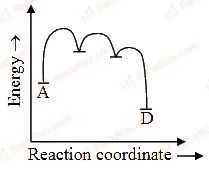
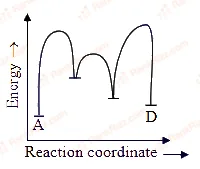
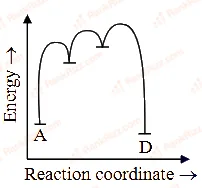
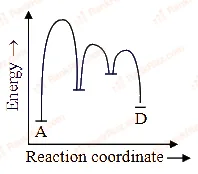
Reactant A converts to product D through the given mechanism (with the net evolution of heat) :
  slow ;
  fast ;
  fast ;

Which of the following represents the above reaction mechanism ?

  1. A
    image
  2. B
    image
  3. C
    image
  4. D
    image
JEE MAIN 2025 · 04 APR S2Arrhenius equation and activation energyTRANSCRIBED

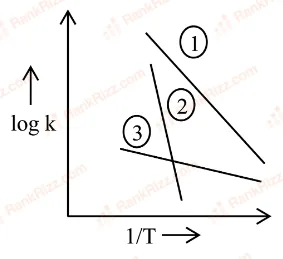
Consider the following plots of log of rate constant k (log k) vs for three different reactions. The correct order of activation energies of these reactions is :

image
  1. A

    Ea_2 > Ea_1 > Ea_3

  2. B

    Ea_1 > Ea_3 > Ea_2

  3. C

    Ea_1 > Ea_2 > Ea_3

  4. D

    Ea_3 > Ea_2 > Ea_1

JEE MAIN 2025 · 07 APR S1Integrated rate laws and half-life (zero and first order)TRANSCRIBED

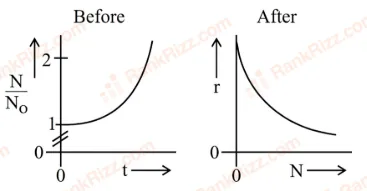
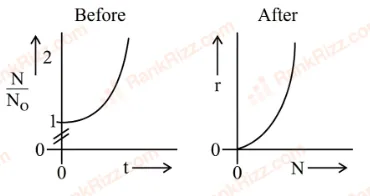
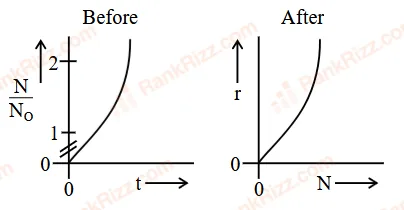
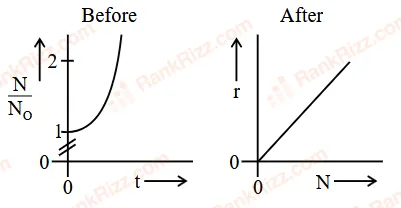
A person's wound was exposed to some bacteria and then bacteria growth started to happen at the same place. The wound was later treated with some antibacterial medicine and the rate of bacterial decay (r) was found to be proportional with the square of the existing number of bacteria at any instance. Which of the following set of graphs correctly represents the 'before' and 'after' situation of the application of the medicine?
[Given : N = No. of bacteria, t = time, bacteria growth follows order kinetics.]

  1. A
    image
  2. B
    image
  3. C
    image
  4. D
    image
JEE MAIN 2025 · 03 APR S2Arrhenius equation and activation energyTRANSCRIBED

Consider the following statements related to temperature dependence of rate constants. Identify the correct statements:
A. The Arrhenius equation holds true only for an elementary homogenous reaction.
B. The unit of A is same as that of k in Arrhenius equation.
C. At a given temperature, a low activation energy means a fast reaction.
D. A and Ea as used in Arrhenius equation depend on temperature.
E. When , A and become interdependent.
Choose the correct answer  from the options given below :

  1. A

    A, C and D Only

  2. B

    B, D and E Only

  3. C

    B and C Only

  4. D

    A and B Only

JEE MAIN 2025 · 04 APR S2Integrated rate laws and half-life (zero and first order)TRANSCRIBED

Half life of zero order reaction product is 1 hour, when initial concentration of reaction is 2.0 mol L. The time required to decrease concentration of A from 0.50 to 0.25 mol L is:

  1. A

    0.5 hour

  2. B

    4 hour

  3. C

    15 min

  4. D

    60 min

JEE MAIN 2025 · 02 APR S2Rate law, order and molecularityTRANSCRIBED

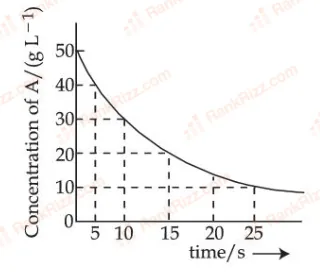
For the reaction the following graph was obtained. The time required (in seconds) for the concentration of A to reduce to 2.5 g L (if the initial concentration of A was 50 g L) is _________.
(Nearest integer)
Given :

image
JEE MAIN 2025 · 22 JAN S1Arrhenius equation and activation energyTRANSCRIBED

The molecule A changes into its isomeric form B by following a first order kinetics at a temperature
of 1000 K . If the energy barrier with respect to reactant energy for such isomeric transformation is and the frequency factor is the time required for 50% molecules of A to become B is
_________ picoseconds (nearest integer).

JEE MAIN 2025 · 23 JAN S1Integrated rate laws and half-life (zero and first order)TRANSCRIBED

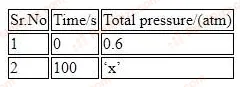
For the thermal decomposition of at constant volume, the following table can be formed, for the reaction mentioned below.
atm [nearest integer] Given : Rate constant for the reaction is

page12_img2
JEE MAIN 2025 · 24 JAN S2Arrhenius equation and activation energyTRANSCRIBED

Consider a complex reaction taking place in three steps with rate constants respectively. The overall rate constant  is given by . If the activation energies of the three steps are   and   respectively, then the overall energy of activation in  is  (Nearest integer)

JEE MAIN 2025 · 02 APR S1Integrated rate laws and half-life (zero and first order)TRANSCRIBED

For the reaction products.

image

The concentration of A at 10 minutes is _______ mol L. (nearest integer).

The reaction was started with 2.5 mol L of A.

JEE MAIN 2024 · 08 APR S2Rate law, order and molecularityTRANSCRIBED

For a reaction . If the rate of formation of is set to be zero then the concentration of is given by :

  1. A

  2. B

  3. C

  4. D

JEE MAIN 2024 · 31 JAN S1Integrated rate laws and half-life (zero and first order)TRANSCRIBED

Integrated rate law equation for a first order gas phase reaction is given by (where is initial pressure and is total pressure at time )

  1. A

  2. B

  3. C

  4. D

JEE MAIN 2024 · 06 APR S2Integrated rate laws and half-life (zero and first order)TRANSCRIBED

Consider the two different first order reactions given below (Reaction 1) (Reaction 2). The ratio of the half life of Reaction 1 : Reaction 2 is . If and represent the time taken to complete and of Reaction 1 and Reaction 2, respectively, then the value of the ratio is ___________ (nearest integer). [Given : and ]

JEE MAIN 2024 · 30 JAN S2Rate law, order and molecularityTRANSCRIBED

required for a reaction is produced by decomposition of in as by equation:

The initial concentration of is 3 mol L and it is 2.75 mol L after 30 minutes. The rate of formation of is mol L min, value of is ________.

JEE MAIN 2024 · 31 JAN S2Integrated rate laws and half-life (zero and first order)TRANSCRIBED

for a reaction, 50% of A is decomposed in 120 minutes. The time taken for 90% decomposition of A is ______ minutes.