RankRizzStart free

Chemical Kinetics — JEE Main Previous Year Questions

Every Chemical Kinetics question JEE Main has set, grouped by the idea it tests rather than the order of the syllabus. 231 questions across 8 distinct ideas. Free to read, answer key on every one.

Questions

231

Distinct ideas

8

Share of marks

5.5%

Difficulty

MEDIUM

The ideas inside Chemical Kinetics

A chapter is not one subject — it is a handful of procedures the examiner reuses. These are the ones Chemical Kinetics questions actually test.

01Rate of reactionset 2×
02Rate law, order and molecularityset 40×
03Integrated rate laws and half-life (zero and first order)set 85×
04Methods to determine order of reactionset 24×
05Parallel, consecutive and reversible reactionsset 1×
06Arrhenius equation and activation energyset 62×
07Collision theory and effect of catalyst on rateset 1×
08Radioactivity and nuclear reactionsset 16×

Every Chemical Kinetics question

201–220 OF 231 · NEWEST FIRST

JEE MAIN 2013 · 23 APR ONLINEIntegrated rate laws and half-life (zero and first order)TRANSCRIBED

The rate constant of a zero order reaction is mol L s. If the concentration of the reactant after 25 seconds is 0.5M. What is the initial concentration?

  1. A

    0.5M

  2. B

    1.25M

  3. C

    12.5M

  4. D

    1.0M

JEE MAIN 2013 · 09 APR ONLINERate law, order and molecularityTRANSCRIBED

The instantaneous rate of disappearance of ion in the following reaction is Ms

The rate of appearance of is :

  1. A

    Ms

  2. B

    Ms

  3. C

    Ms

  4. D

    Ms

JEE MAIN 2013 · 07 APR ONLINEArrhenius equation and activation energyTRANSCRIBED

The rate of a reaction doubles when its temperature changes from 300K to 310K. Activation energy of such a reaction will be:
JK mol and log 2 = 0.301

  1. A

    58.5 kJ mol

  2. B

    60.5 kJ mol

  3. C

    53.6 kJ mol

  4. D

    48.6 kJ mol

JEE MAIN 2013 · 25 APR ONLINERadioactivity and nuclear reactionsTRANSCRIBED

A radioactive isotope having a half-life period of 3 days was received after 12 days. If 3 g of the isotope is left in the container, what would be the initial mass of the isotope?

  1. A

    12 g

  2. B

    36 g

  3. C

    48 g

  4. D

    24 g

JEE MAIN 2012Integrated rate laws and half-life (zero and first order)TRANSCRIBED

For a first order reaction, products, the concentration of changes from M to M in minutes. The rate of reaction when the concentration of is M is :

  1. A

    M/min

  2. B

    M/min

  3. C

    M/min

  4. D

    M/min

JEE MAIN 2012Rate law, order and molecularityTRANSCRIBED

Reaction rate between two substance and is expressed as following: . If the concentration of is doubled and concentration of is made half of initial concentration, the ratio of the new rate to the earlier rate will be:

  1. A

  2. B

  3. C

  4. D

JEE MAIN 2012Arrhenius equation and activation energyTRANSCRIBED

The activation energy for a reaction which doubles the rate when the temperature is raised from 298 K to 308 K is

  1. A

    59.2 kJ mol

  2. B

    39.2 kJ mol

  3. C

    52.9 kJ mol

  4. D

    29.5 kJ mol

JEE MAIN 2012Methods to determine order of reactionTRANSCRIBED

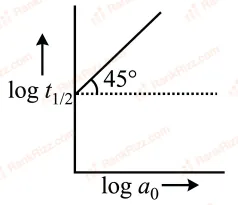
For a reaction Products, a plot of versus is shown in the figure. If the initial concentration of is represented by , the order of the reaction is

image
  1. A

    one

  2. B

    zero

  3. C

    two

  4. D

    three

JEE MAIN 2012Methods to determine order of reactionTRANSCRIBED

In a chemical reaction is converted into . The rates of reaction, starting with initial concentrations of as M and M, are equal to Ms and Ms respectively. The order of reaction with respect to reactant will be

  1. A

  2. B

  3. C

  4. D

JEE MAIN 2011Arrhenius equation and activation energyTRANSCRIBED

The rate of a chemical reaction doubles for every rise of temperature. If the temperature is raised by , the rate of the reaction increases by about:

  1. A

    times

  2. B

    times

  3. C

    times

  4. D

    times

JEE MAIN 2010Integrated rate laws and half-life (zero and first order)TRANSCRIBED

The time for half life period of a certain reaction products is hour. When the initial concentration of the reactant '' is mol L, how much time does it take for its concentration to come from to mol L if it is a zero order reaction?

  1. A

    h

  2. B

    h

  3. C

    h

  4. D

    h

JEE MAIN 2010Rate law, order and molecularityTRANSCRIBED

Consider the reaction: . The rate equation for this reaction is rate . Which of these mechanisms is/are consistent with this rate equation? (A) (slow); (fast). (B) (fast equilibrium); (slow).

  1. A

    B only

  2. B

    Both A and B

  3. C

    Neither A nor B

  4. D

    A only

JEE MAIN 2009Integrated rate laws and half-life (zero and first order)TRANSCRIBED

The half life period of a first order chemical reaction is minutes. The time required for the completion of of the chemical reaction will be () :

  1. A

    minutes

  2. B

    minutes

  3. C

    minutes

  4. D

    minutes

JEE MAIN 2008Rate of reactionTRANSCRIBED

For a reaction , rate of disappearance of '' is related to the rate of appearance of '' by the expression

  1. A

  2. B

  3. C

  4. D

JEE MAIN 2007Collision theory and effect of catalyst on rateTRANSCRIBED

The energies of activation for forward and reverse reactions for are 180 kJ and 200 kJ respectively. The presence of catalyst lowers the activation energy of both (forward and reverse) reactions by 100 kJ . The enthalpy change of the reaction in the presence of catalyst will be (in kJ )

  1. A

    300

  2. B

    120

  3. C

    280

  4. D

    20

JEE MAIN 2007Rate law, order and molecularityTRANSCRIBED

Consider the reaction, Products. When concentration of alone was doubled, the half-life did not change. When the concentration of alone was doubled, the rate increased by two times. The unit of rate constant for this reaction is

  1. A

    L

  2. B

    no unit

  3. C

    mol

  4. D

JEE MAIN 2007Radioactivity and nuclear reactionsTRANSCRIBED

A radioactive element gets spilled over the floor of a room. Its half-life period is 30 days. If the initial activity is ten times the permissible value, after how many days will it be safe to enter the room?

  1. A

    1000 days

  2. B

    300 days

  3. C

    10 days

  4. D

    100 days

JEE MAIN 2007Radioactivity and nuclear reactionsTRANSCRIBED

Which of the following nuclear reactions will generate an isotope?

  1. A

    neutron particle emission

  2. B

    positron emission

  3. C

    -particle emission

  4. D

    -particle emission

JEE MAIN 2006Radioactivity and nuclear reactionsTRANSCRIBED

In the transformation of to , if one emission is an -particle, what should be the other emission(s)?

  1. A

    Two

  2. B

    Two and one

  3. C

    One and one

  4. D

    One and one

JEE MAIN 2006Rate law, order and molecularityTRANSCRIBED

A reaction was found to be second order with respect to the concentration of carbon monoxide. If the concentration of carbon monoxide is doubled, with everything else kept the same, the rate of reaction will

  1. A

    remain unchanged

  2. B

    triple

  3. C

    increase by a factor of 4

  4. D

    double